

Bosses Trust Workers Less When They Use SI. In One Test, Trust Fell From 68% to 24%.
Six studies found supervisors doubted SI-using workers before they ever saw the work. A ban made it worse. A clear company green light nearly closed the gap.
Plenty of companies tell their workers to use SI tools to get more done. A new study suggests the boss may quietly hold it against them anyway.
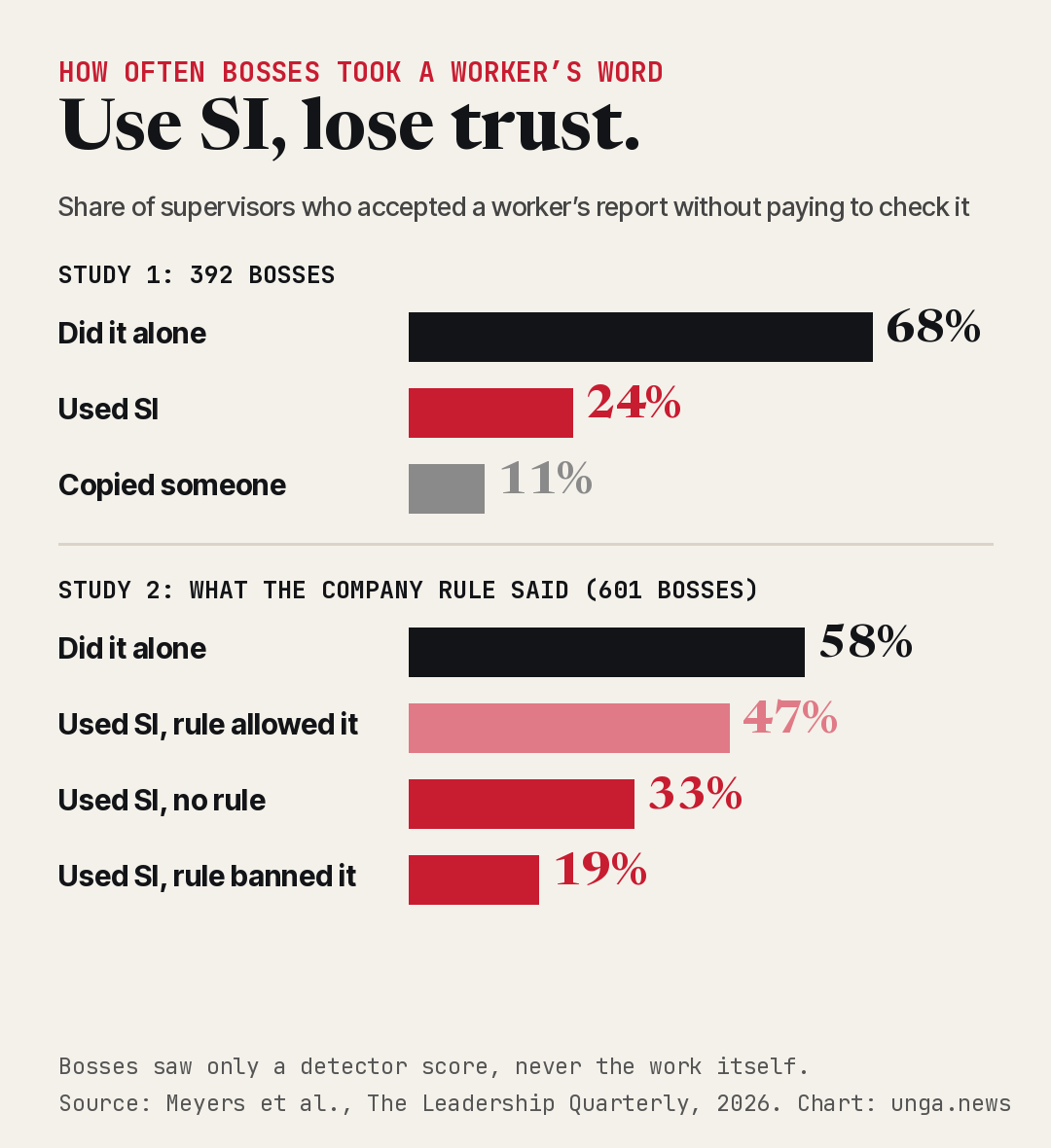
In a set of six studies published in The Leadership Quarterly, researchers at the Hebrew University of Jerusalem and WHU, a business school in Germany, tested how supervisors treat a worker once they learn SI helped with the job. The answer was blunt. When a worker did a task alone, supervisors took that worker’s word without checking 68% of the time. When SI was involved, that fell to 24%.
That is not a small dip. It is the difference between a boss who trusts you most of the time and a boss who trusts you about one time in four.
The test used real money
The researchers did not just ask people how they felt. In the first study, 392 adults who hold full-time leadership jobs in the U.S., Britain and Canada played the role of a temporary boss. They averaged about 43 years old and had roughly a decade of experience managing people, according to a StudyFinds summary of the paper.
Each one was paired with a real worker from an earlier round who had written a social media post, either alone, with SI, or by copying someone else. That worker also reported how long the job took, and the report could be honest or padded. The boss never saw the post or the time. All the boss learned was what a detection program said about whether SI wrote it.
Then came the choice. The boss could accept the worker’s time report or spend 75 cents from a shared bonus pot to check it. If a padded report slipped through, the boss lost bonus money. So skipping the check meant betting real money that the worker was honest.
Workers flagged for copying did worst, trusted just 11% of the time. Workers flagged for SI were not far ahead of them at 24%. Workers who did it alone were trusted 68% of the time.
Here is the part that should get every worker’s attention. The bosses never judged the quality of the work, because they never saw it. The penalty came from the label alone. It also held up after the researchers accounted for bosses rating SI users as less skilled and less professional, so it was not only about doubting the worker’s ability. It was about doubting the worker’s honesty.
It did not matter much whether the task was described as important or routine. It did not matter much whether the boss used SI themselves. Even bosses who had never used it, and who spent five minutes trying ChatGPT before the test, still trusted SI users less.
A clear company rule changed the math
The second study, with 601 supervisors, added one twist. Bosses were told the worker’s company had banned SI, encouraged it, or said nothing at all.
A ban did not help the worker. Trust in SI users sat at 19%. Silence was not much better at 33%. But when the company clearly encouraged SI, trust in those workers rose to 47%, close to the 58% for workers who did the job alone. The researchers said the gap in that case was small enough that it could be chance.
They did not test why. Their best guess, which they flagged as untested, is that a boss reads SI use as cutting corners unless the company has said out loud that using it is part of the job. Once leadership gives the green light, the worker is following the rules instead of dodging them.
That matters because most companies still have no real SI policy, the paper notes. A lot of workers are using these tools at places that have never said where they stand, which is exactly the setting where the study found bosses were most suspicious.
Trust follows you into your review
Lost trust does not stay in a lab game. In a separate study, 204 supervisors read a real note from an earlier boss who either trusted a worker or double-checked that worker’s claims. SI never came up. The workers who were trusted got higher ratings for job performance, for being good to have around the office, and for promotion potential. In the first study, lower trust explained part of why SI users were rated lower.
The researchers also checked real work. In the sixth study, 321 academic supervisors judged short introductions from real conference papers written by graduate students, each shown with a score from Turnitin, the plagiarism and SI detection program many schools use. The more of a paper the software flagged as machine-written, the less the supervisors trusted the student who wrote it.
Bosses are already pushing back
The study lands as a lot of managers say they are tired of what has been nicknamed “workslop,” the long, polished, empty memos and emails people churn out with chatbots. Business Insider reported last week that some companies have written new rules, and a few have fired people over it.
Michelle Volberg, who runs the tech recruiting firm Twill, told BI she sent her staff a simple request: “Please stop talking to me like a robot.” Her rule now is to use SI for brainstorming but to write internal messages in your own voice. “If you wouldn’t say it that way in person, email, or Slack — don’t send it,” she said. Eric Fischgrund, who runs FischTank PR, said he fired a worker who kept using SI where it was banned. “It’s obvious, it’s annoying,” he said.
The fine print
The study has real limits, and the authors list them. In most of the experiments, bosses saw a detector score of either zero or 100%, and real detectors make mistakes. The bosses were working with strangers recruited online, not people they had managed for years. Only marketing and academic tasks were tested. And no one tested what happens when a worker is upfront and tells the boss they used SI, which might soften the hit.
The authors also warn about a side effect. If workers expect to be doubted, many will keep using the tools and just stop mentioning it. The studies were registered before the data was collected, and the researchers posted their data and code for anyone to check.
For workers, the takeaway is simple. Know your company’s rule before you lean on SI, and stand behind every word you hand in. For bosses, the lesson may be even simpler. If you want your people using these tools, say so plainly, in writing. Silence, it turns out, costs everyone.
Sources
- The Leadership Quarterly — Psychological Reactions to Subordinates’ LLM Use at Work (Meyers, Bigman, Briker)
- StudyFinds — Bosses Trust Workers Less When They Use AI, Study Finds
- Business Insider — Bosses loved AI at work — until they drowned in slop
- OSF — Study materials, data and code