

Bought Software Online? Hackers May Have Your Card Number and the Code on the Back
A little-known company that runs checkout for big software brands says thieves copied card data it was holding. Some letters say the stolen details include the security code.
If you’ve ever bought a software license, an antivirus subscription or a photo-editing program online, there’s a decent chance the checkout page wasn’t really run by the company whose logo was on it. It was run by a middleman. One of the biggest of those middlemen now says hackers walked off with card data it was holding, and at least some of the letters going out to customers say the stolen details include the little security code on the back of the card.
The company is Cleverbridge, a German firm that handles payments, subscriptions and sales tax for software makers around the world. Most people have never heard of it. Plenty of people have paid it anyway, because when you buy from one of its clients, the charge often runs through Cleverbridge. Its own support site even has a page titled “What is this charge from Cleverbridge?”
A middleman holding the keys
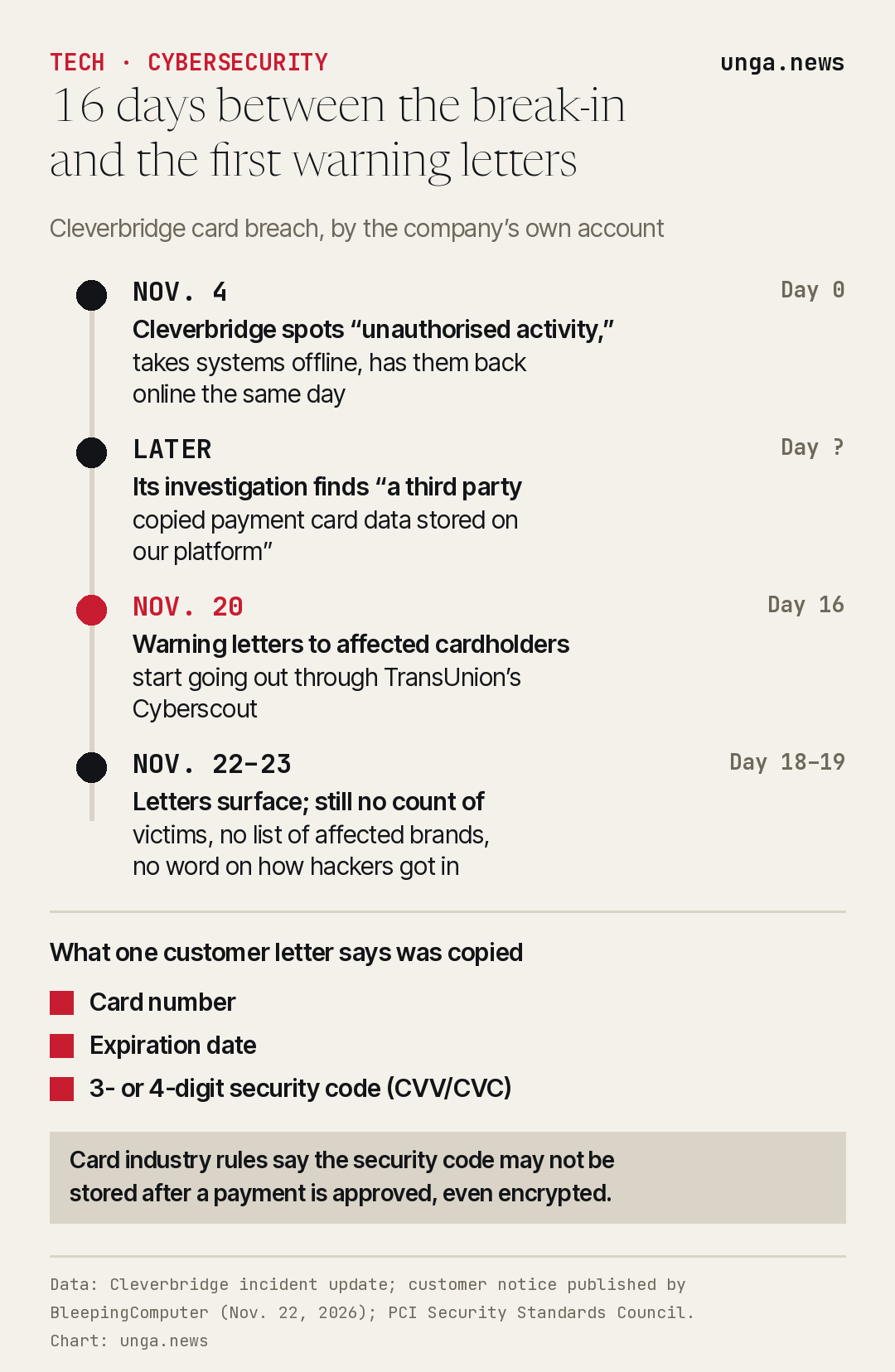
In a public incident notice, Cleverbridge says it “detected unauthorised activity in our platform” on Nov. 4, 2026. It took the affected systems offline and had them back up the same day. Then came the bad news: “our investigation subsequently determined that a third party copied payment card data stored on our platform.”
The company says the attack was not ransomware and that none of its systems were encrypted. That matters. Ransomware crews lock a company’s computers and demand payment to unlock them. This was quieter. Somebody got in, copied card data and left.
Cleverbridge started notifying affected people on Nov. 20, 16 days after it first spotted the intrusion. The letters are being sent by TransUnion’s Cyberscout, which the company hired to handle the notices, and Cleverbridge is telling recipients those letters are legitimate.
The code that wasn’t supposed to be there
The public notice is vague about what was taken. It says only that the data “may include payment card details used to make a purchase through Cleverbridge.” The letters are more specific. One notice obtained by BleepingComputer reads: “Based on our investigation to date, the information involved includes the payment card details you used to make a purchase through Cleverbridge, notably your card number, expiry date, card security code (CVV/CVC).”
That last item is the one that should make cardholders sit up. The three- or four-digit code exists for one reason: to prove the person typing in a card number online actually has the card. Card industry security rules, written by the big card networks, forbid businesses from keeping that code after a payment is approved, even in encrypted form. A thief with a card number and an expiration date has half a key. A thief with the code too has much more of one.
So how did hackers copy a code that is not supposed to be stored? Cleverbridge hasn’t said. The Register, which also saw a customer letter, noted the company has not explained whether the codes were kept after transactions or whether the attackers grabbed them while payments were being processed. Both possibilities are bad. One means data was sitting where it shouldn’t have been. The other means the crooks were inside the checkout itself, watching purchases go through.
The letters don’t all say the same thing, either. Cybersecurity site Cybersixt compared notices people posted online and found two versions. One lists the card number, expiration date and contact details like email, billing address and phone number, and says the security code “was not copied.” The other lists the card number, expiration date and security code, and says no name, contact or billing details were taken. Cleverbridge hasn’t said why the letters differ or whether different groups of customers lost different data.
Big software names, no list of victims
Cleverbridge’s client list includes some recognizable names in business software. Its website features Red Hat, SUSE, Parallels, Plesk, Ashampoo and Shure, and press reports have also named Tenable, Veeam, Jamf and Sony as clients. Being a client doesn’t mean a company’s customers were hit. Cleverbridge hasn’t named which brands’ shoppers are affected, how many cards were copied or how long the intruders were inside before Nov. 4.
That silence leaves a lot of people guessing. Somebody who renewed a backup program last spring has no easy way to know whether their card went through Cleverbridge, unless they dig through old statements or wait for a letter that might never come.
Cleverbridge says it has told data protection authorities, the card networks and its payment partners, and is working with a police cybercrime unit. According to The Register, affected customers are being offered 24 months of free credit monitoring and fraud help. Credit monitoring is fine for spotting someone opening new accounts in your name. It does nothing to stop a crook who already has your card number, expiration date and code from running up charges this week, right as holiday shopping kicks into gear.
What to do if you bought software online
Start with your card statements. Look for any charge labeled Cleverbridge, which usually means you bought something from one of its clients. If you find one, or if you got a letter, call your card issuer and ask for a new card. Cleverbridge’s own notice says the issuer “may decide to replace your card,” and there’s no reason to wait for them to decide. A new number makes the stolen one worthless.
Then watch for scams riding on the news. Crooks love a fresh breach because people expect to hear about it. Cleverbridge warns that it will never ask for card details, passwords or security codes by email, phone or text. Anyone who calls claiming to be from Cleverbridge or your bank and asks you to “confirm” your card number or the code on the back is a thief, not a helper.
This breach also shows how online shopping really works. A purchase that looks like it goes straight to one company can pass through layers of businesses most buyers never see, and each one is another place where card data can leak. The software makers picked Cleverbridge to make buying easy. Their customers are now finding out that the company in the middle had their cards, and what it kept is now in criminal hands.
Cleverbridge can start fixing that by answering the basic questions it has dodged for nearly three weeks: how many cards, which brands, and why the codes were there to steal at all.
Sources
- Cleverbridge — Incident Update & FAQs
- BleepingComputer — Cleverbridge warns hackers stole credit card numbers, CVVs in data breach (Nov. 22, 2026)
- The Register — Cleverbridge admits attackers stole customers’ credit card and CVV numbers (Nov. 23, 2026)
- Cybersixt — Cleverbridge data breach: stored payment card details copied
- Help Net Security — Cleverbridge alerts customers that hackers stole their credit card and CVV numbers (Nov. 23, 2026)
- PCI Security Standards Council — PCI Data Security Standard