

Britain Secretly Ordered Apple to Unlock Your iCloud. Now a Court Says It Can’t Hide It
Three British judges ruled the government must admit it served Apple a secret order tied to encrypted iCloud data, calling its national security excuse “fanciful.” The fight over whether the order is legal comes next year.
For almost two years, the British government has played a game everyone could see through. It sent Apple a secret order tied to the encrypted data people keep in iCloud, then refused to admit the order existed, even while officials leaked it to newspapers and Washington pushed back in public. On Thursday, a panel of three British judges ended the charade.
The Investigatory Powers Tribunal, the special court that hears complaints about Britain’s spy powers, ruled on Nov. 19 that the Home Office must stop hiding the fact that it served Apple with a “technical capability notice.” That is the legal tool, under a 2016 surveillance law, that lets the government require a tech company to keep the ability to hand over users’ data. The full judgment is public, and it does not mince words.
The secret everybody already knew
The Home Office argued that simply confirming the order would damage national security. Its officials leaned on a long-standing policy called “neither confirm nor deny,” the same stance spy agencies take on informants and operations. The judges weren’t buying it.
They pointed out that The Times had reported the order as “confirmed by Home Office sources.” The Financial Times later quoted senior British officials on the fight, including one who said, “The Home Office is basically going to have to back down.” Apple was even allowed to brief America’s Attorney General and Vice President about it, while being told to keep quiet with Congress. The tribunal found those confirmations to reporters and foreign officials were authorized, not stray leaks.
So when the government insisted that saying the obvious out loud would help terrorists, the panel answered that anyone curious could find the answer “with ease.” In a line that should embarrass every bureaucrat involved, the judges noted the answer pops up by “simply typing the question into Google’s chatbot.”
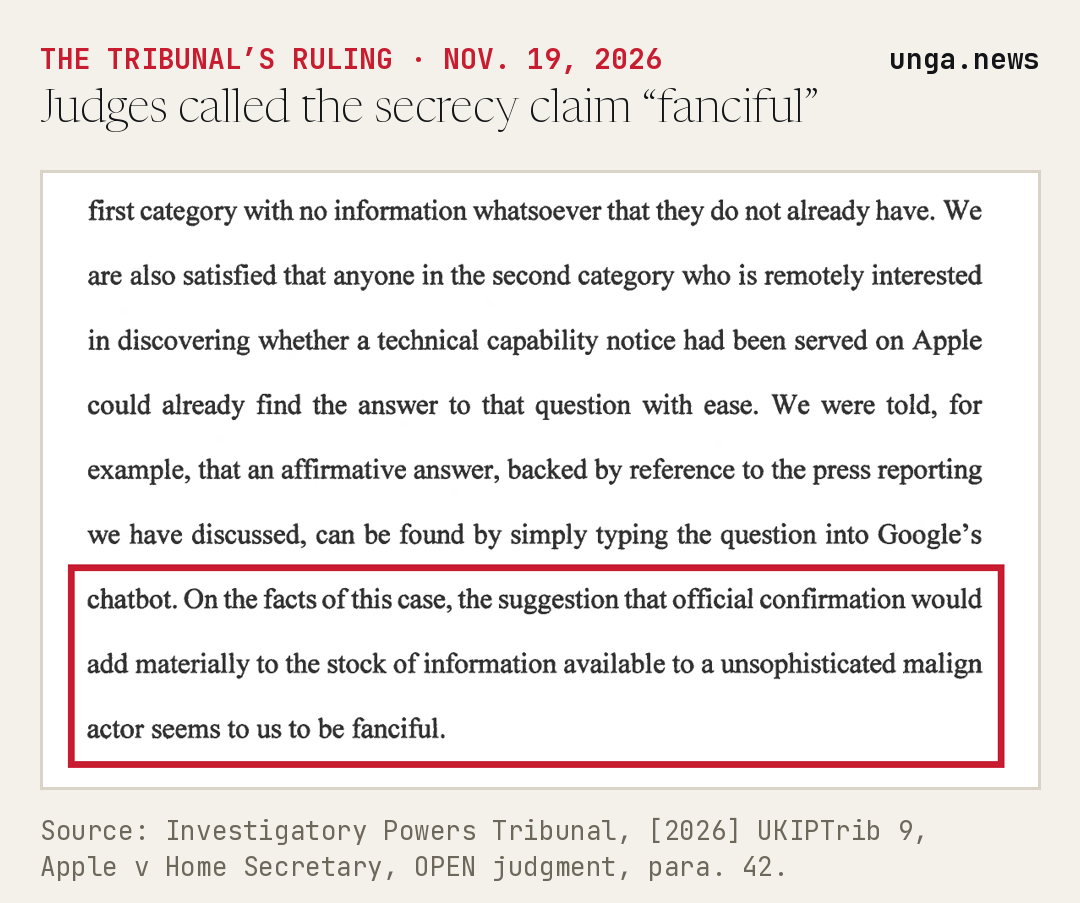
They also took apart the government’s leak investigations. A Home Office witness said a probe into The Times story identified “no Government source,” but gave no detail of who was questioned or what was checked. The panel found the government’s security assessment “flawed in the public law sense” because it ignored the fact that officials themselves had already broken the silence.
What British iPhone owners already gave up
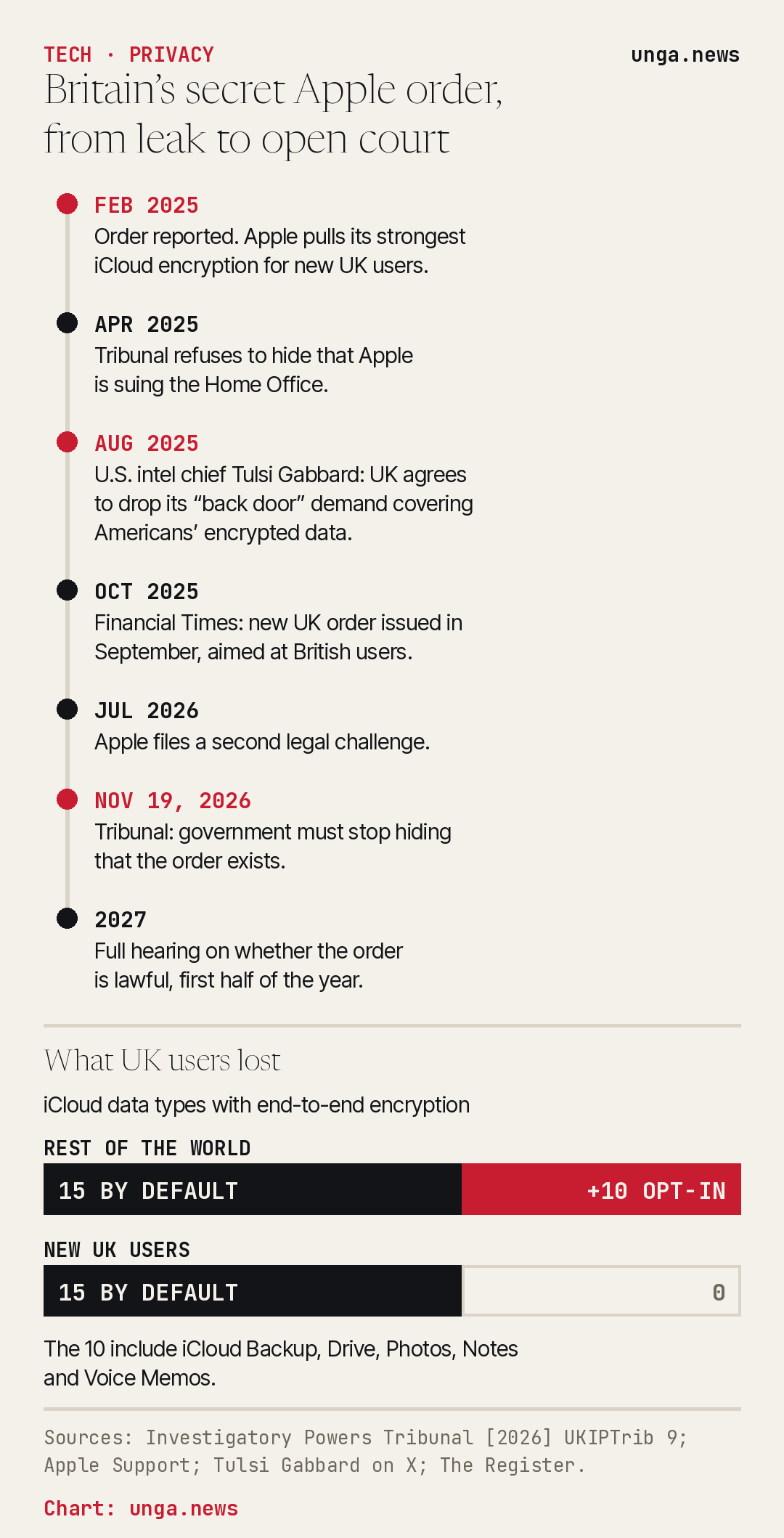
Regular people paid for this fight long before any judge weighed in. In February 2025, after the order was first reported, Apple stopped offering its strongest iCloud protection, Advanced Data Protection, to new users in the United Kingdom. Apple’s own support page spells out the cost: 10 kinds of iCloud data, including backups, iCloud Drive, photos, notes and voice memos, fall back to standard protection, where Apple holds the keys.
Apple put it bluntly: “We are deeply disappointed that our customers in the UK will no longer have the option to enable Advanced Data Protection.” It added the line the company has repeated for a decade: “we have never built a backdoor or master key to any of our products or services and we never will.”
Fifteen other categories, like passwords stored in iCloud Keychain and Health data, stay fully end-to-end encrypted by default, and iMessage and FaceTime remain locked down worldwide. But the photos and backups most families care about lost their strongest lock in Britain.
Washington stood up for Americans’ data
The order didn’t stay a British problem for long. Reporting at the time said it reached beyond the U.K., which meant Americans’ encrypted files could be in play. The Trump administration treated that as a red line.
On Aug. 19, 2025, Tulsi Gabbard, then President Trump’s Director of National Intelligence, posted the result on 𝕏, in words the tribunal quoted in full: “Over the past few months, I’ve been working closely with our partners in the UK, alongside @POTUS and @VP, to ensure Americans’ private data remains private and our Constitutional rights and civil liberties are protected. As a result, the UK has agreed to drop its mandate for Apple to provide a ‘back door’ that would have enabled access to the protected encrypted data of American citizens and encroached on our civil liberties.” Her post drew more than three million views.
That was a real win, and it held for Americans. Advanced Data Protection is still available in the United States. London didn’t give up, though. The Financial Times reported in October 2025 that a new order, issued in September, targeted British users instead, with two senior British government figures saying the U.S. was no longer leaning on London to rescind it.
Members of Congress kept up the pressure too. Sen. Ron Wyden and Rep. Warren Davidson wrote to the tribunal asking it to let the public see the case, a letter the judges cited in their ruling.
The real fight comes next year
Thursday’s ruling settles one question, not the whole case. The judges agreed that publishing every detail of the order would harm national security, and they left for later how much of its actual content can come out. Apple’s first challenge was dismissed after a “change of circumstances,” and the company filed a new one in July 2026. A separate challenge comes from Privacy International, Liberty and two individuals.
Apple is pressing five arguments, including whether Britain can use this power to reach communications outside the country and whether it can dictate the privacy features a tech company sells its customers. The tribunal said those first two questions can be decided entirely in public. The parties expect a full hearing in the first half of 2027.
The Home Office isn’t backing off. A government spokesperson told The Register that “Terrorists, child abusers and organized crime groups cannot be allowed to operate beyond the reach of the law,” and said the notice “simply requires” Apple to keep helping police as it has for years. That sentence is itself an admission of the very order the government swore it couldn’t discuss.
Nobody serious argues that police should never get evidence from a phone. The question is whether a government can quietly force a company to weaken the lock on everyone’s photos and backups, then hide behind “national security” to keep voters from even knowing it happened. On that, three judges just said no. When the real hearing starts next year, Americans will want to make sure the lock on their own data stays exactly where Gabbard and the President fought to keep it.
Sources
- Investigatory Powers Tribunal — Apple Inc. and Privacy International & Ors v Secretary of State for the Home Department, [2026] UKIPTrib 9, OPEN judgment (Nov. 19, 2026)
- Investigatory Powers Tribunal — Judgment page, IPT/26/191/CH and IPT/25/83-86/CH (Nov. 19, 2026)
- Apple Support — Apple can no longer offer Advanced Data Protection in the United Kingdom to new users
- The Register — Spy court blasts UK secrecy, forces government to admit Apple ‘backdoor’ demand (Nov. 20, 2026)