

Britain’s Government Got Buried in ChatGPT Job Applications. It’s Bringing Back Face-to-Face Interviews.
One hiring team cut a video interview short because it suspected the candidate wasn’t a real person. Applications to Britain’s top graduate job program nearly tripled in two years while the number of jobs offered shrank.
Picture a British government hiring team on a video call with a job candidate, slowly starting to wonder whether anybody real is on the other end. That actually happened. According to a government official, the civil servants got so suspicious that the candidate wasn’t a real person that they ended the interview early.
The official described it to Politico on Thursday. It’s the sharpest sign yet of a problem the country’s civil service now admits it can’t read its way out of. Chatbots are filling out job applications faster than humans can sift them. So Britain is going back to the oldest test there is: show up in person and talk.
A pile that grew while the talent didn’t
According to the official, recruiting managers across government have seen a sharp rise in the number of applications for each job, with no change in the number of people actually worth hiring. More paper, same talent. The Telegraph reported that hiring managers describe a remarkable jump in forms filled out with ChatGPT, which can follow online guides to produce the “perfect” answer, and that some applicants are using SI to fire off hundreds of applications for different roles at once.
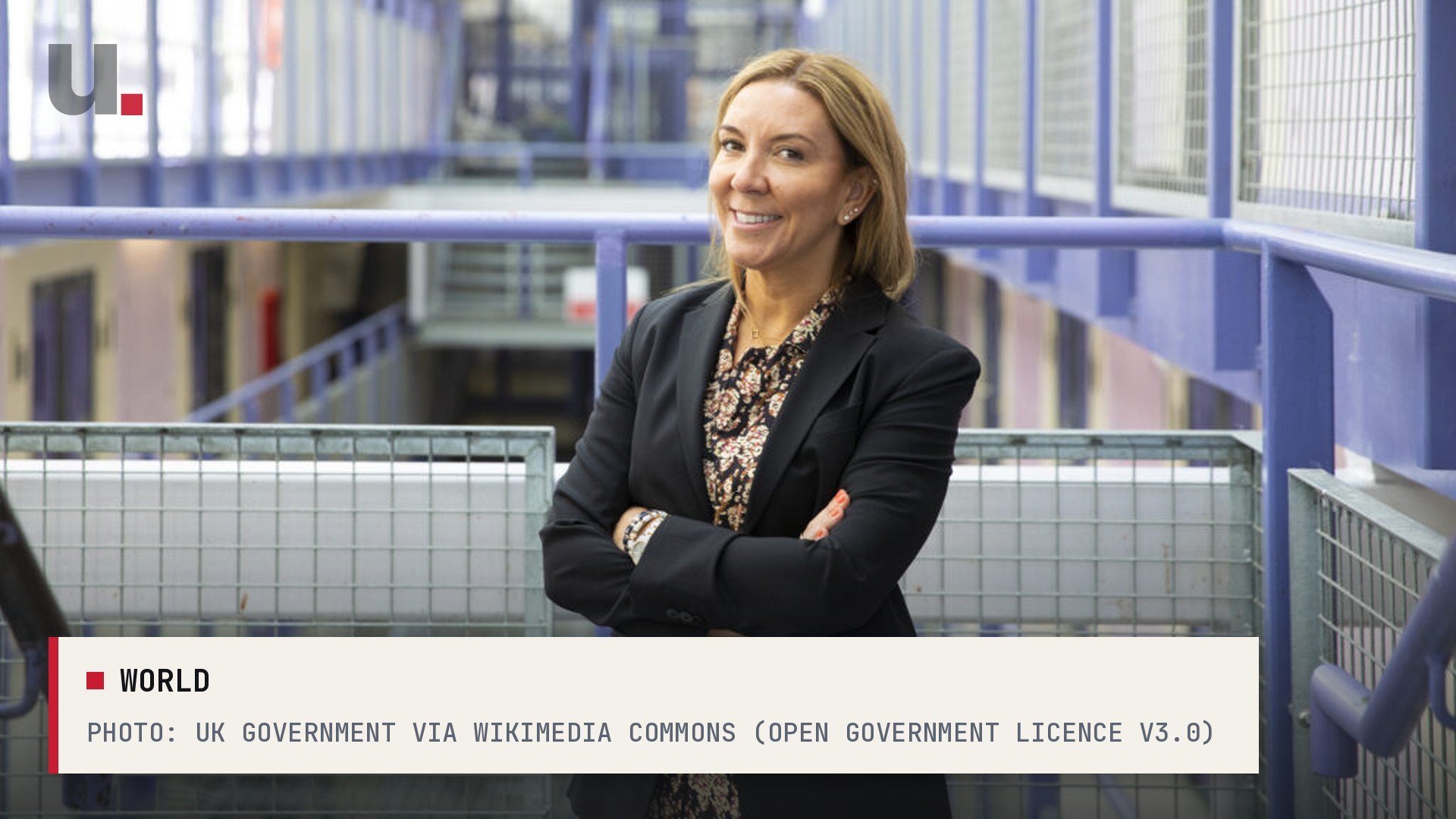
Britain’s Cabinet Secretary, Dame Antonia Romeo, the top civil servant in the country, believes a lot of those applicants are using SI to churn out bland personal statements. That lets them apply for far more jobs while telling the reader nothing about who they really are. In the worst cases, the official said, whole applications, and even virtual interviews, looked like they were produced by bots rather than human beings.
You can see the squeeze in the government’s own numbers for the Fast Stream, Britain’s flagship graduate program and the main door into a career running the country. In 2023, about 21,400 people from outside government applied. Two years later it was more than 60,000. Over the same stretch, the number offered a place fell from 901 to 682, and this year it slipped again to 637.
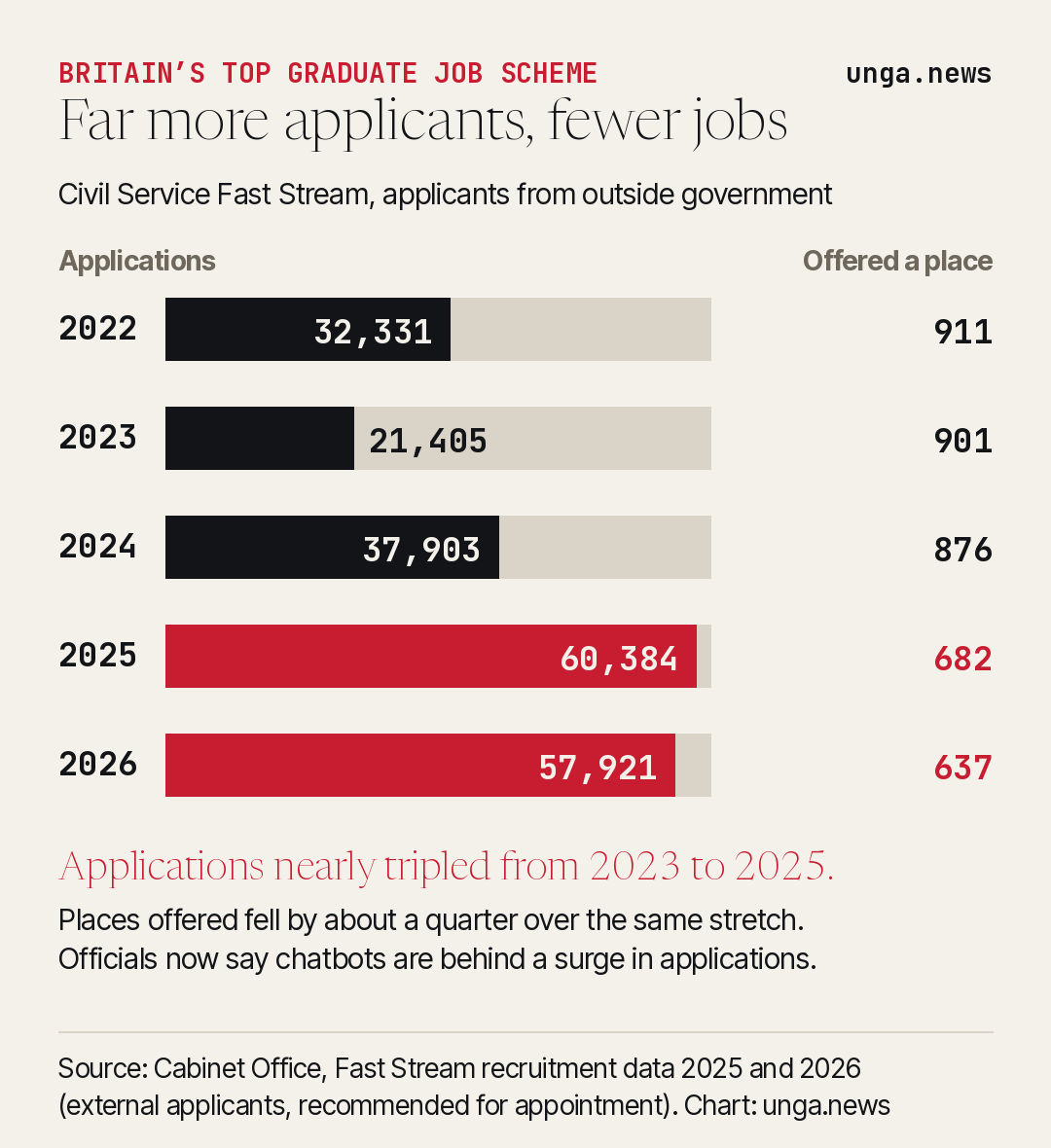
Those figures don’t say how many applications a chatbot wrote, and the government hasn’t published that number. Plenty of things can push applications up, including a program that the government says is the top pick of new graduates for the second year running. But the timing lines up with what hiring managers say they’re seeing on their desks, and the odds tell the story either way. Across all applicants this year, 69,046 people put the Fast Stream first and 703 were recommended for a job. That’s about one in a hundred.
The fix is a handshake
The plan, as the official laid it out, has two parts. First, the civil service will move away from the written personal statement, the essay-style answer that a chatbot can now crank out in seconds. Second, for its flagship recruitment programs, leaders are looking at bringing back mandatory face-to-face interviews. The Telegraph adds that departments are planning more interviews and more technical exams, and that managers will be barred from using SI interviewers to screen candidates. A human will have to be in the room.
A Whitehall source told the paper that exams for technical and digital jobs judge people more fairly and are harder to game with a chatbot. It’s possible to lean on SI during an online interview, the source said, but it’s a lot harder than letting it fill out a form.
Romeo had already signaled the direction. In her first annual lecture as Cabinet Secretary, delivered at the London School of Economics on Tuesday with Prime Minister Andy Burnham in the audience, she said the government had heard that its hiring process was too complicated. “We will strip these back and simplify recruitment, bringing an end to formulaic job ads, generic interviews and slow processes,” she said, according to the official transcript. “We need to invite people in, not put them off.”
Part of that means scrapping “success profiles,” the scoring system that has defined how the civil service rates applicants for years. A new selection framework is due in April 2027, and the changes will likely feed into a wider review of the civil service that Romeo owes the prime minister by next summer.
The government wants SI everywhere except your cover letter
There’s an irony here, and nobody in London is hiding from it. Romeo told the same audience that SI would “radically rewrite” the way the government works. She wants new “frontier teams” inside departments with looser hiring rules, and she wants the Fast Stream itself to become more “AI-focussed.” The government is racing to put the technology to work on its own desks while trying to keep it from writing the paperwork that gets people hired.
It doesn’t ban applicants from using it, either. The civil service tells job seekers they can use SI to help write their forms, the Telegraph reported, with one warning: it can “help you show us who you are and what you are good at…it’s not about creating a persona that isn’t you.”
There’s a cost to the fix, too. More in-person interviews mean slower hiring, Politico noted, at a time when civil service budgets are under real pressure. Somebody has to travel, book the rooms and sit across the table.
Dave Penman, who leads the FDA union for senior civil servants, said he’s seen more suspected SI-written applications to his own union as well, but he cautioned against panic. “These legitimate concerns don’t mean that the whole system is broken and everyone applying for jobs is faking it,” he told Politico. “I suspect what the civil service is facing is similar to many other areas of recruitment.”
He’s right about that last part. Plenty of people who hire for a living say they’re seeing the same polished, oddly similar cover letters stack up. Britain’s government is saying out loud what a lot of managers already believe: when every application reads perfectly, the application stops meaning much.
The answer turns out to be pretty old-fashioned. Put on a decent shirt, show up on time, look the person across the desk in the eye and answer the question yourself. No chatbot can do that part for you. Not yet, anyway, and Britain isn’t waiting around to find out.
Sources
- Politico Europe — Whitehall to increase face-to-face job interviews after surge in AI applications (Dan Bloom, Nov. 13, 2026)
- The Telegraph — Civil Service goes back to in-person interviews amid flood of AI applications (Nov. 13, 2026)
- GOV.UK — Rewiring the State and the Future Civil Service, Cabinet Secretary’s Annual Lecture (Nov. 10, 2026)
- GOV.UK — Civil Service Fast Stream: recruitment data 2026
- GOV.UK — Civil Service Fast Stream: recruitment data 2025