

British Actors May Soon Have to Be Asked, and Paid, Before Studios Use Their SI Doubles
A new deal between the UK actors’ union and film and TV producers would require consent and pay for every digital replica. About 8,000 members are voting now.

Picture this: you’re an actor, you finish a day on set, and someone asks you to step into a ring of cameras so the production can make a perfect digital copy of your body. Nobody tells you exactly what it will be used for. Saying no might cost you the job.
For British film and TV performers, that has been a real worry. Now their union says it has a deal that puts them back in charge of their own faces.
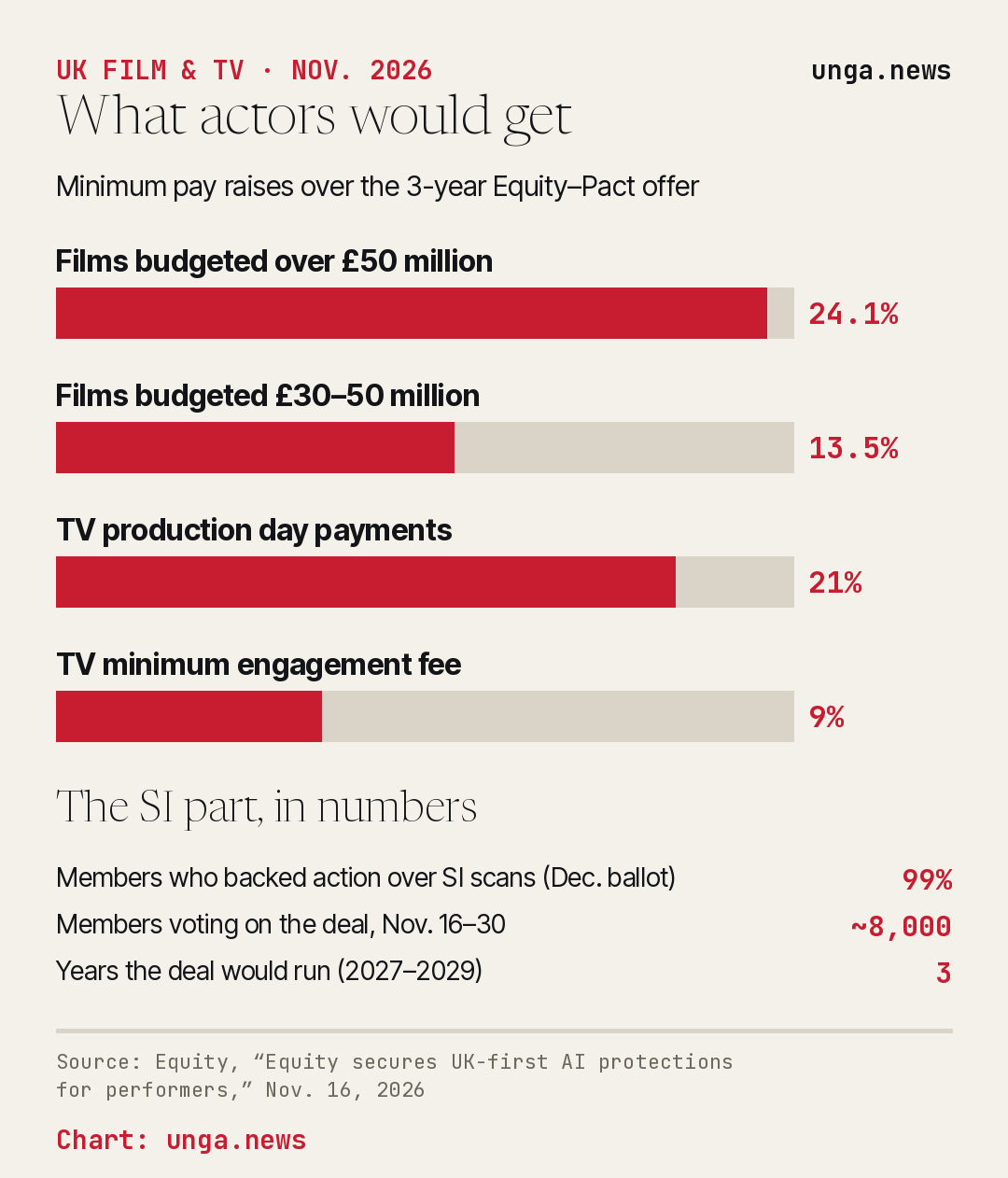
Equity, the UK performers’ union, has reached a three-year agreement with Pact, the trade group for British film and TV producers. The union calls it the first-ever collective SI protections for performers in UK film and television. Equity’s announcement says almost 8,000 members will vote on the offer online from Nov. 16 until noon on Nov. 30. Union leaders are telling members to vote yes.
Your face, your call
The heart of the deal is consent and money. Under the offer, performers get the right to be paid when their digital replica is used. They also get the right to say yes or no to its use, and to be told about the specific use before they agree.
Producers can’t get “blanket consent” anymore. Permission covers one specific project, not every future show a studio might dream up, Deadline reported.
There’s also a line for the most sensitive scenes. If a digital double or digital alteration makes “substantive changes” to a scene covered by a nudity rider, the actor has to approve it.
And a studio can’t lean on digital copies to keep working during a walkout. The Guardian reported that producers may not use a digital replica during a strike “in any circumstance where consent is required for such use.”
Producers also have to limit access to digital replicas to people with a real business need, and use “commercially reasonable efforts” to keep them from being stolen or copied.
How actors got here
This didn’t come easy. Talks dragged on for nearly three years, according to Deadline, and SI was the issue that held things up again and again.
The turning point came last December. In an early ballot, Equity members voted 99% in favor of taking industrial action and refusing to be scanned on set unless they got better SI protections. After that, the union says, it got a “vastly improved offer” that meets the standard set by SAG-AFTRA, the big American actors’ union.
Actors have been loud about this. Olivia Williams, of “The Crown” and “Dune: Prophecy,” told The Guardian last year that performers were regularly pressed to have their bodies scanned by banks of cameras, with few guarantees about where the data would end up. Many fear those scans could train SI models that eventually take their work.
Equity general secretary Paul W. Fleming didn’t hold back. “We’ve achieved the best AI provisions in the business – protecting performers and ensuring that human performance is valued and prioritised across the industry,” he said.
A raise, too
The SI rules ride along with a pay deal. Minimum fees on films with budgets over £50 million would rise 24.1% over three years, with 17% in the first year. TV’s minimum engagement fee would rise 9%, and production day payments 21%. The deal would run from January 2027 through Dec. 31, 2029.
Streaming deals change as well. Use periods on TV would drop from 15 years to 10, which means repeat payments reach performers sooner when a show gets sold on or keeps getting watched.
There are smaller wins that matter to working actors, too. Casting directors would have to give at least 72 hours’ notice for self-taped auditions, with a six-page limit.
What the deal doesn’t do
The union is upfront about the gaps.
Equity said that despite its efforts, the deal doesn’t give actors explicit contract protection against their performances being used to train SI systems. It also didn’t win a rule forcing studios to delete digital replicas, and it doesn’t cover the kind of scanning that’s long been routine for special effects, according to To Their Credit.
The union also warned members that a digital replica can be built from the regular footage shot for a production, with no special scan needed. So stepping away from the camera ring isn’t a full shield.
Still, for a lot of actors, the basic rule is the one that counts: nobody gets to use a digital you without asking first and paying you for it. If the members vote yes by Nov. 30, that rule becomes part of the contract on most British shows and movies starting in January.
Sources
- Equity — Equity secures UK-first AI protections for performers
- The Guardian — Actors in UK to get more rights over their ‘digital replicas’ in deal on AI protections
- Deadline — Final Equity-Pact Deal Offer Includes AI Provisions, Streamer Residuals
- To Their Credit — Equity ballot puts UK film and TV AI consent rules to the test