

California Forces Doctors to Teach Its Lessons on Hidden Bias. Three Justices Wanted to Stop It.
The Supreme Court turned away an eye doctor’s free-speech case, one vote short. Justice Clarence Thomas warned that California has found a way to make private teachers recite the state’s script.
Dr. Azadeh Khatibi teaches other doctors how to take care of eyes. California says that if her classes are going to count toward a doctor’s license, she also has to teach the state’s view on “implicit bias,” the idea that doctors unconsciously treat patients worse because of race, sex or other traits. She went to court and said the government can’t put words in her mouth. On Monday the Supreme Court declined to take her case, but three justices said they would have heard it, and Justice Clarence Thomas wrote a blistering dissent explaining why California is wrong.
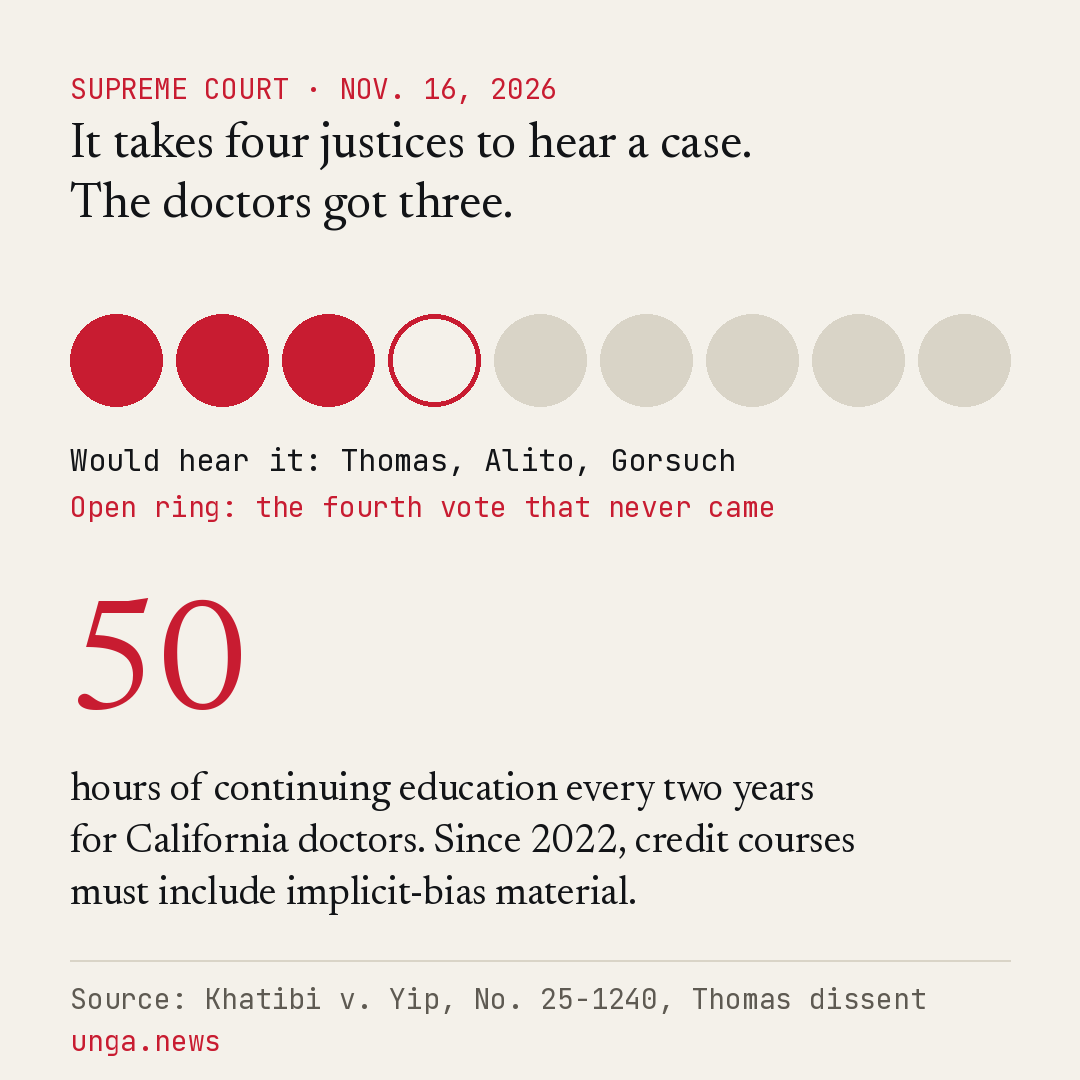
The court’s order was one line: the petition is denied. Under the court’s rules it takes four votes to hear a case. Justices Thomas and Samuel Alito dissented, and Justice Neil Gorsuch said he would have granted review. That left the doctors one vote short.
A rule hiding inside a license
California-licensed physicians must complete 50 hours of continuing medical education every two years. Most of those courses are run by private groups, accredited by private bodies and taught by private instructors. The state doesn’t preapprove what they teach, though it can audit courses after the fact.
In 2019 the Legislature changed that arrangement with AB 241. Starting Jan. 1, 2022, every credit-eligible course has to “contain curriculum that includes the understanding of implicit bias.” To check that box, instructors must offer “examples of how implicit bias affects perceptions and treatment decisions” of doctors, or “strategies to address” how bias may contribute to health care disparities. When lawmakers adopted the rule, they said unconscious prejudice drives unequal care based on a patient’s race, gender, age or disability, according to USA Today.
Khatibi, an ophthalmologist, disagrees that implicit bias is the main driver of health disparities and doesn’t want to spend her limited class time on it. She sued with the late anesthesiologist Dr. Marilyn Singleton and Do No Harm, a national medical group. One Do No Harm member who teaches these courses believes the trainings “have not been shown to successfully reduce barriers to healthcare, and instead risk infecting healthcare decisions with divisive and discriminatory ideas,” according to the complaint Thomas quoted.
Her first name means “freedom” in Farsi. Her family fled Tehran when she was six to escape repression, her lawyers said.
“For the government to tell doctors what they can and cannot teach to other doctors is really frightening to me,” Khatibi said in a statement from her lawyers at Pacific Legal Foundation. “The State should not be involved in what is taught and not taught in medicine.”
How a court turned her words into the state’s
A federal district court threw the case out, and the Ninth Circuit agreed. Its reasoning is what alarmed Thomas. The appeals court said that because California regulates medicine and continuing education so heavily, everything said in a credit-eligible course counts as “government speech.” And the First Amendment doesn’t limit what the government says for itself.
That logic runs backward, Thomas wrote. “First Amendment protections do not give way simply because a State heavily regulates speech,” he said. “It cannot be the case that compelled speech becomes government speech because the government has compelled the speech.”
He pointed out that the people doing the talking here are private instructors in privately run classes, and even the Ninth Circuit admitted Khatibi “plausibly alleged” that students see her as the one responsible for what she teaches. California, he added, hasn’t historically used these courses to push its own messages, and the appeals court couldn’t point to any other state law forcing instructors to express a particular viewpoint. Ninth Circuit Judge Lawrence VanDyke had made the same point when the full appeals court declined to rehear the case, calling the panel’s method a “single-factor analysis” that asked only whether the state heavily regulates the field.
Where this road leads
The strongest part of the dissent is a list of questions. If enough regulation turns a teacher’s words into the government’s, Thomas asked, could California make a medical instructor deliver the state’s preferred message on abortion? Could it require instructors to tell doctors that for some patients, gender-transition surgery is “ethically required”? Lawyers are licensed too. Could a state make the keynote speaker at a legal education conference argue a position on racial preferences in law firm hiring?
Under the Ninth Circuit’s rule, each of those messages would escape First Amendment review. “A State cannot regulate its way out of First Amendment scrutiny,” Thomas wrote. The government-speech doctrine, he warned, shouldn’t become “a cover for censorship” or “a cloak for compelled speech.”
He also went after the Supreme Court’s own 2022 ruling in Shurtleff v. Boston, the city flag case, which gave lower courts a three-part test for spotting government speech: history, public perception and government control. Thomas and Alito warned back then that the test would let courts treat heavy regulation as a reason to call private speech the government’s. “Those concerns were prescient,” Thomas wrote, and the court should rethink the test.
A loss on paper, a marker for later
For now the Ninth Circuit’s ruling stands in the nine Western states it covers, and California’s requirement stays on the books. Caleb Trotter, a senior attorney at Pacific Legal Foundation, said the training “tells doctors that their colleagues harbor hidden racial prejudices that no amount of training can fully cure, and it tells minority patients that a white physician is likely to damage their health.” He added: “That’s not medicine. It’s compelled speech.”
A denial isn’t a ruling on the merits, and it sets no national precedent. Three votes to hear a case is a signal that some justices are waiting for a cleaner vehicle, and the dissent reads like a road map for the next challenger. Doctors, lawyers, nurses and anyone else who needs a state license to work now have a detailed explanation, from two sitting justices, of why a license shouldn’t come with a script.
Sources
- Supreme Court of the United States — Khatibi v. Yip, No. 25-1240 (Thomas, J., dissenting from denial of certiorari), Nov. 16, 2026
- Pacific Legal Foundation — Justice Thomas dissents as SCOTUS declines doctors’ challenge to California’s compelled speech mandate
- USA Today — Supreme Court won’t weigh in on doctor bias training
- U.S. Court of Appeals for the Ninth Circuit — Khatibi v. Hawkins, No. 24-3108 (2025)