

California Lost 52,016 Film Jobs. Newsom's Answer Is $1 Billion a Year, Including Movie Stars' Pay
Two months before he leaves office, the governor wants Hollywood's tax credit raised to at least $1 billion a year through 2040, with actors' and directors' salaries counted for the first time. L.A. County's film jobs hit a record low in 2025.

California has lost 52,016 film and television jobs since 2022, and 99.6% of them were in Los Angeles County. Gov. Gavin Newsom's answer, with two months left in office, is more money: at least $1 billion a year in tax credits for Hollywood, and for the first time, credits on the paychecks of the stars.
Newsom announced the plan Monday, the day before Election Day. It would grow the state's Film and Television Tax Credit Program from $750 million a year to "at least $1 billion," stretch it through 2040, and make "above-the-line" pay a qualified expense. In Hollywood, above-the-line means the actors, directors, writers and producers whose names go on the poster.
"California created the modern entertainment industry; we're the capital of entertainment and we're going to keep it here," Newsom said. In the same statement he added that "states can't shoulder the cost alone" and called on Congress to pass a federal film credit by the end of the year.
What's in the plan
The governor's office lists five pieces. The yearly cap rises to more than $1 billion. Star and director pay becomes eligible, "subject to appropriate funding caps" that the release doesn't spell out. The program's sunset moves from five years to 10. Studios that commit to at least two California productions get a 5% bump in credits. And the set-aside for independent films rises to $100 million a year, up $26 million.
Right now, star pay doesn't count. Under the current program, the credit covers crew wages and in-state spending, not the salaries at the top of the call sheet. That line is exactly what the new plan would erase.
A program that keeps getting bigger
This credit started small. When California launched it in 2009, the cap was $100 million a year. Program 2.0, which began in 2015, raised it to $330 million. Last year Newsom and the Legislature pushed it to $750 million a year, a $3.75 billion commitment over five years through 2030. Now, barely a year into that expansion, the ask is $1 billion and a decade.
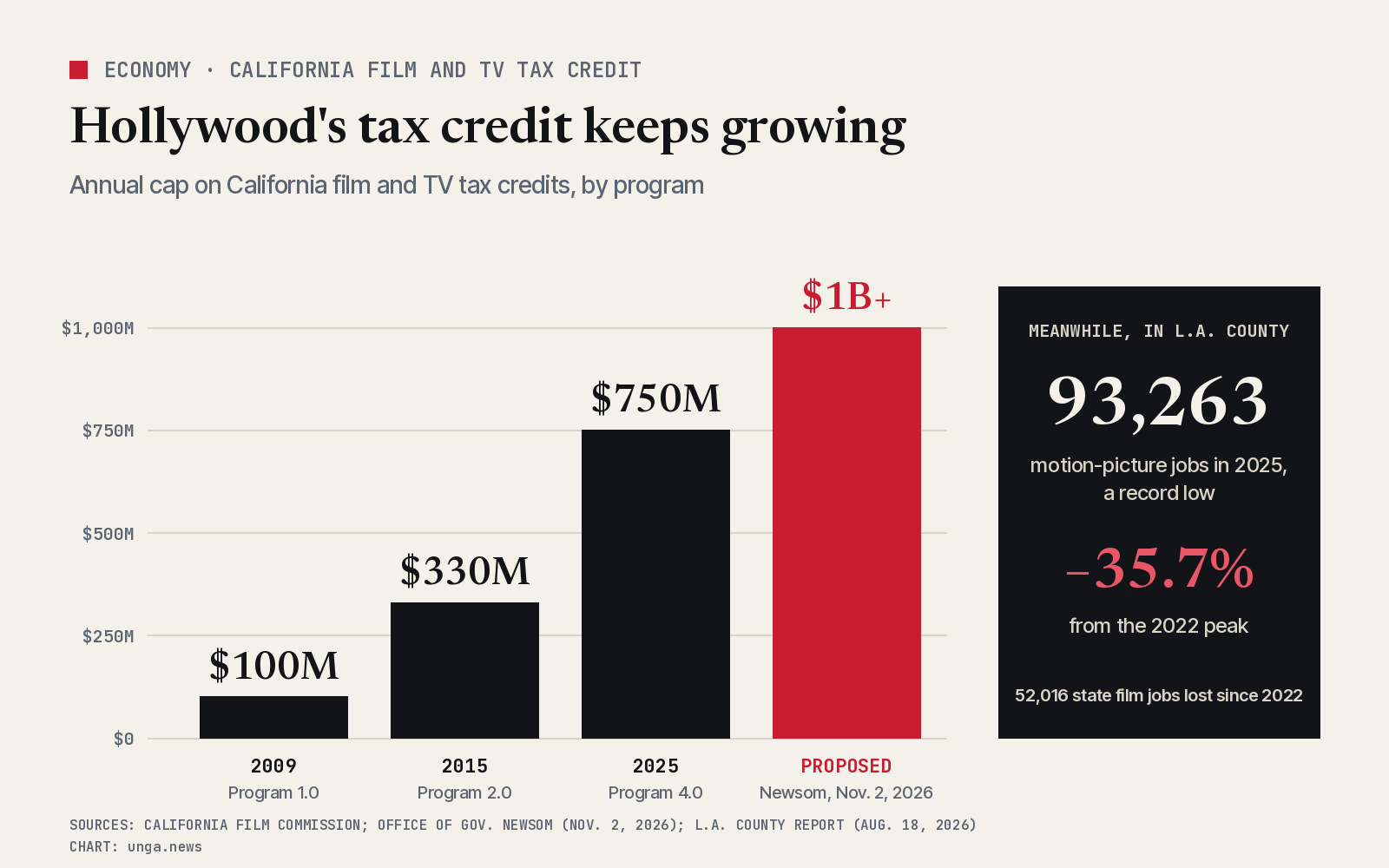
Think of it as a bidding war where California keeps raising its own bid. Rival states and countries often offer uncapped deals that already count star salaries, so the studios keep asking Sacramento to match.
The jobs numbers the press release skips
Newsom's office says the first year of the $750 million program reported "Over 43,000 cast and crew jobs created" on credit-backed projects, $8.25 billion in direct production spending, and an 82% jump in applications.
Los Angeles County's own economists tell a harder story. In an August report on the Paramount and Warner Bros. Discovery merger, the county found that motion-picture employment averaged 93,263 jobs in 2025, "the lowest level in the comparable" federal data series, down 35.7% from the 2022 peak. It fell another 10.4% in 2025 alone, the same year the bigger credit became law, and the county says "the 2023 strikes did not mark the bottom."
To be fair to the numbers, the county also found signs of a floor. Monthly employment reached 99,600 in June 2026, and six straight quarterly averages stayed between about 98,200 and 102,200 jobs. That's what the report calls "stabilization at this lower level rather than a meaningful recovery." Both things can be true: credit-backed shoots are coming back, and the industry is still far smaller than it was four years ago.
Who pays, and who finishes the job
The bill comes due long after Newsom leaves. His term ends Jan. 4, and Variety reports that Democratic nominee Xavier Becerra has promised to enhance the credit without saying how. A 2040 sunset means several governors after Newsom would inherit it.
A tax credit isn't a check from the state, but it's money the state doesn't collect, and every dollar of it has to be made up somewhere in the budget. Newsom's office counters that each $1 of credit has historically returned $24.40 in economic output. That's the governor's own math, and it's the number to test when lawmakers take up the bill.
President Trump took a different road on the same problem. In May 2025 he wrote that "the Movie Industry in America is DYING a very fast death," blamed other countries' incentives, and ordered work on a 100% tariff on movies "produced in Foreign Lands." His fix makes foreign studios pay. Newsom's makes California taxpayers pay, now including the stars.
What happens next
Monday's release is a proposal, not a law. The Legislature would have to pass it, and an Assembly committee heard testimony last week on lifting the cap, adding star pay and extending the sunset. Newsom is also pushing Congress to pass the federal Motion Picture, Television, and Entertainment Revitalization Act, which would add a 20% national credit that productions could stack on top of California's.
Sources
- Office of Gov. Gavin Newsom — Governor Newsom proposes historic $1 billion California film and television tax credit (Nov. 2, 2026)
- County of Los Angeles — Report back on potential economic and workforce impacts of the Paramount Skydance acquisition of Warner Bros. Discovery (Aug. 18, 2026)
- California Film Commission — Film & Television Tax Credit Program 4.0: The Basics
- California Film Commission — Progress report on the Film & Television Tax Credit Program, Sept. 2017 (Programs 1.0 and 2.0)
- President Trump on Truth Social — "The Movie Industry in America is DYING a very fast death" (May 4, 2025)
- Variety — Gavin Newsom proposes expanding California's movie and TV tax credit to at least $1 billion (Nov. 2, 2026)