

California Surrendered Its Fight to Unmask ICE Agents, and a Judge Made It Permanent
After losing in two courts, Newsom’s team signed on to an order that bars the state’s mask and badge laws from ever being used against federal officers.
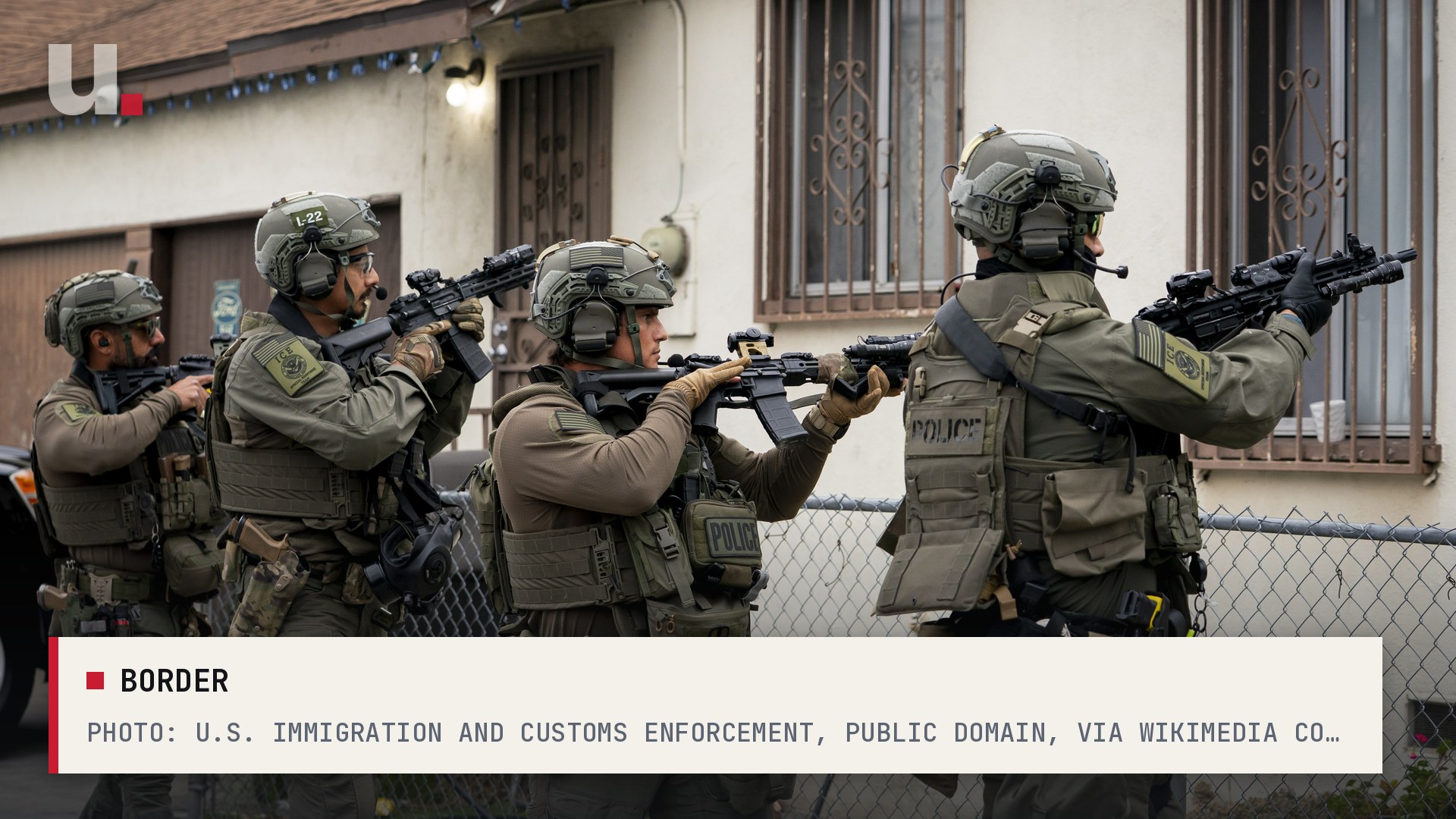
California spent a year telling federal immigration agents they had to show their faces and wear their names. This week the state quit. On Tuesday, U.S. District Judge Christina A. Snyder in Los Angeles signed a two-page order that permanently bars California, Gov. Gavin Newsom and Attorney General Rob Bonta from enforcing the state’s mask ban and its badge-display rule against federal officers. The kicker is how it happened. The order was entered on a joint stipulation, which means California’s own lawyers signed on to it.
The Justice Department announced the result Thursday. It came a year to the day after the department sued, on Nov. 17, 2025, arguing that Sacramento had no business telling federal officers how to dress or what to wear on their chests while they do a federal job.
Four laws, one signature
The order is short and it doesn’t waste words. Newsom, Bonta, “each of their successors,” and anyone working “in active concert or participation with them” are “enjoined from enforcing” four provisions “against the United States, federal law enforcement officers, and federal law enforcement agencies.” Those are Sections 7288 and 7289 of the California Government Code and Sections 185.5 and 13654 of the California Penal Code. That is the legal plumbing behind the two laws Newsom signed in September 2025, which supporters branded the No Secret Police Act and the No Vigilantes Act.
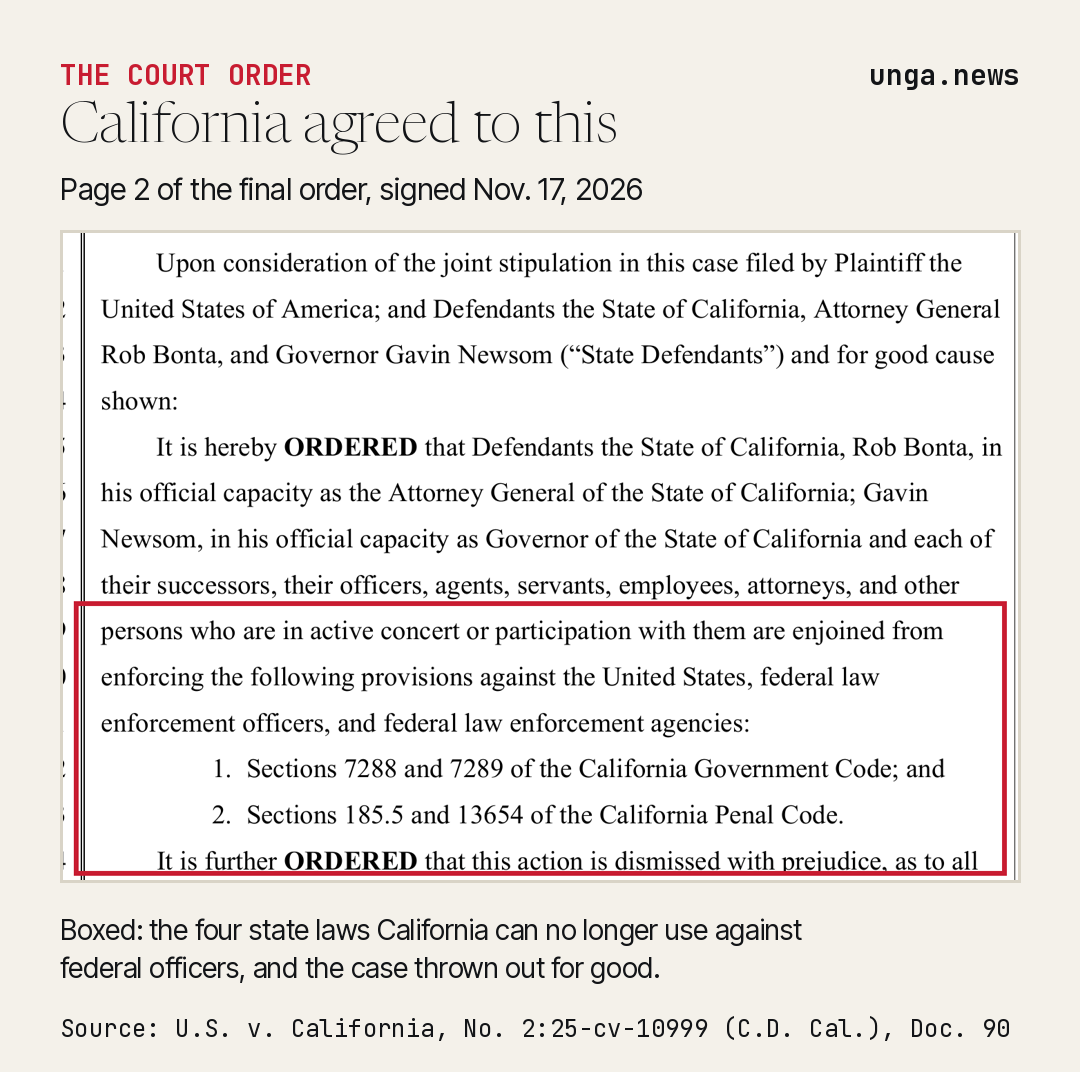
The case was then “dismissed with prejudice, as to all Defendants.” In plain English, it can’t be brought back. Snyder also canceled a scheduling deadline the court had set for Nov. 13 and kept the power to enforce the judgment if anyone tries to get cute. Because California agreed to the outcome, there is nothing left for the state to appeal.
Associate Attorney General Stanley E. Woodward Jr. put it simply in the Justice Department’s release: “states do not have the authority to regulate the Federal Government or dictate how federal law enforcement officers perform their official duties.” Jonathan D. Guynn, who runs the Civil Division as acting assistant attorney general, was blunter. “The Federal Government, not the states, gets to decide what equipment federal officers may use and what measures they may take to protect themselves while performing their official duties,” he said.
Why the state ran out of road
The laws came out of the summer of 2025, when immigration sweeps hit Los Angeles and other cities. Supporters said masked officers without badges were frightening people and dodging accountability. Federal lawyers later pointed to protesters harassing agents and posting their names and home addresses online. “It’s problematic when Californians can’t tell the difference between a law enforcement officer who is charged with protecting them and a criminal who is attempting to cause them harm,” Bonta said last year, as quoted by the Sacramento Bee.
The laws came out of the summer of 2025, when immigration sweeps hit Los Angeles and other cities and activists started filming, following and posting the names of agents. Supporters said masked officers without badges were frightening people and dodging accountability. “It’s problematic when Californians can’t tell the difference between a law enforcement officer who is charged with protecting them and a criminal who is attempting to cause them harm,” Bonta said last year, as quoted by the Sacramento Bee.
The Justice Department’s answer was officer safety. Its lawsuit argued the rules stopped federal agents from protecting their identities while they faced what the department called “an unprecedented wave of harassment, doxxing, and even violence,” and that the rules put their families at risk too.
The courts sided with the agents. In February, Snyder blocked the mask ban as applied to federal officers because the law carved out exceptions for some state officers, which treated federal agents worse than California’s own. She let the badge rule stand at first. The Ninth Circuit Court of Appeals didn’t. It blocked the badge rule in April, and on Oct. 14 a three-judge panel ruled that the rule directly regulated federal operations and broke the Supremacy Clause, the part of the Constitution that puts federal law on top. That ruling knocked out Snyder’s earlier decision on the badges and left California with almost nothing to argue.
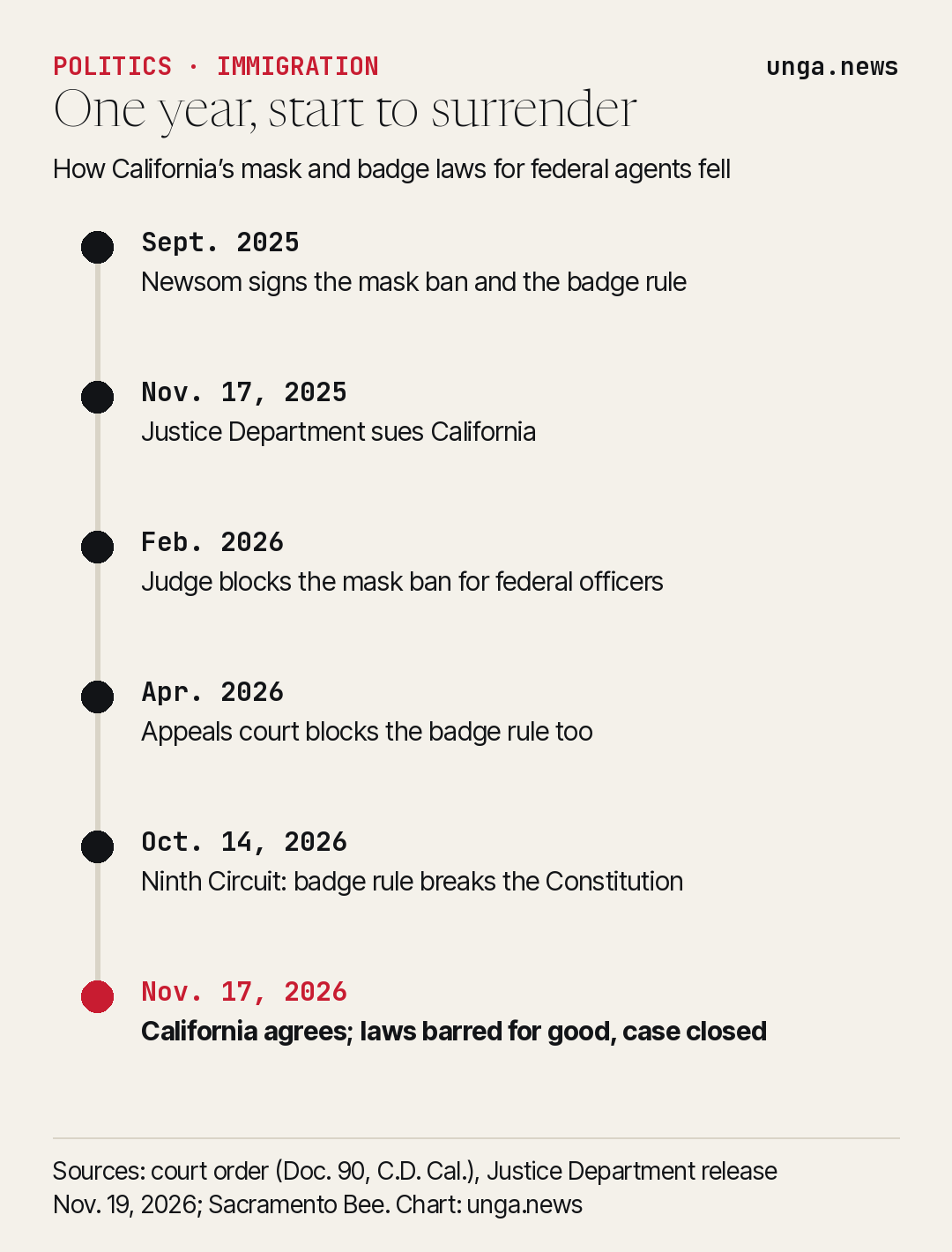
Even in surrender, the state kept up appearances. In a filing last week, California’s lawyers said officials “continue to dispute” the federal government’s claims that the laws were unconstitutional or endangered agents, according to the Sacramento Bee. Then they agreed to the permanent order anyway. That’s a lot like saying you still think you’re right while handing over the keys.
Wiener’s workaround has a problem
State Sen. Scott Wiener, the San Francisco Democrat who wrote the mask ban, saw the February ruling as a roadmap. He told KQED that the court had recognized California’s power to ban masks on federal agents and that “we simply have to add state police back into the law to make it enforceable.” This year’s version, SB 1004, does that by making state and local departments write and post mask policies of their own.
But the Ninth Circuit’s October reasoning didn’t turn only on unequal treatment. It said the badge rule failed because it regulated federal agents directly, even though it covered state police as well. Adding state cops to a mask ban may fix the fairness problem, but it does nothing about that one. The final order also bars enforcement of the underlying code sections without carving out the new wording, so the Sacramento Bee reported the new law’s fate wasn’t immediately clear.
What agents still have to do
None of this means federal officers in California answer to nobody. Federal rules already require it. Under the immigration enforcement regulation at 8 CFR 287.8, an officer making an arrest has to identify himself as an immigration officer, tell the person they’re under arrest and say why, as soon as it’s practical and safe to do so. That rule comes from Washington, where the Constitution says it should.
What changes is that a state legislature can’t layer its own dress code on top of it and threaten federal officers with state charges for covering their faces. For agents who have had their home addresses posted online, that is the whole ballgame.
California isn’t the only target. The department said Attorney General Todd Blanche has told the Civil Division to find state and local laws, policies and practices that get in the way of lawful federal operations, and it called this order “the latest success” in that push. Other blue states and cities with their own unmask-the-agents ideas now have a plain answer from the country’s biggest state. California fought it for a year, lost in two courts, and signed the paper.
Sources
- U.S. District Court, C.D. Cal. — Order Entering Permanent Injunction and Dismissing Action, United States v. State of California, No. 2:25-cv-10999 (Nov. 17, 2026)
- U.S. Department of Justice — Justice Department Secures Permanent Injunction Against California Laws Restricting Federal Law Enforcement Operations (Nov. 19, 2026)
- Sacramento Bee — California barred from enforcing mask ban, badge display for ICE agents (Nov. 19, 2026)
- eCFR — 8 CFR 287.8, Standards for enforcement activities