

California's Lawyer Tells Appeals Court He 'Honestly' Doesn't Know How the State Verifies Citizenship
At a rare Sunday Ninth Circuit hearing on DOJ's bid to set aside 20,000 suspected noncitizen ballots, Trump appointee Patrick Bumatay pressed the state, while two other judges questioned whether the court can act at all.
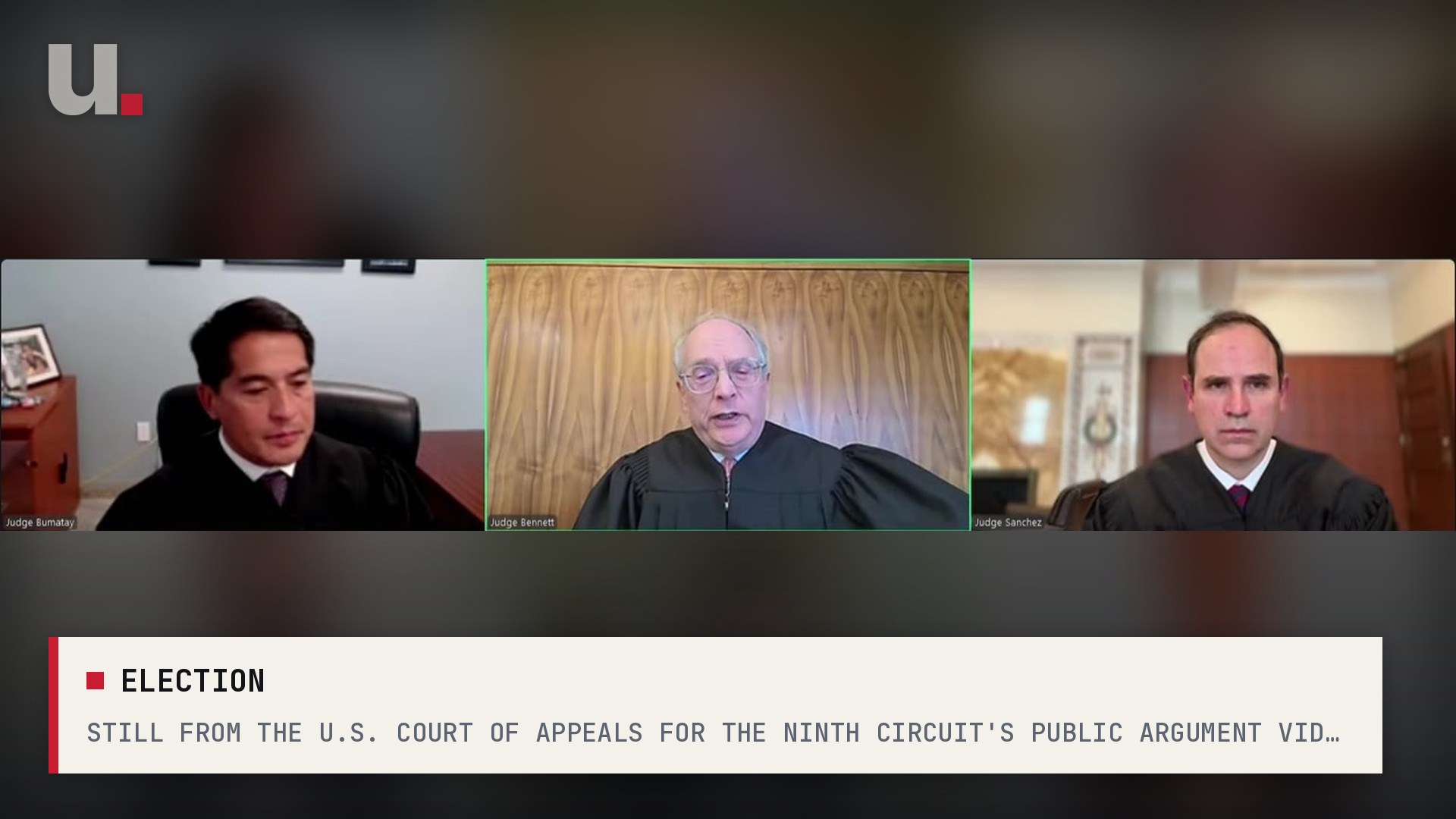
Nine days before the election, a federal appeals judge asked California the simplest question in this whole fight: when someone challenges a voter's citizenship, how does the state check it?
"Then what does California do to verify citizenship?" Judge Patrick Bumatay asked. Samuel Siegel, the lawyer arguing for the state, answered: "Your Honor, I honestly don't know the answer to that question." He added that the state's lawyers had "about 48 hours" to prepare.
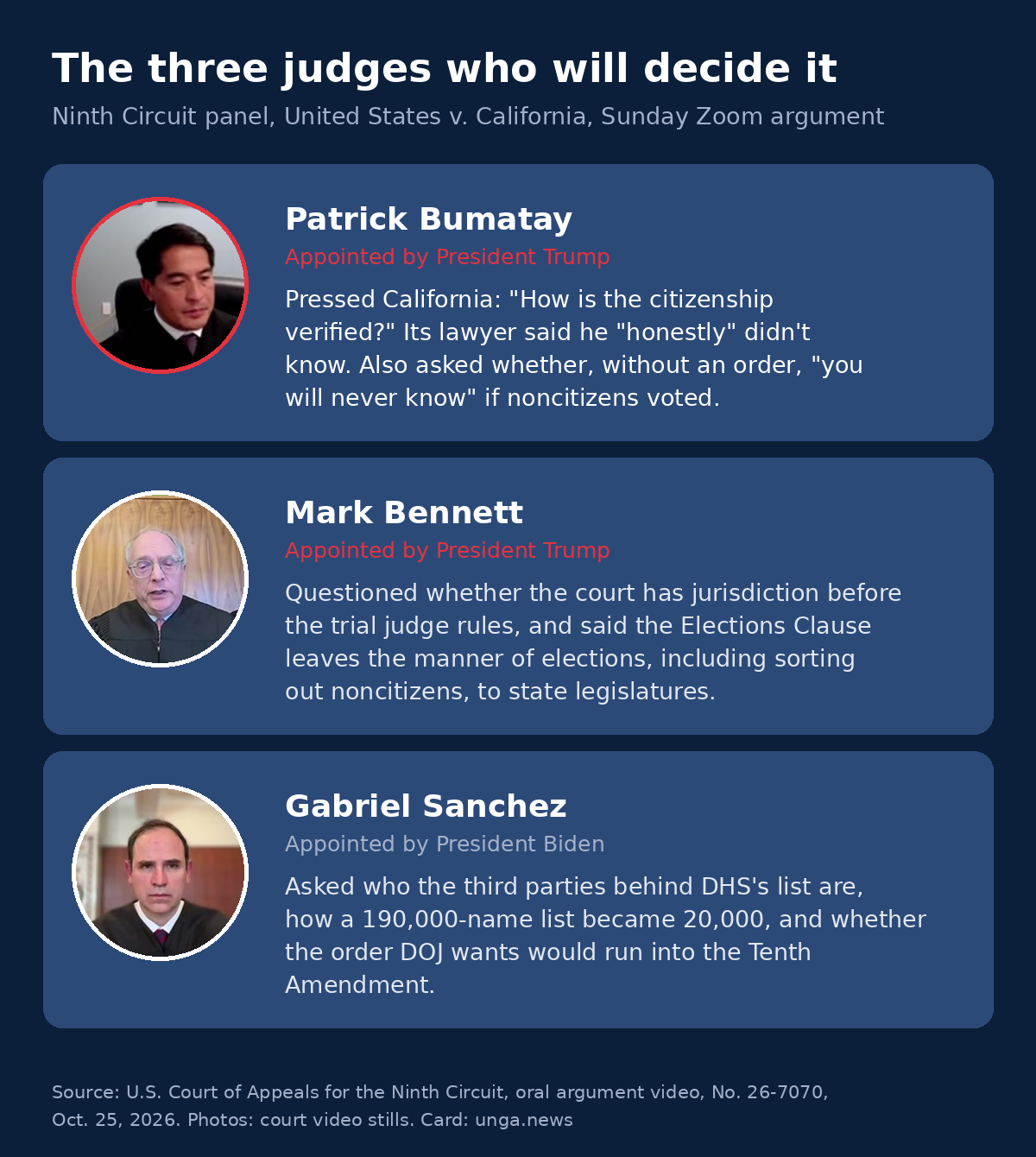
That exchange came near the end of a rare Sunday hearing at the Ninth Circuit Court of Appeals, held over Zoom and streamed by the court (watch the full argument). The Justice Department wants the mail ballots of more than 20,000 people federal agencies flagged as likely noncitizens set aside until their citizenship is checked. California and Los Angeles County want the appeal thrown out. The panel is Bumatay and Mark Bennett, both appointed by President Trump, and Gabriel Sanchez, appointed by President Biden.
DOJ's case: you can't un-open a ballot
Matthew Donnelly argued for the United States, and he opened with the whole problem in one breath. "Once a mail-in vote is processed, it cannot be unprocessed," he said, "and the damage is irreversible and irreparable. Because it is separated from the envelope and you can no longer tell which ballot goes with which envelope and who cast it."
Think of it like a bank deposit. Once the check clears and the cash is mixed into the vault, you can't pull out the one bill that came from a bad check. DOJ isn't asking anyone to throw out a vote. Its motion asks the court to "segregate—not to cancel" the flagged ballots, the same way election offices already hold provisional ballots to the side. Los Angeles County alone has processed roughly 550,000 mail ballots, by its own estimate in a Saturday filing, up from about 331,000 earlier in the week.
Federal law already makes it a crime for a noncitizen to vote in a federal election (18 U.S.C. § 611). DOJ has charged 28 people on the same list with election and immigration crimes. Those defendants are presumed innocent, but the point stands: if no one looks before the count, that law can't be enforced for these ballots at all.
Bumatay: 'You will never know'
Bumatay put that point to California directly. Is it true, he asked, that without an injunction "potentially non-citizens will be able to vote in California elections?" Siegel said the state has "no evidence that that is the case."
"Well, without an injunction, you will never know, correct?" Bumatay shot back. "Because if the ballots are cast and separated, then they're going to be tabulated and there was no way of knowing."
He also gave DOJ a legal path the others doubted. If Section 611 is an elections law, Bumatay asked, "doesn't that solve the anti-commandeering problem," since under the Supreme Court's Inter Tribal Council decision, laws made under the Elections Clause aren't subject to that doctrine? When Siegel argued that 611 is about who may vote, not the manner of voting, Bumatay asked, "Is that semantic? I mean, having non-qualified people like non-citizens vote is a manner restriction, don't you think?" Siegel said the Supreme Court drew exactly that line in Inter Tribal Council. Bumatay pressed again, noting there was "no source" saying Section 611 isn't Elections Clause law. Siegel conceded he didn't know where Congress got the power to pass it.
And when Siegel kept repeating that DOJ can't show harm, Bumatay said it plainly: "If non-citizens are voting in California elections, that does seem like a harm."
Where the other two judges pushed DOJ
Bumatay was one vote of three, and the other two judges spent most of the hour grilling DOJ. Bennett and Sanchez went first at jurisdiction. Trial Judge David O. Carter hasn't ruled on DOJ's request; he set a hearing for Tuesday, Oct. 27. DOJ appealed anyway, calling his silence past its noon deadline on Oct. 22 a "constructive denial." Sanchez asked how there could be a denial "if the court is actively moving forward with that process." Donnelly said DOJ had not appreciated the scale until the county's own filings showed hundreds of thousands of ballots already opened.
Bennett then went at the merits. The Constitution gives state legislatures the power to set the "times, places and manner" of congressional elections, and lets Congress change those rules. Bennett said California already bars noncitizens, requires voters to swear they are citizens, and has its own process for challenging a ballot, which says a challenger must show "extraordinary proof."
When Bennett cited the Supreme Court's 1932 Smiley v. Holm ruling, Donnelly said, "I'm not incredibly familiar with Smiley." Bennett also said DHS's two sworn declarations use terms like "highly reliable" that "they never explain," and that he saw nothing meeting the Supreme Court's tests for expert evidence.
Sanchez went after the list itself. DHS says it started from what looked like California's voter roll and ran it through outside analytics. Sanchez asked who those third parties were. Donnelly said he didn't know which third-party software was used, but that two DHS employees swore the process is reliable. Sanchez also asked how a DHS letter in July flagging about 190,000 people turned into a list of 20,000.
Donnelly's answer: the list went through "the rigorous process" in the declarations, and if California worked with DHS, "this could be done very fast" and "we could figure out exactly who on the list is 100% a citizen, who is 100% not."
California and LA County: no list, no lawsuit
California's case is that the list is junk and the clock has run out. Siegel said nobody knows where DHS's starting roster came from, that it dates to August 2025, and that federal courts can't change election rules once voting has started, under the Supreme Court's Purcell rule. Seth Waxman, arguing for Los Angeles County Registrar Dean Logan, said the appeal should be dismissed for lack of jurisdiction. He also said that after the July DHS letter the county asked for the names, warned that a 90-day federal quiet period on voter-roll purges was coming, and "heard zip, absolutely nothing from the government at all until mid-October."
California's own filing says a sample of about 200 names found more than a quarter listed a U.S. birthplace.
The hole this hearing exposed
Here's what Sunday made clear. California's whole defense of its voter roll is a checkbox. A voter swears he's a citizen, and that's the end of it unless someone shows up with "extraordinary proof" while the ballot is being processed. The state doesn't use the federal SAVE citizenship database. Last week Los Angeles County told the trial court under oath that its registrar is "not equipped or authorized to verify voter citizenship," as we reported here. And on Sunday, the state's own lawyer couldn't tell a federal judge how a citizenship challenge is actually checked.
Bennett's answer is that if the federal government wants more than the checkbox, it has to go to Congress, and Siegel agreed: "in the first instance, they need to go ask Congress for it." That's a fair civics point. It's also cold comfort to every citizen whose vote gets diluted while the paperwork moves.
What happens next
The panel didn't rule from the bench. It can grant DOJ's injunction, deny it, or dismiss the appeal outright, and it could act within hours. If the appeal is dismissed, the case goes back to Carter for Tuesday's hearing. Whoever loses can go to the Supreme Court. Election Day is Nov. 3. Every day without an answer, more ballots in Los Angeles get opened, and the ones on DOJ's list get harder to find.
Sources
- U.S. Court of Appeals for the Ninth Circuit — Oral argument video, United States v. California, No. 26-7070 (San Francisco Courtroom 2, Oct. 25, 2026)
- U.S. Court of Appeals for the Ninth Circuit — Order scheduling remote oral argument, No. 26-7070 (Oct. 24, 2026)
- U.S. Department of Justice (Ninth Circuit filing) — Emergency Motion for Injunction Pending Appeal (Oct. 23, 2026)
- State of California (Ninth Circuit filing) — State Defendants' Opposition to Emergency Motion for Injunction Pending Appeal (Oct. 24, 2026)
- Los Angeles County Registrar Dean Logan (Ninth Circuit filin — Opposition to Emergency Motion for Injunction Pending Appeal (Oct. 24, 2026)
- U.S. Department of Justice (district court filing) — United States' Notice of Appeal, No. 2:26-cv-12025 (C.D. Cal., Oct. 22, 2026)
- U.S. Department of Justice — Justice Department Charges 28 Foreign Nationals in California for Election Crimes (Oct. 19, 2026)
- U.S. Code — 18 U.S.C. § 611, Voting by aliens
- California Legislative Information — California Elections Code § 15101 (processing vote-by-mail ballots on receipt)