

Canada Promised Health Care for Everyone. Last Year, 29,468 Patients Died Waiting for It.
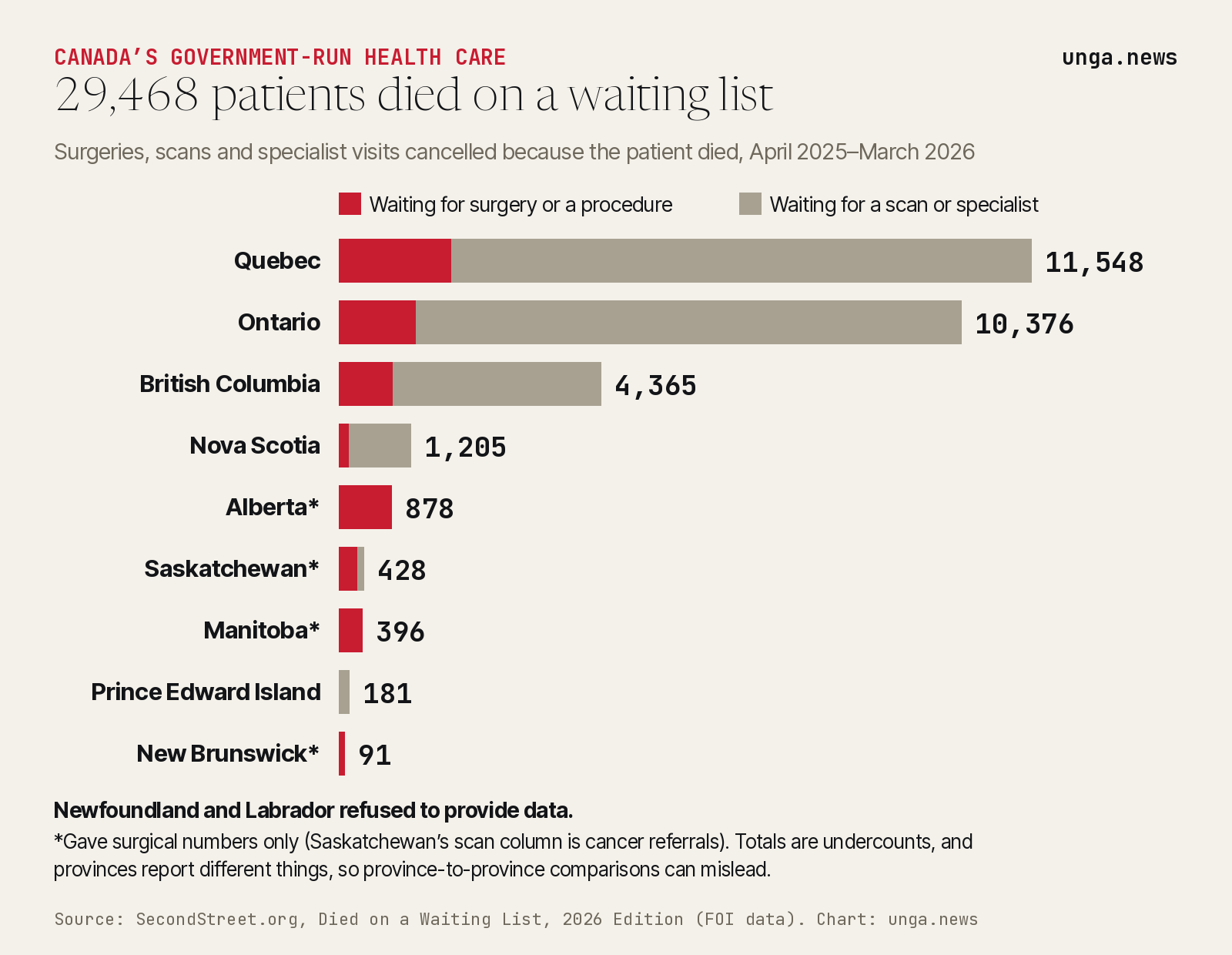
As Democrats line up behind Medicare for All, records pried loose from Canada’s government-run system show at least 29,468 surgeries, scans and specialist visits were cancelled last year because the patient had died.

Canada’s health care system is free at the door. The catch is getting through the door.
In the 12 months that ended March 31, at least 29,468 surgeries, procedures, diagnostic scans and specialist appointments across Canada were cancelled for one reason: the patient had died before the government got to them. That’s about 80 people a day, every day, for a year.
The count comes from the 2026 edition of “Died on a Waiting List,” an annual report released Nov. 25 by SecondStreet.org, a Calgary-based think tank. Its president, Colin Craig, filed freedom of information requests in April with more than 30 provincial health departments, health authorities and regions, and asked each one a simple question: how many patients came off your waiting lists last year because they died?
Since April 2018, the running total passes 129,892 Canadians.
“Governments will publicly report if a restaurant is missing a paper towel holder, but they don’t report how many patients die in the health system,” Craig said. “That double standard needs to end.”
The government had to be made to count
That isn’t a joke. In 2024, Alberta health inspectors publicly posted a daycare’s missing paper towel holder. The same governments publish no yearly tally of patients who die in line for care they were promised.
Craig has to drag the numbers out, and sometimes pay for them. SecondStreet.org says it often hands health bodies thousands of dollars a year just to compile the data, a sign nobody was compiling it for their own use. A former senior Ontario health official told the group the province’s figure exists mostly by accident, because the waiting list software happens to offer “patient died” as a reason to cancel a booking. Vancouver Coastal Health warned its number is “dependent on clerical staff receiving accurate information from the patient’s family during the booking process.”
Some governments didn’t answer at all. Newfoundland and Labrador refused, saying it would have to create records by hand. Alberta, Manitoba and New Brunswick sent surgical numbers only, and most provinces said they don’t track patients who die waiting to see a specialist. So 29,468 is a floor, not a ceiling.
Two years in line for a hip
Behind the big number are brutal individual waits. In Saskatchewan, one patient had waited more than two years for a hip replacement when they died, and another nearly two years for spinal surgery. In Manitoba, deaths on the surgical list nearly doubled in a year, from 163 to 316. Alberta reported 52 patients who died waiting for heart care. Ontario’s numbers include 115 cancer surgeries cancelled because the patient died first.
Some of the stories have names. Manitoba’s Debbie Fewster died in 2024 waiting for heart surgery after her case was wrongly labeled a non-priority. A freedom of information response later showed no health care worker faced any consequence, the report says, in a province that will fine you $143 for forgetting to update the address on your driver’s license.
And regular Canadians know it. In an October poll by Leger for SecondStreet.org, 18% of Canadians said they personally know someone who died because of a long health care waitlist.
The report is upfront about its limits. A death on a waiting list doesn’t prove the wait caused it. Some patients die in car crashes or of unrelated illness, and many cases involve hip, knee or cataract surgery rather than lifesaving care; Saskatchewan said 36% of its surgical waitlist deaths were cataract patients. Nova Scotia once broke down its 532 waitlist deaths in 2022-23 and found 50 where delays “might reasonably be implicated causally.” This year’s total is the highest SecondStreet.org has recorded, but more health bodies reported, too. Counting only those that reported both years, deaths rose 1.4%, with surgical waitlist deaths up 17.5% and scan waitlist deaths down 2.8%.
But a family that waits two years for a hip operation that never comes doesn’t need a study to know something went wrong. And the governments in charge could settle every one of those questions by tracking the cases themselves. They choose not to.
It isn’t a money problem
The usual answer, in Ottawa or Washington, is more money. The report shoots that down. Provincial governments spent at least $269 billion on health care in 2025-26, according to the Canadian Institute for Health Information, about $6,867 per person, up from $1,670 in 1995-96. Had spending merely kept up with inflation, it would be $3,147. And in 2024, Canada ranked third among universal health care countries for health spending as a share of its economy.
What’s missing, Craig argues, is competition and choice. Canada is the only country in the world, the group says, that puts up barriers to, or outright bans, patients paying for care at home. A patient in Toronto can’t pay a Toronto clinic for a hip operation. Sweden, France and Australia all let patients choose, and in Sweden 13% buy private insurance, taking pressure off the public line. Countries that pay hospitals for each patient treated, instead of a yearly lump sum, turn patients into revenue instead of a drain on the budget.
The plan Democrats are warming up
All of this matters because Democrats are moving the other way. Rep. Pramila Jayapal of Washington, lead sponsor of the House’s Medicare for All Act, has 118 cosponsors and told Punchbowl News she wants a markup and a floor vote. On Nov. 20, Sen. Tammy Duckworth signed on to Bernie Sanders’ Senate version, which would move Americans into one government plan over four years and now has 20 sponsors. Hakeem Jeffries, in line to be speaker in January, has promised to lower the Medicare age, add dental and hearing benefits and expand coverage for kids. Jayapal called that “a really important step towards Medicare for All.”
Even some Democrats aren’t sold. “People want healthcare, but they don’t necessarily think government implementing it is a solution either,” House Democratic Caucus Chair Pete Aguilar told Punchbowl News. “They don’t really trust us to implement this well.”
Canada shows why. When one government is the only payer and the only place to go, the line becomes how costs get controlled, and nobody even has to count the people who never reach the front. Americans have real problems with high bills and confusing insurance. The fix is more choices, more competition and more doctors, not one line run out of Washington. Our neighbors to the north have nearly 130,000 reasons to show for that lesson.
Sources
- SecondStreet.org — Died on a Waiting List, 2026 Edition, policy brief by Colin Craig (Nov. 25, 2026)
- SecondStreet.org — 29,468 Canadians died on a waiting list last year. Nearly 130,000 have died waiting since 2018 (news release and provincial FOI responses, Nov. 25, 2026)
- SecondStreet.org — Leger national omnibus poll for SecondStreet.org (Oct. 21, 2026)
- Canadian Institute for Health Information — National Health Expenditure Trends, data table series F (2026)
- Politico — Dems plot first steps toward ‘Medicare for All’ (Nov. 19, 2026)
- Office of Sen. Tammy Duckworth — Duckworth Cosponsors the Medicare for All Act (Nov. 20, 2026)
- Punchbowl News — Get ready for the Medicare for All fight (Nov. 3, 2026)
- Punchbowl News — Dems eye lower Medicare age (Nov. 12, 2026)