

ChatGPT Can Now Prep Your Sales Calls, Write the Follow-Up and Warn You When a Deal Goes Cold
OpenAI’s new ChatGPT for Sales plugs into Salesforce, HubSpot and more than 30 other work tools, with an always-on helper that checks your deals every morning.

Ask anybody who sells for a living where their week goes, and you’ll hear the same answer. Not on the phone with buyers. It goes to digging through the customer file, rereading call notes, writing the follow-up email nobody wants to write and typing the same update into the company’s customer database twice.
OpenAI wants to take that pile off their desk. On Tuesday the company launched ChatGPT for Sales, a version of its chatbot built for salespeople, along with what it calls “more than 30 new and enhanced partner plugins” that hook ChatGPT into the tools sales teams already use every day.
The pitch, in OpenAI’s own words, is to help teams “understand customers better, spend less time on busywork, and close more deals.” Whether it does that is up to the people using it. But the list of tools it now plugs into tells you how serious the company is about the office, not just the homework assignment.
One window instead of nine tabs
A modern sales rep juggles a lot of software. There’s the customer database, usually Salesforce or HubSpot. There’s a prospecting tool to find leads, a call recorder that transcribes meetings, an email sequencing app, a deck builder and, at the end, a contract tool to get the signature.
ChatGPT for Sales tries to sit on top of all of it. According to OpenAI’s announcement, it can pull account history from Salesforce, HubSpot, Close or monday CRM. It can combine lead signals from Apollo, Clay and Common Room with its own web research, then plan outreach through Outreach or Salesloft. Call notes can come from Gong, Otter.ai, Granola or ChatGPT’s own meeting notes. When a buyer is ready, it can help prepare quotes and agreements through Docusign, Ironclad, PandaDoc or ServiceNow.
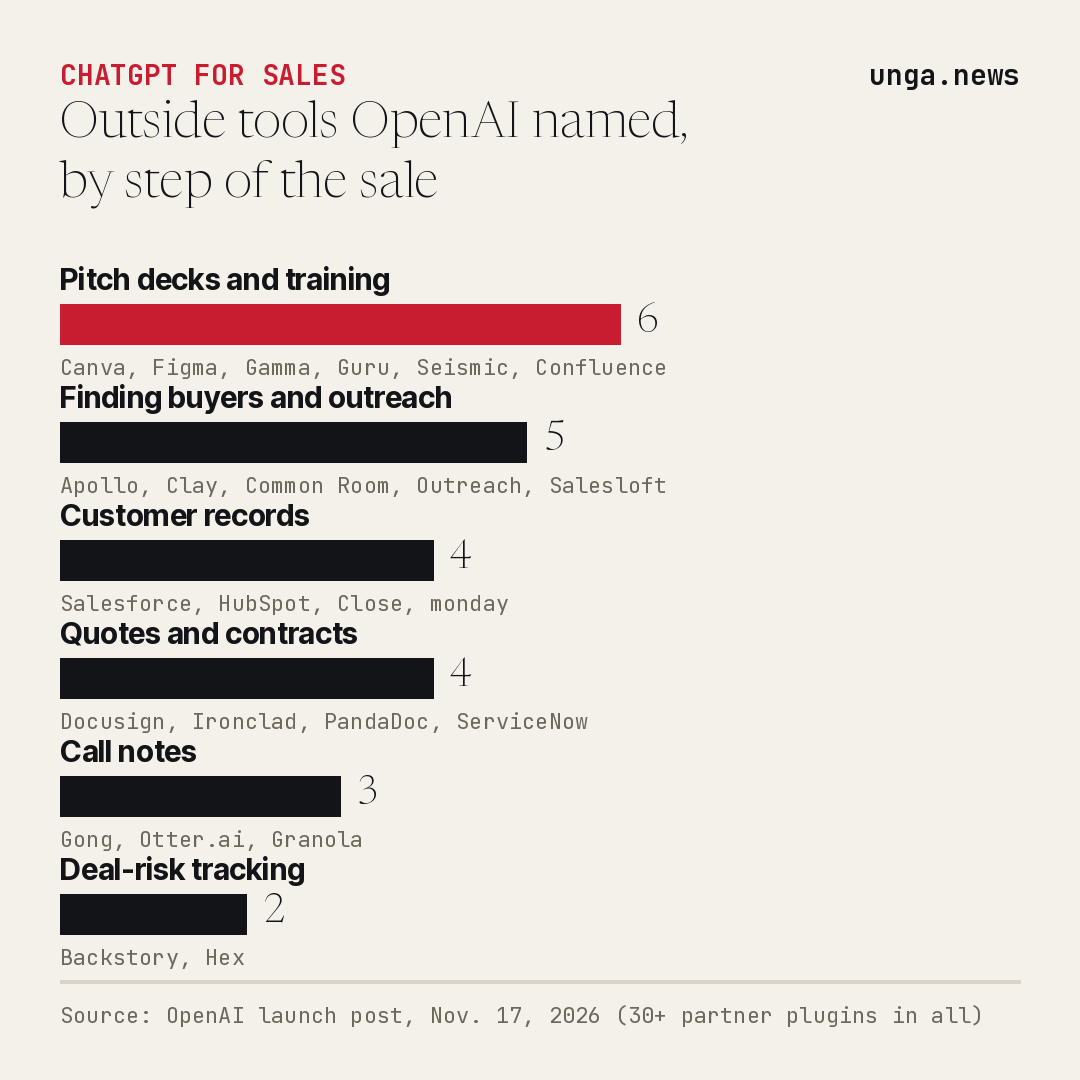
There’s also a new Sales plugin from OpenAI itself with ready-made routines for the daily grind: deciding which accounts to chase, building a briefing before a call and drafting the follow-up afterward. Reps can rehearse a pitch out loud against ChatGPT Voice and practice handling objections before they face a real buyer. They can build a customer-specific deck with Gamma, Figma or Canva, or spin up an interactive demo or price calculator.
The assistant that checks your deals every morning
The most interesting piece is what OpenAI calls a “dot,” which it describes as “an always-on agent in ChatGPT.” Instead of waiting to be asked, a dot can watch a deal, prepare meeting briefs and bring the rep “relevant changes and proposed next steps for review.”
OpenAI gives one concrete example. With a deal-tracking tool called Rox, a rep can ask a dot “to check the deal each morning, flag changes that need attention, and prepare a meeting brief or follow-up sequence.” That’s the kind of job a sales manager would love to hand to someone who never forgets and never sleeps.
Note the word “review.” OpenAI is careful to frame almost every action as a proposal. After a call, ChatGPT drafts the follow-up and “prepare[s] updates to the customer record,” and the rep looks them over before anything goes out. With some tools, like Attio, the rep can save the next step to the customer database straight from the chat. That’s the right instinct. Nobody wants a chatbot firing off a wrong price to their biggest client.
Companies stay in control too. Admins on ChatGPT Business and Enterprise plans turn the Sales plugin on in their console, choose which partner plugins members can install and “review access to the required apps and the actions they can use.” OpenAI says availability varies by plan, region and workspace settings.
What the early customers say, and what they don’t
OpenAI lined up five customer quotes for the launch. The most specific came from Gunnar Gombert, co-founder of NeoBid, a company that helps property owners buy energy. He said using HubSpot with ChatGPT for Sales to research prospects, clean up customer data and prepare outreach cut manual effort on those tasks “by around 65%.”
Treat that as what it is: one customer’s own estimate, published in the seller’s own announcement. OpenAI didn’t release a study, a test group or a before-and-after measurement. The Michael J. Fox Foundation said the Salesforce plugin “reduces the time and effort” of researching donor prospects, which is a nonprofit using sales tools to raise money. Those are encouraging signs, not proof.
The bigger question is trust. A sales assistant is only as good as the customer data it reads, and most companies’ customer files are a mess of stale notes and half-filled fields. If the records are wrong, a faster assistant just gets you to the wrong answer sooner. The review step matters for that reason as much as any other.
Why OpenAI is going after the sales floor
This launch landed on the same day OpenAI rolled out its new GPT-6.2 Astra and Sol models and a legal-focused push. The pattern is plain. The company isn’t content to be the chatbot you ask for a recipe. It wants a seat in the software that runs a business, one job at a time, and the sales floor is where the money gets made.
That puts ChatGPT on the same turf as the big sales software makers, even as several of them, Salesforce and HubSpot included, signed on as partners here. For now, they’ve decided it’s better to be inside ChatGPT than shut out of it.
For the rep on commission, the math is simpler. Every hour not spent on paperwork is an hour on the phone with someone who might buy. If ChatGPT can give back even part of that hour, sales teams will use it whether their bosses planned for it or not.
Sources
- OpenAI — Introducing ChatGPT for Sales
- TMC Insight — AI Unifies Sales Data & Powers Seller Outreach Tasks
- OpenAI — OpenAI News