

ChatGPT Is Switching Off Its Old Voices on Dec. 11. Custom GPTs Shut Down the Same Day.
OpenAI says almost everyone already talks to ChatGPT through its newer GPT-Live voice, so Advanced and Standard voice are going away. The custom GPTs people built and shared retire the same day, and creators need to move them to plugins first.
If you talk to ChatGPT out loud, the voice you’re used to has a month left. OpenAI says it will retire Advanced voice and Standard voice on Dec. 11, and everyone who still uses either one will be moved to its newer voice, GPT-Live. That same day, the custom GPTs millions of people built or borrowed are scheduled to stop working too.
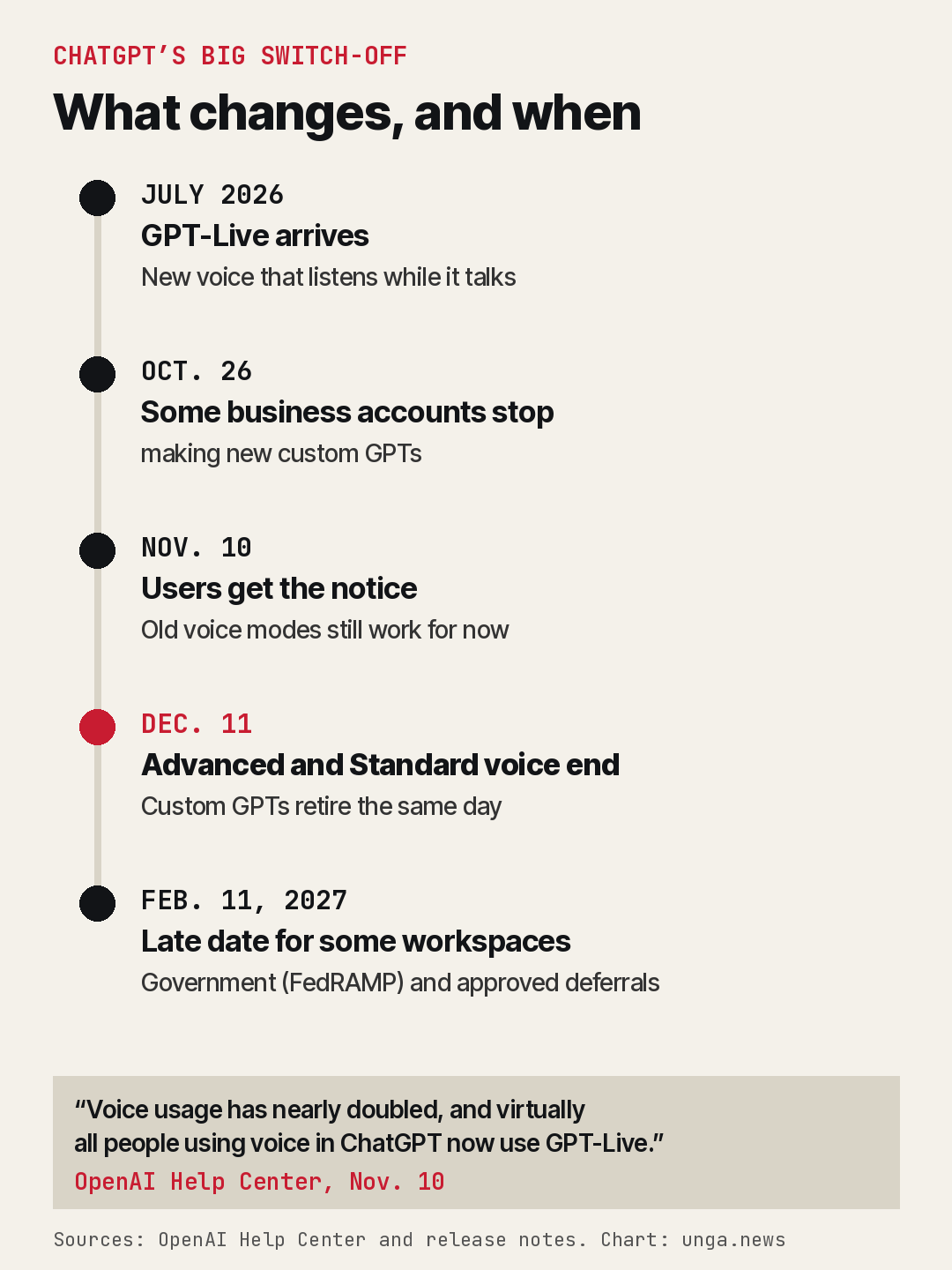
OpenAI posted the voice change Tuesday in its ChatGPT release notes and started notifying users the same day. The reasoning is short. “In July, we introduced GPT-Live, our latest voice model that combines natural conversation with frontier intelligence,” the company wrote. “Since then, voice usage has nearly doubled, and virtually all people using voice in ChatGPT now use GPT-Live.”
In other words, most people already left the old voices behind. OpenAI wants to stop running three voice systems and put its effort into one.
Three voices, one survivor
It helps to know what’s actually going away, because the three options work very differently under the hood.
Standard voice is the oldest. OpenAI describes it as three separate programs chained together: one turns your speech into text, a second writes the answer, and a third reads the answer back out loud. The company admits that setup “resulted in slow responses and loss of information across voice and text modalities.” Tone of voice, hesitation and emphasis mostly got lost in the hand-off.
Advanced voice was the upgrade. It handled audio directly instead of converting everything to text first. But it still took turns. It had to wait for you to stop talking before it answered, which OpenAI now calls a “rigid back-and-forth.”
GPT-Live is what OpenAI calls full-duplex, a fancy way of saying it can listen and talk at the same time, like a person on the phone. According to OpenAI’s help page, it can toss in a “mhmm” or “yeah” to show it’s following you, jump in for quick back-and-forth, or stay quiet while you think. It can also hand a hard question off to OpenAI’s stronger text models in the background and keep chatting while that work runs. It can search the web, use memory and show visual results inside the chat.
The catch for video and screen sharing
There’s one thing GPT-Live still can’t do. It doesn’t support live video or screen sharing, the feature that lets you point your phone camera at a broken faucet or share your screen and ask what you’re looking at. OpenAI says those features “will continue to be powered by Advanced voice until GPT-Live has this capability.” It didn’t give a date for when that will happen.
So Advanced voice isn’t fully dead on Dec. 11. It just disappears from the menu. After that date, you won’t be able to pick Advanced or Standard under Settings and then Voice, and anyone who had one selected gets switched to Live automatically.
Your old chats are safe. OpenAI says conversations held in Advanced or Standard voice stay in your ChatGPT history and can be picked back up in text or in GPT-Live.
The company also acknowledged that some people won’t love the change. “We recognize that some people are accustomed to Advanced or Standard voice’s style or way of responding, and these model transitions can be challenging,” it wrote. That’s not a hypothetical. When OpenAI tried to retire Standard voice in September 2025, users pushed back hard enough that the company kept it around, saying it had “heard feedback that Standard Voice is special to some folks.” This time there’s no sign of a reprieve, and the reason is in OpenAI’s own numbers: almost nobody is still using it.
Custom GPTs hit the same wall
The voice change is the smaller of two Dec. 11 deadlines. OpenAI’s custom GPT retirement page says custom GPTs are scheduled to retire that day as well. After that, “custom GPTs and their GPT pages become inaccessible.”
Custom GPTs were OpenAI’s big idea in late 2023: anyone could package instructions and reference files into a mini ChatGPT for a single job, like a recipe planner, a grant writer or a homework tutor, and share it. OpenAI is replacing them with plugins, which bundle the same instructions and files with connected apps.
For the people who built GPTs, there’s a migration button. Go to My GPTs and choose Migrate to plugin once it shows up for your account. The GPT’s instructions become a “skill,” its knowledge files become reference files and connected apps carry over. Some things don’t. The model the GPT was set to use doesn’t transfer, custom actions have to be rebuilt, and unpublished drafts are left behind. Once you migrate, the original GPT goes read-only.
Regular users of someone else’s GPT have less control. OpenAI’s advice is to check the GPT’s notice and the creator’s guidance about a replacement. If the creator never migrates, that tool is simply gone after Dec. 11. Your past conversations with it, OpenAI says, stay in your history.
Personal accounts already can’t build new GPTs. OpenAI’s help pages say creating and publishing new ones isn’t available on Free, Go, Plus or Pro plans, and some company workspaces lost that ability on Oct. 26. A small group gets more time: government workspaces under the FedRAMP security program and some business accounts with an approved extension have until Feb. 11, 2027.
Even voice is tied into this. OpenAI says voice chats inside custom GPTs will keep running on Advanced voice until the GPTs themselves are retired on Dec. 11.
What to do before the switch
If you only use ChatGPT’s voice now and then, you probably don’t need to do anything. Odds are you’re already on GPT-Live, and the change will pass without notice.
If you lean on video or screen sharing, keep using it. That still runs on Advanced voice behind the scenes for now.
If you built a custom GPT, or your business runs on one, the clock matters more. Migrate it, test the plugin version on your usual tasks before Dec. 11, and tell the people who use it where to find the new one. If you depend on someone else’s GPT, look for a notice from its maker now rather than finding a dead link next month.
OpenAI is cleaning house and betting everything on one voice and one way to build custom tools. For most users that means faster, more natural conversation. For the ones who liked things the old way, Dec. 11 is the date to circle.
Sources
- OpenAI Help Center — Retiring Advanced and Standard Voice in ChatGPT
- OpenAI Help Center — ChatGPT release notes (Nov. 10, 2026)
- OpenAI Help Center — Custom GPT retirement and migration FAQ
- OpenAI Help Center — GPTs in ChatGPT
- OpenAI Help Center — ChatGPT Voice