

ChatGPT’s Boss Told Samsung Some SI Demand Is Counted Twice. He Still Wants More Chips.
In a private Q&A with about 50 Samsung executives, Sam Altman said only OpenAI and Anthropic are really driving the boom, warned of short-term swings, and said chips and data centers are still the biggest bottleneck.
Sam Altman runs the company that has done more than anyone to convince the world it needs to build more chips, more memory and more data centers. So it got attention when the head of ChatGPT’s maker sat down with about 50 of Samsung’s top executives and told them some of that demand has been counted twice.
The meeting happened Oct. 31 at Samsung’s Human Resources Development Center in Yongin, south of Seoul. The remarks stayed private until Wednesday, when the Korean business paper Financial News reported that it had obtained the question-and-answer materials from the session. The quotes below are the paper’s English translation.
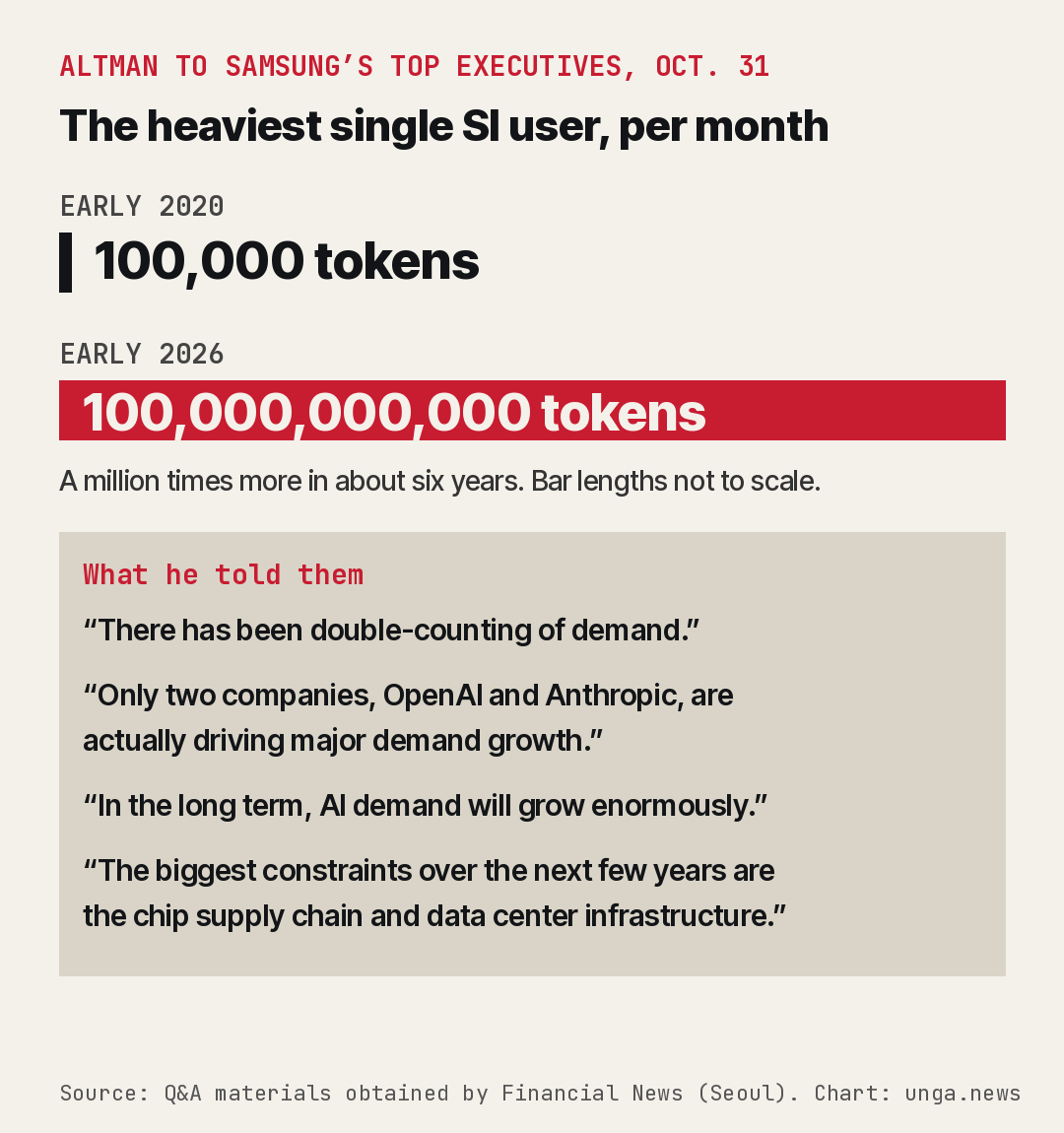
Asked whether demand for SI, memory and data centers could hit a ceiling or slow down over the next five to 10 years, Altman answered, “There are short-term fluctuations.” Then he went further. “There has been double-counting of demand,” he said. “Only two companies, OpenAI and Anthropic, are actually driving major demand growth, so there could be a supply shock and an unsettled period.”
That is a remarkable thing for the industry’s biggest customer to say to one of its biggest suppliers.
How one order turns into four
Altman tied his comment to the fight this year over so-called neoclouds, the newer cloud companies built to rent out computing power for SI, mostly racks of graphics chips. Financial News noted that some infrastructure projects show up in more than one tally, and that appears to be what he meant.
Here is how that can happen. A model maker reserves computing power at a neocloud. The neocloud orders chips. The chipmaker orders high-speed memory from a company like Samsung. Each step announces its own big number. Add them up and one customer can look like three or four. A memory maker that plans its factories against that pile could end up building for buyers who are really the same buyer.
And if Altman is right that just two companies are pulling the whole wagon, the risk is concentrated. One slowdown at OpenAI or Anthropic ripples straight down the line to the factories in Korea and Taiwan.
Don’t mistake this for a bubble warning, though. In the same session, Altman was as bullish as ever about where this goes.
“In the long term, AI demand will grow enormously,” he said. He pointed to SI writing custom software on the fly and running robots, spacecraft and scientific research, all of which chew through tokens, the small chunks of text and data these models read and write.
Then he gave a number that tells the story better than any chart. “At the start of 2020, the top token user consumed about 100,000 tokens a month, but early this year the heaviest user consumed 100 billion tokens a month,” he said. “The amount of compute one person can consume is astonishing.”
That is a millionfold jump in about six years. “Everyone will increasingly want intelligence that works for them,” he said.
So his message to Samsung was not “slow down.” It was closer to “expect a bumpy ride, then build more anyway.”
The real choke point is chips
Asked what could hold SI back, Altman listed four things: “the supply chain,” “financing,” “AI safety and social acceptance” and “corporate transformation.” Then he picked the top two. “The biggest constraints over the next few years are the chip supply chain and data center infrastructure,” he said. “More investment in the supply chain is needed.”
That is why he was in that room. Samsung and SK hynix agreed last October to join OpenAI’s Stargate data center project and supply advanced memory. Financial News described Altman’s quick one-night, two-day trip to Korea as a sign of how urgent the memory crunch has become. Other Korean outlets reported he also had lunch that day with SK Group Chairman Chey Tae-won to talk chips and data centers.
The Samsung side billed the gathering under the theme “The Next 10 Years Shaped by AI: The Enterprise’s Choice,” and its executives took part in hands-on SI sessions before Altman arrived, according to The Korea Herald.
Selling cheap and selling a lot
Samsung’s executives also asked the obvious question: Isn’t all this spending crushing OpenAI’s profits?
Altman didn’t dodge it. “That’s the point,” he said. “If a company has vertically integrated infrastructure that costs less than any other company’s and sells tokens at scale on low margins, it can get ahead of the competition.”
He said OpenAI’s spending on efficiency, including chips it designs in-house, is starting to pay off, and that long-term contracts keep its operations lean. The plan, in plain English: drive the cost of each answer down, then make it up on volume.
“The market is so large that the rules of a commodity business do not apply,” Altman said. “Simply meeting the world’s demand for tokens would be enough to build a great industry.”
Investors will weigh that against the books. As this site reported, OpenAI brought in about $10 billion last quarter and lost more than that. Anthropic is heading to a public stock listing priced at $70 to $78 a share. If two companies really are driving the boom, every chipmaker and memory maker on earth is betting on how those two hold up.
This isn’t just a Wall Street story. The same memory chips Samsung sells to data centers go into the phones and laptops regular people buy. When factories plan against inflated forecasts, the swings can land on store shelves and on the workers who build the parts.
Altman’s answer to Samsung boils down to two things at once. The next year or two could be choppy because the order books are fuzzier than they look. And the decade after that will need far more chips than anyone has built. Samsung, which makes the memory every one of these SI systems runs on, heard both halves straight from the customer.
Sources
- Financial News (Seoul) — [Exclusive] Sam Altman warns Samsung executives of volatility: “AI demand has been double-counted, with short-term fluctuations”
- The Korea Herald — Samsung executives meet OpenAI’s Altman to discuss AI strategy
- BigGo Finance — Sam Altman Warns Samsung Executives of Double-Counted AI Demand, Hints at Near-Term Correction