

ChatGPT’s Maker and Cisco Are Giving Away an SI Shield That Blocks Hackers Before Fixes Arrive
Hackers now strike within hours of a big software hole going public. OpenAI and Cisco released a free tool that lets SI write temporary shields, and in their own test it stopped a fresh Java attack on a live server.
Every time a big software hole goes public, the same ugly race starts. Hackers start firing at it within hours. The companies that run the software need days or weeks to test a fix, schedule downtime and roll it out. On Monday, ChatGPT’s maker and Cisco said they want SI to cover that gap, and they’re giving the tool away.
OpenAI and Cisco launched Shirudo, a free, open-source program that lets SI agents write small, temporary “shields” and drop them onto computers while they keep running. A shield blocks the one path a hacker needs to reach a weak spot and lets normal traffic through. When the real fix lands, the shield comes off. Shirudo is Japanese for “shield.”
OpenAI on 𝕏: We’re introducing Shirudo, an open-source Linux runtime allowing agents to defend systems without downtime.
— @OpenAI View on 𝕏
Greg Brockman, OpenAI’s president and co-founder, explained the problem in plain terms. “We’re giving defenders better models and tools to find and fix vulnerabilities faster, but finding a bug today doesn’t mean you can patch every system tomorrow,” he said. “So many teams rely on the same software that it makes sense to build these tools in the open. Now when one team finds a better way to protect a system, others don’t have to start from scratch.”
The Java hole that sat in plain sight
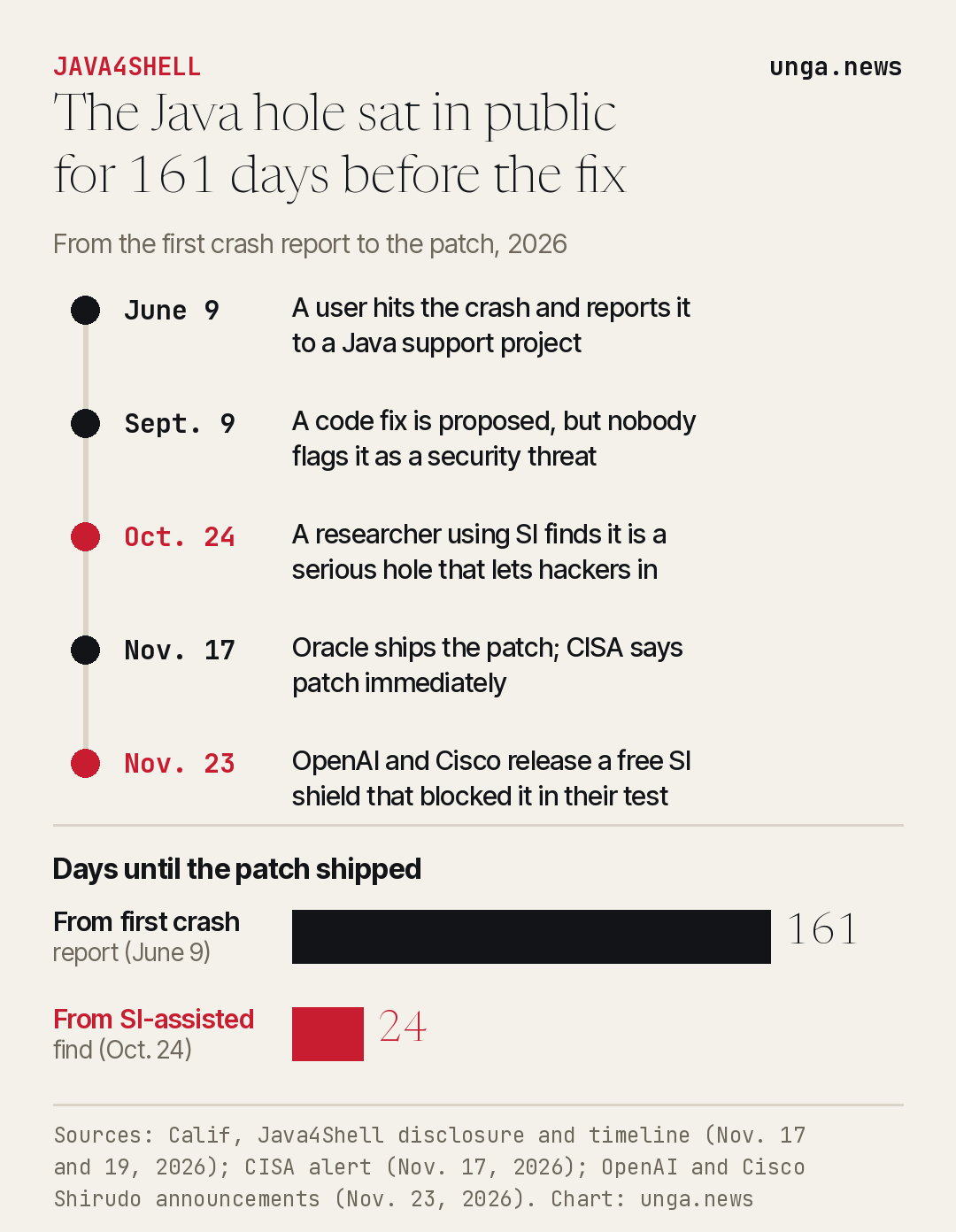
The best way to see why this matters is the bug they tested it on. Last Tuesday, Nov. 17, Oracle shipped a fix for a flaw nicknamed Java4Shell, and the federal government’s cyber agency, CISA, told organizations to patch immediately. Specially crafted text sent to an affected Java program could crash it and let an attacker run code with no password at all.
Java is not some niche tool. The security startup that reported the bug, Calif, says Java powers 90% of Fortune 500 companies and runs through banking, aviation, telecom and national security systems. The flaw scores 9.2 out of 10 on the industry’s severity scale, and Calif showed it taking over popular business software like Jenkins, Jira and Confluence in their default setups. The trigger was almost comically simple: 64 letter A’s followed by one equals sign.
Here’s the part that should bother anyone who runs a computer network. According to Calif’s own published timeline, someone hit the crash in the wild and reported it to a Java support project back on June 9. A fix was proposed on Sept. 9. Nobody connected it to a serious security threat until Calif researcher Quang Luong, using OpenAI’s Codex, found it independently on Oct. 24. Oracle’s patch went out 24 days later.
Calif said finding the bug took Luong about an hour, building the first working attack took two more, and the SI computing bill came to less than $200. That’s the new math. If a researcher can do it that fast and that cheap, so can a criminal gang or a hostile government.
What the shield actually did
Cisco’s Isovalent team, the engineers behind the Linux security tool that Shirudo grew out of, walked through the test. They fed the Java4Shell details to an agent running on Codex. It wrote a small patch that checks incoming text before Java’s decoder touches it, attached it to a live Elasticsearch server, and then the team tried the attack. The server’s own logs show the guard rejecting the exact poisoned input, 65 characters with one equals sign, while the service kept running.
Keep the scorekeeping straight. That was one controlled lab test run by the companies that built the tool, not an independent review and not a real-world attack. Cisco says Shirudo also wrote code that blocked attempts on a recent PHP flaw, and it says that flaw reportedly touched about 70% of websites. Those are the companies’ claims. The code is public, so outside researchers can now check the work for themselves, which is exactly what Cisco and OpenAI are asking them to do.
They also built in brakes. Every shield is digitally signed, so a computer can check where it came from before loading it, and Cisco says that check holds even if an attacker has grabbed administrator access. A hardware security chip keeps a record of every shield added or removed. According to Cisco, a shield only starts blocking once testing shows it stops the attack without breaking the service, and people approve what gets deployed.
Defense at the speed of the attack
Jeetu Patel, Cisco’s president, has been blunt about why companies can’t keep playing defense at human speed. In a post announcing the project, he wrote that with the PHP flaw and Java4Shell, “exploit campaigns were underway within a day of disclosure, if not before.”
“Bugs and flaws used to unfold over days and weeks. It’s now minutes and hours,” Patel wrote. “The only way to combat the speed of threats powered by AI is with AI agents of our own. This doesn’t mean replacing security teams.”
That’s the right instinct, and it lines up with what the Trump White House laid out in America’s AI Action Plan in July 2025. The plan warned that critical infrastructure owners, “many of whom operate with limited financial resources,” face growing cyber threats, and said “AI systems themselves can be excellent defensive tools.” A water utility or a small-town hospital can’t hire a team of elite hackers. A free, inspectable tool built by two American companies is the kind of thing that can actually reach them.
It also beats the alternative Washington usually reaches for. Instead of a new mandate or a new office, two private companies spotted a problem, built something and put the code on GitHub under a permissive license anyone can use. The government’s job here was the one it should do: CISA sounded the alarm, Oracle fixed the bug, and the private sector built the bridge between the two.
There are fair questions left. Shirudo runs on Linux, so it won’t cover every machine. A bad shield could still knock a service offline, which is why the human sign-off matters. And handing SI agents more power inside computers only works if the guardrails hold when somebody tries to fool them. Cisco is inviting kernel developers and security researchers to try to break it and plans a public technical deep dive on Dec. 15.
But the direction is right. The hackers already have SI. For years the good guys have been stuck waiting on the patch cycle while the other side moved in hours. A shield that can go up in the meantime, built in the open by American companies, gives them a way to fight back on the same clock.
Sources
- OpenAI — OpenAI and Cisco introduce Shirudo (Nov. 23, 2026)
- Cisco Newsroom — Cisco and OpenAI Launch Shirudo, A New Project to Safeguard Agentic AI (Nov. 23, 2026)
- Cisco Blogs — Jeetu Patel, Expanding the Defender’s Window with Self-defending Infrastructure (Nov. 23, 2026)
- Isovalent (Cisco) — Thomas Graf and Liz Rice, Cisco and OpenAI introduce Shirudo (Nov. 23, 2026)
- OpenAI on 𝕏 — We’re introducing Shirudo, an open-source Linux runtime (Nov. 23, 2026)
- CISA — Critical Java Vulnerability Requires Immediate Patching (Nov. 17, 2026)
- Calif — Java4Shell: Write once, RCE everywhere (Nov. 17, 2026; timeline added Nov. 19)
- The White House — America’s AI Action Plan (July 2025)
- GitHub — shirudo-dev/shirudo