

ChatGPT’s Maker Hit $10 Billion in Sales Last Quarter and Lost Even More Than That
OpenAI nearly tripled its revenue in a year, but its quarterly loss grew to $10.9 billion while rival Anthropic lost about half a billion on $17 billion in sales.

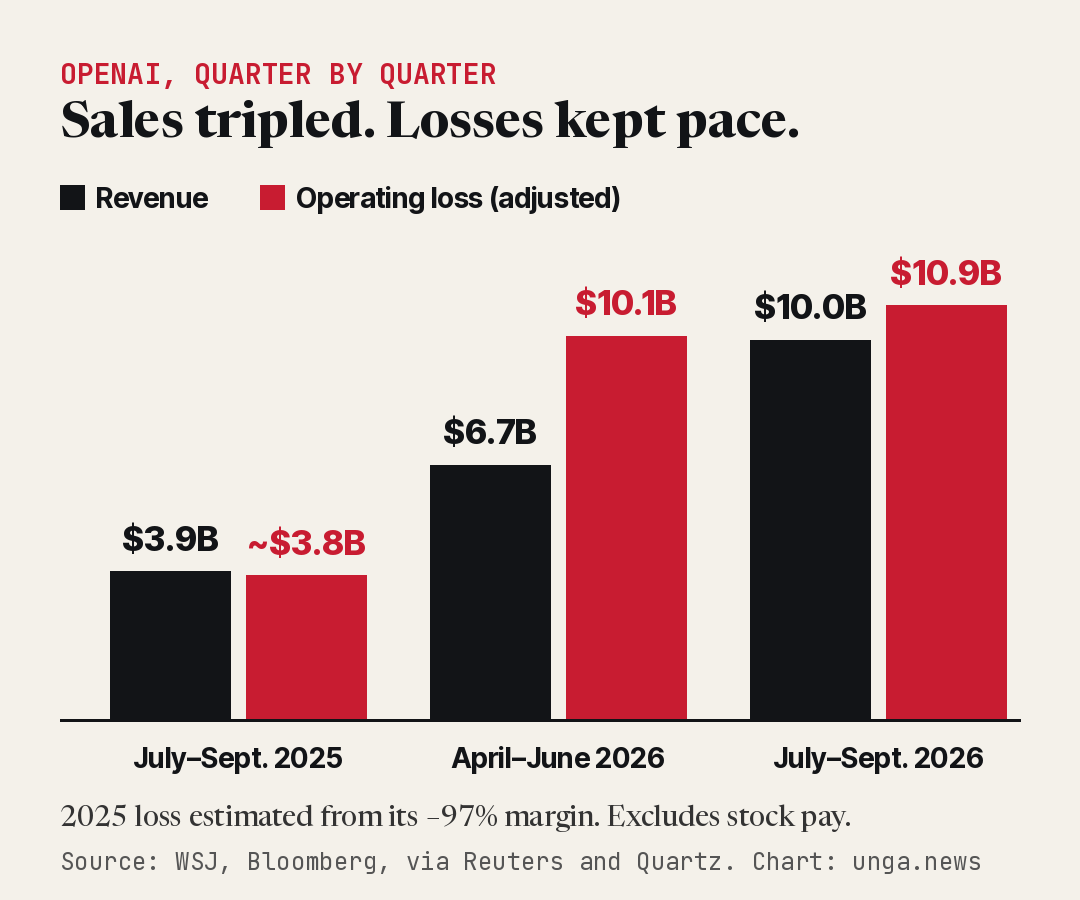
The company behind ChatGPT just had the best sales quarter in its history. It also lost more money than it brought in. According to investor documents first reported by The Wall Street Journal and confirmed by Bloomberg, OpenAI took in $10 billion in revenue from July through September, its first quarter ever at that level. Over the same three months its adjusted operating loss came to $10.9 billion.
Put that in kitchen-table terms. For every dollar a customer paid OpenAI last quarter, the company spent a little more than two dollars running the business. And that’s the generous version of the math, because the loss figure leaves out the stock the company hands its employees as pay.
The numbers were shared with investors on a call Tuesday. OpenAI President Greg Brockman, Chief Financial Officer Sarah Friar and product leader Thibault Sottiaux were on it, according to Bloomberg. OpenAI declined to comment to Quartz and didn’t answer Reuters.
The good news is real
Let’s give the company its due first. Revenue jumped about 50 percent from the spring quarter, when OpenAI brought in $6.7 billion. A year earlier, in the same July-to-September stretch of 2025, it made $3.9 billion. So in twelve months the company nearly tripled its sales. Very few businesses of any size can say that.
Bloomberg tied the jump to demand for OpenAI’s newest software, and Computing reported the company has been chasing big business customers hard. It cut prices on its latest models to win them, hired a new chief revenue officer named Dali Rajic to run that push, and signed a partnership with JPMorgan Chase. Brockman said at a Journal conference in Napa Valley earlier this month that the first two quarters of the year were rough but the third brought an “incredible revenue inflection.”
Paying ChatGPT users grew to roughly 100 million. That sounds like a lot until you learn it’s only about 8.5 percent of the people who use the app every week. The other 91.5 percent are using it for free. OpenAI started running ads inside ChatGPT earlier this year, and it expects those ads to help close the gap.
The bill keeps getting bigger
Here’s the part that should make anyone think twice. The loss didn’t shrink as sales grew. It went up, from $10.1 billion in the spring quarter to $10.9 billion last quarter.
The company points to its margin, which did get better. In the spring OpenAI was spending about $2.50 for every dollar of revenue, a margin of minus 150 percent. Last quarter it was minus 109 percent. That is progress. But a year ago the margin was minus 97 percent, which means the company is losing more per dollar of sales today than it was in the fall of 2025, not less.
Then there’s the stock pay. The Journal reported, citing a person familiar with the matter, that stock-based compensation hit $2.6 billion last quarter. That cost isn’t in the $10.9 billion. Count it, and OpenAI’s three-month loss would top $13 billion.
Where does all that money go? Mostly into the giant computer farms that train and run these SI systems, and into the chips and electricity that feed them. Every question you type into ChatGPT costs real money to answer. When the company cuts its prices to win business customers, the revenue line grows faster, but each sale carries less margin to pay for those costs.
The rival that just beat it
The context makes it even tougher. OpenAI’s chief rival, Anthropic, the maker of the Claude chatbot, reported third-quarter revenue of about $17 billion with an operating loss of just $567 million, according to Computing. Anthropic passed OpenAI in the spring, $11.6 billion to $6.7 billion, on the back of its popular coding tool. It’s now on a roadshow for a stock offering that Reuters says could value it at about $1.4 trillion. We’ve written before about how much Anthropic is spending to keep its own lights on.
To be fair to OpenAI, the two companies count differently. Anthropic’s loss figure includes stock pay, and OpenAI’s doesn’t. Quartz notes the two have long used different methods to tally revenue, too. So it isn’t a perfect apples-to-apples comparison. But even if you squint, one company is losing about half a billion dollars on $17 billion in sales, and the other is losing nearly $11 billion on $10 billion.
Anthropic’s growth is cooling, though. Bloomberg reported its revenue rose about 47 percent from the spring, down from a jump of more than 140 percent the quarter before. Outside data cited by the Journal shows OpenAI gained ground last quarter as some businesses went looking for cheaper alternatives to Claude.
About that $68 billion
One more number worth knowing. OpenAI told investors its yearly revenue pace stood at about $50 billion at the end of September. You may have seen a much bigger figure, $68 billion, floating around. According to Quartz, that higher number counted gross revenue from partner companies selling OpenAI’s products, not just the money OpenAI itself keeps. The real figure is roughly a quarter smaller than the one that got passed around.
None of this means OpenAI is about to fold. It has raised enormous sums from investors who are betting that SI will become as basic as electricity, and that whoever builds the best systems will own the market. Plenty of great companies, from Amazon on down, lost money for years before they turned the corner.
But Amazon’s losses shrank as it grew. OpenAI’s grew right along with its sales. When a company tells investors that a nearly $11 billion loss in three months counts as an improvement, regular folks are right to ask how long that can last, and who ends up paying for it. The company is already fighting a lawsuit from Texas Attorney General Ken Paxton, and if it ever goes public the way Anthropic is, ordinary Americans’ retirement accounts could be holding the bag.
For now, the scoreboard is simple. OpenAI is selling more than ever, its main rival is selling more and losing far less, and the cost of keeping ChatGPT running is still bigger than everything it earns.
Sources
- Reuters — OpenAI posts steep losses even as quarterly revenue rises to $10 billion, WSJ reports
- Quartz — OpenAI’s quarterly revenue crossed $10 billion, but so did its losses
- Bloomberg Law — OpenAI Third-Quarter Revenue Soars Nearly 50% to $10 Billion
- Computing — OpenAI narrows revenue gap with Anthropic, but losses increase to $10.9 billion