

ChatGPT’s Maker Says Its SI Can Design New Proteins. A Lab Found 35 That Worked.
OpenAI says its newest system dreamed up tiny proteins using only reasoning and code. When a partner lab tested 322 of them, 35 latched onto their targets — a real first step, not a cure.
For years the pitch for powerful SI has been that it would one day help cure diseases. On Tuesday, Nov. 24, the company behind ChatGPT put a small, concrete down payment on that promise: it says its newest system designed brand-new proteins out of thin air, and a partner lab found that 35 of them actually worked.
OpenAI laid out the results in a preprint and a post on its own account, titled “GPT‑6 as a Universal Foundation Model for Protein Biology.” The short version: its GPT‑6 family of models can design the shape of a new protein and the chain of chemical building blocks that make it up, using nothing but reasoning and ordinary coding tools. No special-purpose biology software to dream up the design in the first place.
OpenAI: We’re sharing a new preprint showing wet lab validation of intrinsic protein design capabilities of the GPT-6 family of models. Our models can design new protein shapes and sequences using reasoning and code, without calling specialized biology models to generate them.
— @OpenAI View on 𝕏
That matters because proteins do most of the hard work inside the body. They carry oxygen, run the chemistry that keeps cells alive, and fight off infection. When one is shaped wrong, you get disease. Scientists have long wanted to design proteins to order — to build a tiny one that clamps onto a cancer cell’s defenses, say — but turning that goal into a real molecule normally takes a stack of narrow, finicky programs, each handling one slice of the job.
What the lab actually found
Here is where it pays to keep OpenAI’s claims and the measured results in separate columns, because the company did the same.
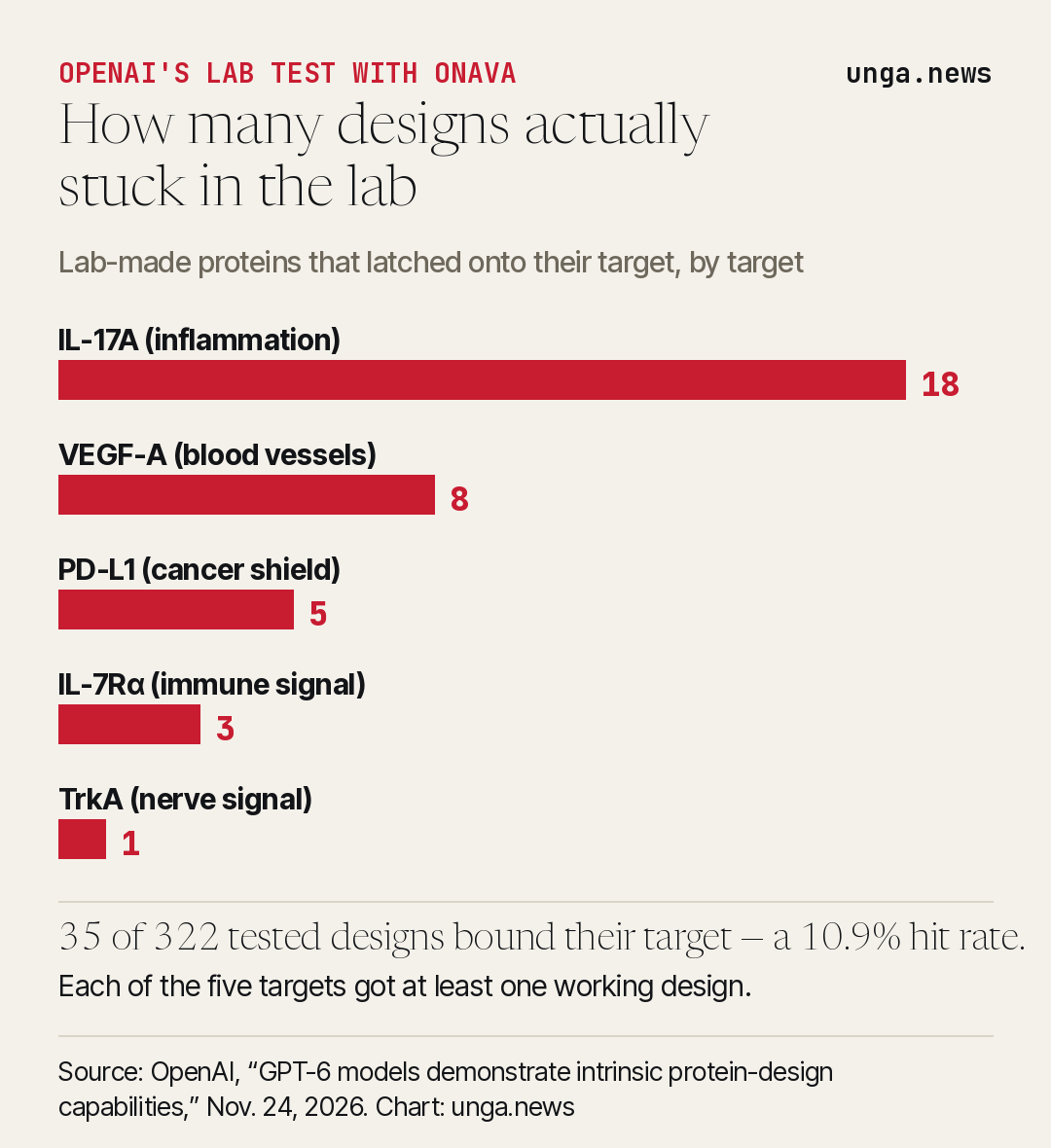
Working with a research partner called Onava, OpenAI had a pre-release version of its model, GPT‑6.2, design small proteins called minibinders — little proteins built to grab onto a chosen target. The lab then physically made those designs and tested whether they stuck. Out of 322 designs tested against five targets, 35 latched on, a 10.9% hit rate. Every one of the five targets got at least one design that worked.
A second experiment went a step further. GPT‑6.2 wrote fresh building-block sequences for shapes it had already designed, and 14 of 107 of those bound in the lab. The model also redesigned the gripping parts of existing antibodies — the Y-shaped proteins the immune system uses to tag invaders — and many of those kept working too.
None of this is a cure, and OpenAI did not pretend otherwise. A 10.9% hit rate means roughly nine out of ten designs did nothing. The company noted that an older, specialized tool called RFdiffusion posted higher hit rates in its own study, though it argued the numbers are hard to compare because they depend on how aggressively you filter designs before testing and on what you count as a “hit.” Binding to a target is also just the first step. A protein that sticks still has to actually do something useful and be safe before it is anywhere near a medicine.
The honest fine print
The more interesting part of OpenAI’s own write-up is the list of things its system still cannot do. The design pipeline leaned on specialized structure-prediction programs — tools with names like Boltz‑2 and ESMFold2 — to filter the candidates down before the lab ever saw them. In plain terms, the general-purpose model did not run the whole job start to finish by itself. It is good at the creative part, generating shapes and sequences, but it still needs the old specialist tools to check its homework.
The company also flagged what it called a “jagged” frontier: the same model that can design a working minibinder is still well behind the specialists at the harder task of predicting how a full protein folds up from its raw sequence. And it warned that some of its eye-popping benchmark scores “may partly reflect memorization” rather than true understanding — a candid admission you do not always see in a splashy product announcement.
That candor is worth crediting. Too much SI coverage swings between breathless hype and doom. Here the measured lab numbers, the limits and the open questions are all on the table, which is how this kind of science should be reported.
Why regular people should care anyway
Step back from the acronyms and the stakes are easy to see. The expensive, slow part of inventing a new drug is the hunt for a molecule that does exactly one job without wrecking everything around it. If a general-purpose system can churn out credible candidates from a plain-English description of the goal, and a lab only has to test the best of them, the whole pipeline gets faster and cheaper. OpenAI said as much on its own account: the goal is for scientists to “one day design working medicines simply by prompting.”
There is real American competition driving this. OpenAI’s work follows years of effort from Google’s DeepMind, whose AlphaFold protein-structure work won a Nobel Prize, and from a wave of U.S. biotech startups racing to turn computer models into real drugs. Keeping that frontier here, rather than ceding it to China, is the kind of race that actually matters.
For now, treat Tuesday’s news as what OpenAI called it — a proof of concept. Its models can design proteins that, more than one time in ten, grab what they were built to grab. That is not a miracle drug. It is a promising first result, reported with its limits attached, and that is exactly how it should be judged.
Sources
- OpenAI — GPT-6 models demonstrate intrinsic protein-design capabilities (Nov. 24, 2026)
- OpenAI on 𝕏 — Preprint showing wet lab validation of intrinsic protein design capabilities (Nov. 24, 2026)
- OpenAI on 𝕏 — Of 322 proteins tested, 35 showed evidence of binding (Nov. 24, 2026)
- OpenAI on 𝕏 — 14 of 107 proteins with new sequences bound; antibody redesign results (Nov. 24, 2026)