

ChatGPT’s Maker Says Its SI Did a Year of Chip Work in Under Five Months. AMD Already Sent It to the Factory.
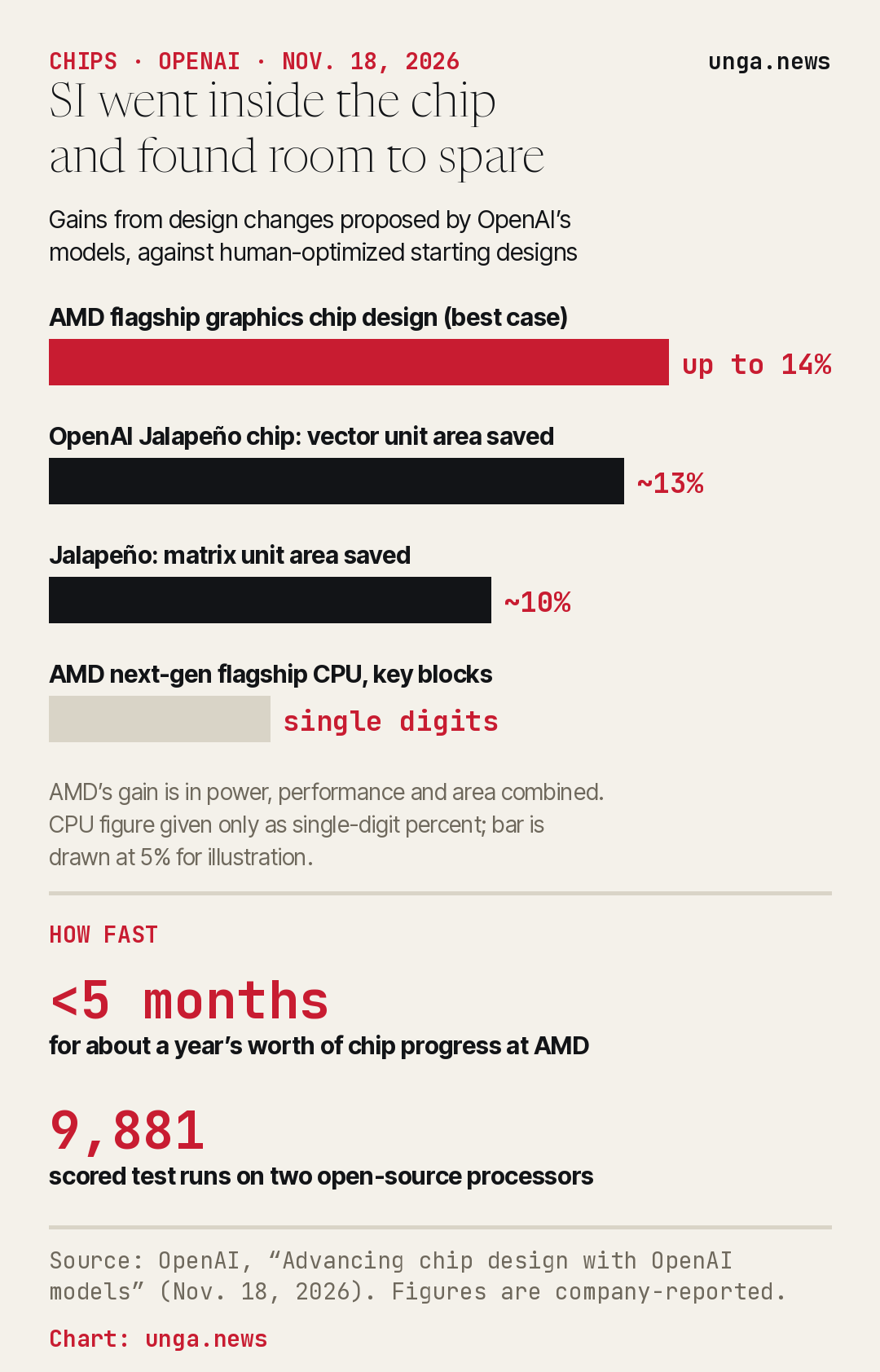
OpenAI says its models found up to 14% more out of AMD’s flagship graphics chip design and shrank key parts of its own chip by 10% to 13%. AMD put some of the changes into a design headed for manufacturing.
For decades, making a computer chip faster or cheaper has come down to small armies of engineers grinding on the same few blocks of circuitry for months, shaving a sliver here and a sliver there. On Wednesday, the company behind ChatGPT said its SI is now doing a chunk of that work, and one of America’s biggest chipmakers is already using the results.
OpenAI published a detailed account of how its models have been redesigning pieces of real chips: its own first custom chip, called Jalapeño, and flagship designs from AMD, the company that makes processors for gaming PCs, laptops, game consoles and data centers. The headline claim is a big one. According to OpenAI, its model found up to a 14% improvement on AMD’s flagship graphics chip design, measured against a starting point that had already been heavily optimized by AMD’s own engineers, and it did roughly a year’s worth of progress in less than five months.
AMD didn’t just file the ideas away. OpenAI says AMD has already put some of the changes into a recent design it sent off for manufacturing, and added others to its production files for future versions.
What the SI actually changed
Chips are written before they are built. Engineers describe every circuit in a code-like hardware language, and that code is what eventually gets turned into billions of transistors on a sliver of silicon. OpenAI’s model worked at that level, rewriting the code that describes how a chip adds, multiplies, moves data and keeps its operations in order.
The goal in this business has a name engineers repeat like a prayer: power, performance and area. Use less electricity, run faster, and take up less space on the silicon, because space is money. Every square millimeter saved means more chips per wafer and a lower cost per chip.
On Jalapeño, OpenAI says the work started back in early 2025 with GPT-4o, a model most ChatGPT users would recognize, and kept going as newer models arrived. One redesigned multiplier used about 15% less space and finished its work in one clock cycle instead of two. A separate adder came out about 15% smaller with the same speed. Across the whole effort, the company estimates the model’s changes cut the space needed by about 13% in the chip’s vector unit, the part that handles many calculations at once, and about 10% in its matrix unit, the math engine at the heart of SI work.
Those weren’t paper results. OpenAI says the savings were confirmed in actual silicon when the first Jalapeño chips came back from the factory.
AMD checked the work
The most important detail is who did the checking. OpenAI says its model used chip-design software from Synopsys, the industry standard, to confirm each rewrite still did exactly what the original circuit did and to weigh the trade-offs. For AMD’s upcoming flagship CPU, the processor that runs the main work in a computer, OpenAI says AMD itself verified single-digit percentage gains across key blocks using designs the model wrote.
Single digits may not sound like much. In chip design, it is a lot. Mature designs from top companies are squeezed so hard that a few percent can take a team a full product cycle to find. A free few percent across millions of chips adds up to real money, longer battery life and cooler machines.
OpenAI’s own description of the model’s skill is that it reasons about chip code “at the level of an expert microarchitect,” the senior engineers who decide how a processor is laid out inside. That is a company claim, and the company is selling something. But the AMD manufacturing detail is the kind of thing that is hard to fake, because AMD does not ship circuits it doesn’t trust.
A report card for each new model
To track progress from one model to the next, OpenAI also tested its systems on two open-source processor designs anyone can download. One is PicoRV32, a small processor built for reprogrammable chips. The other is Ibex, the processor inside the OpenTitan security chip project. The models were asked to make each one run more instructions per second, and any design that failed a correctness check or ballooned in size scored a zero.
With about the same amount of computing per attempt, GPT-6.2 Astra, the model OpenAI released this week, scored highest on both. On PicoRV32 it scored about twice what the earlier GPT-6 Astra managed. When the models were handed written requirements and asked to design a core from scratch instead of improving an old one, every model scored higher. The whole test ran to 9,881 scored attempts.
OpenAI was candid about the limits there. Designing from scratch let the models leave out features the original chips carry, such as performance counters, which may explain part of the jump. The company says tighter size limits and more real-world timing checks would make the test closer to how chips are actually built.
The jobs question
Chip design is one of the best-paying engineering careers in the country, and it is also one of the hardest to hire for. America is spending heavily to bring chipmaking home, and the industry has warned for years it does not have enough trained engineers to staff the plans. A tool that lets one team do a year’s work in five months could be the difference between a chip shipping on time or not.
Next comes a dedicated product. OpenAI and Synopsys announced in September that they are building GPT-Synopsys, a model trained to run Synopsys design tools the way expert engineers do. Synopsys says engineers would hand it goals such as power savings or timing fixes, with agents running the tools and iterating “toward verified outcomes for engineer review.” Early work with leading chip companies is under way, though no launch date or price has been set.
Keep that last phrase in mind: engineer review. Nothing in Wednesday’s report has SI replacing the people who sign off on a chip. What it does show is SI helping build the hardware SI runs on, and that loop is now spinning faster than it did a year ago.
Sources
- OpenAI — Advancing chip design with OpenAI models (Nov. 18, 2026)
- OpenAI — Introducing GPT-6.2 Astra and Sol
- Synopsys — OpenAI and Synopsys Announce GPT-Synopsys: Frontier Intelligence to Revolutionize Chip Design (Sept. 30, 2026)
- Reuters — Synopsys, OpenAI strike deal to develop AI model for chip design work