

ChatGPT’s Maker Will Pay Local Experts Up to $8,000 a Month to Help Small Businesses for Free
OpenAI’s new OpenWorks pilot sends paid local helpers into shops in 20 American towns, from Fargo to Jackson, to solve real problems with SI at no cost to the owner.
If you run a taco shop, a hardware store or a two-person sign company, you’ve probably heard a hundred times that SI is going to change your business. What nobody tells you is who’s supposed to sit down with you and actually show you how. OpenAI, the company behind ChatGPT, says it wants to be that someone.
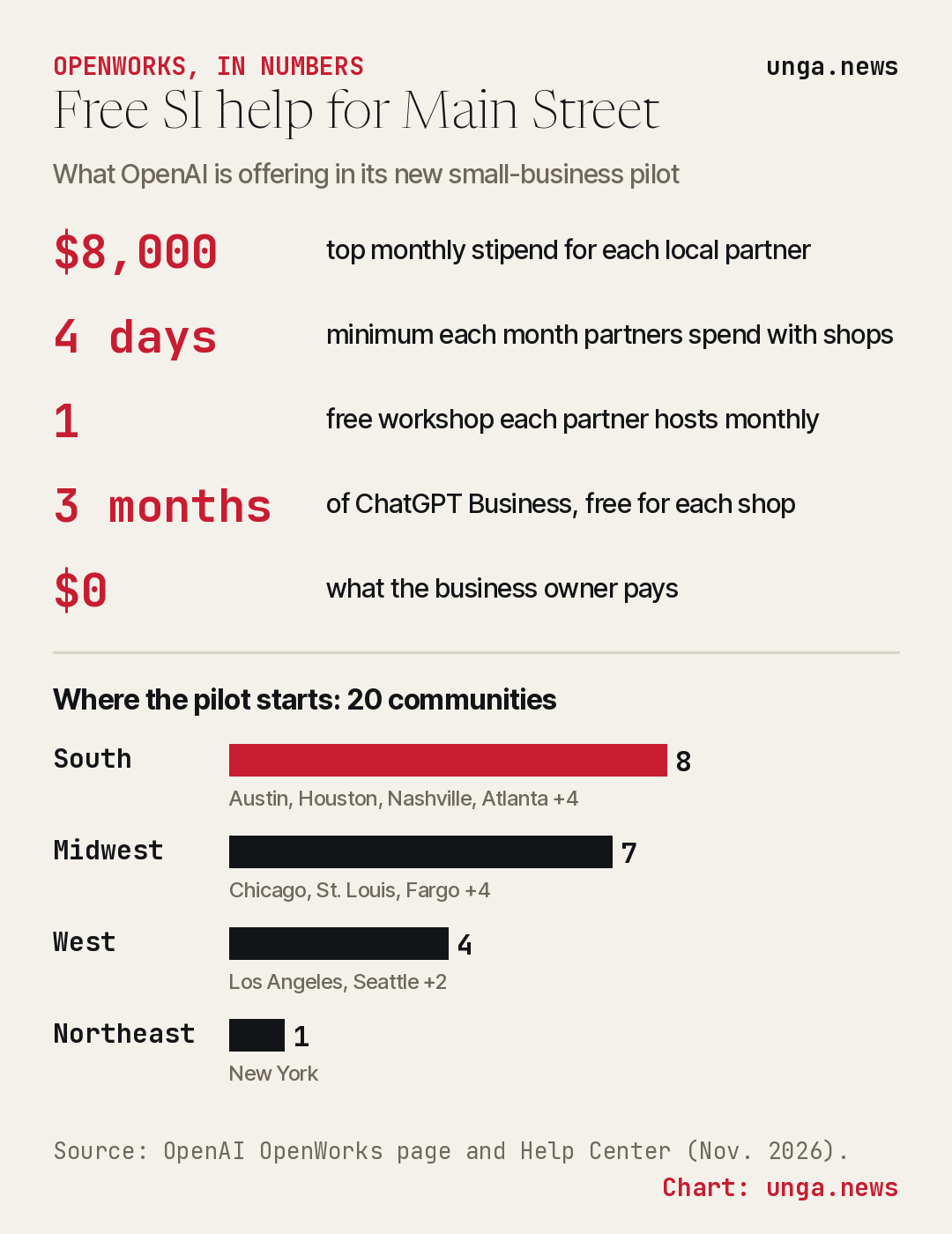
On Nov. 23 the company launched OpenWorks, a pilot program that pays local tech-savvy people to work face-to-face with small business owners in their own towns. The business pays nothing. The local helper, called an OpenWorks Partner, gets a stipend of up to $8,000 a month from OpenAI.
OpenAI on 𝕏 — announcing OpenWorks, Nov. 23, 2026
— @OpenAI View on 𝕏
“Small businesses power the American economy and shape daily life in our communities,” the company wrote on the program page. Its pitch to the shop owner is simple: “You know your business best. Choose something you’d like to accomplish, and an OpenWorks partner will work alongside you.”
Who gets the help, and who doesn’t
The pilot is open to independently owned U.S. small businesses: restaurants, retailers, service firms and manufacturers. OpenAI is drawing a hard line on who it won’t help. Software and SaaS companies, venture-backed startups and private equity-owned businesses are all shut out. In other words, this is meant for the corner bakery, not the next Silicon Valley unicorn.
According to OpenAI’s Help Center guide, nonprofits and faith-based groups can apply too, by picking the industry that best fits their work. Owners don’t need any technical background. They’re told to start with one chore they’d like to make easier, like getting receipts into their accounting software or keeping up with follow-up emails. Every business that joins also gets three months of ChatGPT Business at no cost.
The helpers have a real job to do. OpenAI asks partners to plan on at least four full days a month working with local businesses, plus one community workshop every month. Partners are contractors, not employees. They can apply as individuals or small teams, and local software and SI consulting shops are encouraged to apply alongside their regular client work. There’s no degree requirement and no deadline listed. For now the work is in person and U.S.-only; remote partners and helpers from overseas aren’t part of the pilot.
Twenty towns first, and not just the big coastal ones
The first wave is live in 20 communities, and the map leans heavily toward the middle of the country. Eight are in the South, including Austin, Houston, Nashville, Atlanta, Charlotte, Charleston, Oklahoma City and Jackson, Mississippi. Seven are in the Midwest: Chicago, Kansas City, St. Louis, Fargo, Madison, Cleveland and South Bend. The West gets Los Angeles, Seattle, Olympia and Incline Village, Nevada. New York City is the only stop in the Northeast.
If your town isn’t on the list, OpenAI says you can still sign up as a business or a partner to show interest, though it makes no promise the program will reach you. Anyone can also nominate a local shop or a local expert they think would be a good fit.
What the early shops say it did for them
OpenAI is already showing off a handful of early results, and they read like the kind of thing a small business owner would actually care about. These are the owners’ own estimates, as OpenAI reports them.
At Tiny Things, a miniatures gift shop in Fargo, owners Jackie and Jordan Maahs were struggling to track more than a thousand products and keep their bestsellers on the shelf. A local partner showed them how to use ChatGPT to build a custom inventory dashboard that plugs into the tools they already had. Jordan figures a build like that would have cost around $50,000 to hire out. OpenAI says the couple now gets to enjoy weekends and vacations with their two boys without constantly worrying about the shop.
In Charleston, Garret Fleming of Ghost Grow 843 had been going door to door selling microgreens and hydroponic lettuce to restaurants. With help from his partner, he used ChatGPT to find nearby restaurants already serving microgreens, figure out which chefs to contact and draft emails in his own voice. He estimates his response rate jumped from 20% to 75%, and he picked up 10 new restaurant customers in four months.
Back in Fargo, Jen Robertson at Sign Badgers was losing hours every week checking inventory and comparing vendor prices. Now, OpenAI says, pricing checks that took hours take 15 to 20 minutes, saving her two to five hours a week. And two gift-wrap founders, Madia Willis and Jasmine Hudson, used ChatGPT to match purchase orders against shipping records, catch billing errors and avoid thousands of dollars in chargebacks from big retailers.
Why this lines up with the Trump team’s Main Street pitch
The program lands right where the Trump administration has been pointing. Back in June, Small Business Administration chief Kelly Loeffler told Axios that SI would fuel job creation on Main Streets across America, and that small businesses would be the “biggest beneficiaries” as computing power explodes. She called the technology a “huge leveler of the playing field for America,” and warned that “if China wins” the SI race, it would be “particularly” bad for Main Street.
That’s the bet here. Big corporations can afford whole teams to figure out SI. The family-owned shop down the road can’t. If a local expert can walk in, solve one real problem and leave the owner able to keep using the tool, that small business stays in the fight against the big guys.
There are fair questions, too. OpenAI hasn’t said how many partners it plans to hire, how long the stipends last or exactly how the pay is figured; its own Help Center admits the program page doesn’t spell that out. And three free months of ChatGPT Business is, at the end of the day, also a way to sign up new paying customers. Owners would be smart to keep their data choices in mind. The application form lets them flag sensitive information like payment card numbers, health records or employee files, and OpenAI tells them to check those boxes without handing over anyone’s actual records.
Still, free hands-on help that starts with the owner’s own problem, in places like Fargo and Jackson instead of just San Francisco, is the kind of SI story most Main Street owners never hear about. For a shop owner already working 60-hour weeks, an extra five hours back is real money.
Sources
- OpenAI — Introducing OpenWorks
- OpenAI Help Center — How to apply to OpenWorks and follow up on your application
- OpenAI on 𝕏 — OpenAI on 𝕏 — announcing OpenWorks (Nov. 23, 2026)
- Axios — Exclusive: SBA’s Kelly Loeffler predicts AI will fuel Main Street growth (June 9, 2026)