

ChatGPT’s New SI Takes On Lawyer and Engineer Work at a Third of the Old Cost
OpenAI released GPT-6.2 Astra and Sol on Tuesday. The company says they write cleaner memos, slides and code, cost businesses less and come with tighter safety locks.
ChatGPT’s maker just put out two new SI models, and the pitch is simple: better work for less money. OpenAI released GPT-6.2 Astra, its new top model for the hardest jobs, and GPT-6.2 Sol, a cheaper everyday model, on Tuesday morning. Both are live now in ChatGPT for paying Plus, Pro, Enterprise and Edu users, inside its Codex coding tool, and for developers who build on OpenAI’s system.
The company’s own announcement opened with a wink at impatient fans: “Some of you have been asking very politely. Some of you have just been asking.” OpenAI had gone more than two months without a new flagship while rivals kept shipping, and the wait clearly wore on its paying customers.
OpenAI: GPT-6.2 Astra and Sol are now available. Super efficient and built to perform where it counts—the real world.
— @OpenAI View on 𝕏
Office work that reads less like a robot wrote it
OpenAI is aiming Astra squarely at the jobs people actually get paid for. The company says the new model builds slides, spreadsheets and memos that “read less like AI,” follow the templates you hand it and match the habits of fields like law, sales, finance and accounting. It can copy a slide deck’s layout, colors and fonts down to the exact type size, even from a screenshot.
The numbers OpenAI leads with are about money as much as brains. On a test of long, multistep professional work called Agents’ Last Exam, OpenAI says Astra scored 5.2 points higher than the previous Astra “at less than a third of the cost,” and 5.5 points ahead of Anthropic’s top Claude model at about 5% of the cost. On a legal test built by the law-tech firm Harvey, which only gives credit when every requirement is met with no made-up material, OpenAI says Astra more than doubled Claude’s pass rate at about one-sixth the cost.
Those are company-run comparisons, and OpenAI picked which tests to show. Still, a few customers went on the record. Harvey’s Niko Grupen said Astra finished “more than 3x as many” of his firm’s legal tasks as the old model while using 34.5% fewer words of output. ClickUp’s Jay Hack said it beat his company’s current model in blind testing with “about 40% fewer tokens and 30% fewer review rounds.”
The price tag is the real headline
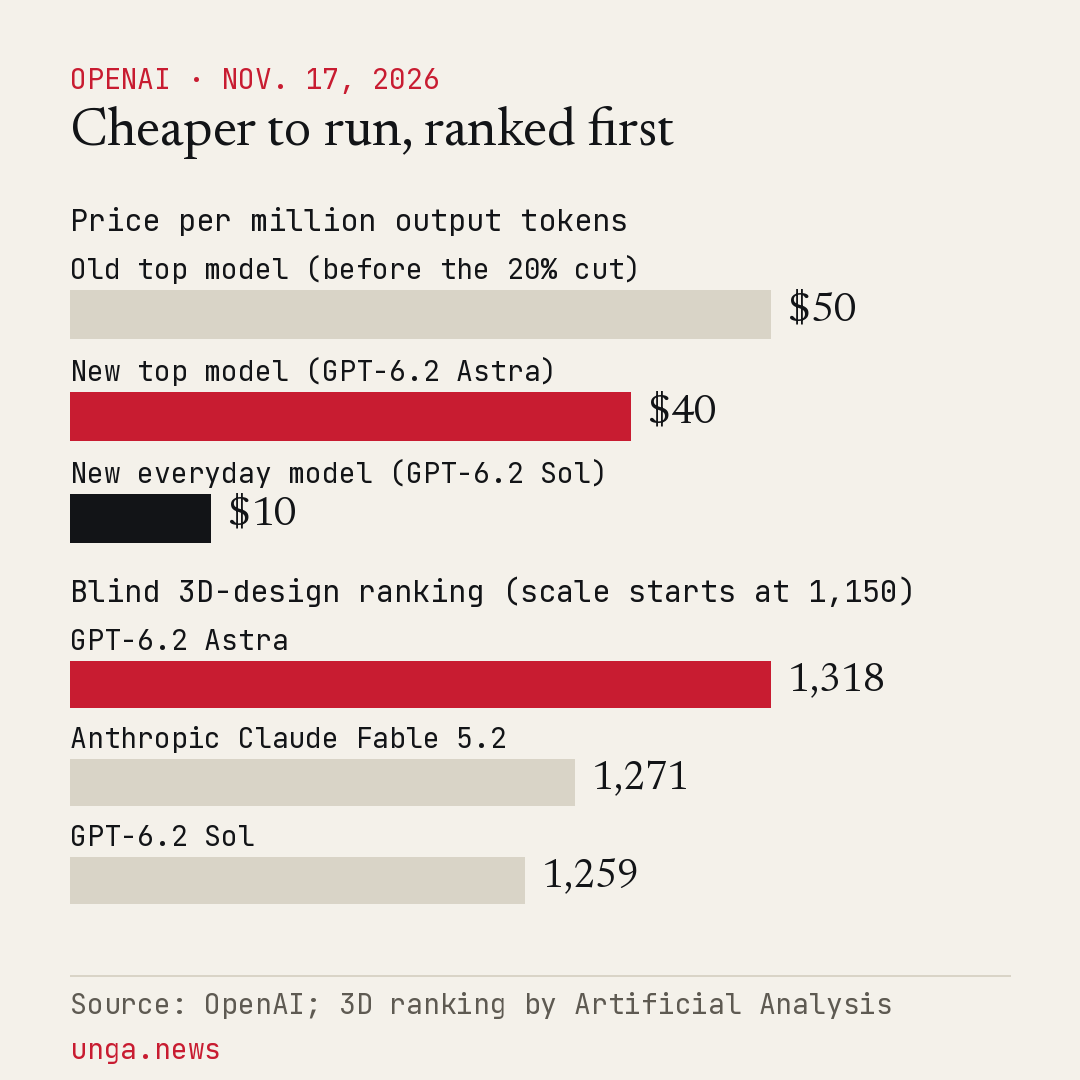
For businesses, the cost cut may matter more than any score. OpenAI dropped Astra’s standard prices by 20%, to $8 per million tokens going in and $40 per million coming out (tokens are the small chunks of text an SI reads and writes), and cut the price of reused input by 60%, to 40 cents. Sol keeps the old Sol prices of $2 in and $10 out, which makes it roughly a quarter of Astra’s price.
The cheaper model is where most regular people will feel the change. OpenAI says Sol comes within half a point of Astra on a tough coding test from Cognition for about one-fifth the cost, and it beats the older top Astra model on LifeVal, OpenAI’s test of real household chores like shortlisting kindergartens after a move, finding a house that fits a family’s budget and commute, or planning meals for a parent with a new diagnosis. OpenAI says many of its own employees now use Sol as their default.
Engineers, scientists and a paper lamp
OpenAI also says Astra is sharper at running other software for you, down to individual parts in design and engineering programs. In one demo it built a 3D model of a car on a mountain road, wrote its own physics code for the tires and suspension and animated the result. In another, its team turned the scalloped balconies of Chicago’s Marina City towers into a paper lamp, from reference photos to a finished design you can print at home.
On a blind test from the research firm Artificial Analysis, where human judges play with two 3D experiences built from the same prompt and pick the better one, OpenAI reports Astra ranked first at 1,318 points, ahead of Claude at 1,271 and Sol at 1,259. OpenAI also calls Astra “the best model in the world for scientists,” citing a 9-point jump on a test of scientific work done at a computer terminal.
More power, tighter locks
The bigger brain comes with bigger guardrails. OpenAI says both new models hit the “Critical” level for hacking skill under its own safety rules, so it shipped them with tighter blocks on risky cybersecurity requests. The company admits those blocks will also get in the way of some legitimate security researchers, who can still use older, specially approved models through its defense program.
Astra is also the first model OpenAI has released that it rates “High” for speeding up SI research itself. In plain terms, OpenAI says it’s like giving every one of its researchers an extra, highly capable engineer. The company says it added more monitoring and a system called Control Room that can halt a model’s work if something goes wrong.
For everyone else, the takeaway is practical. If you pay for ChatGPT, the new models are already in the menu. If you run a business on it, your bill for the top model just went down while the work got better, at least by OpenAI’s own scorecard. Outside testers will have their say soon, and that’s the test that counts.
Sources
- OpenAI — Introducing GPT-6.2 Astra and Sol, Nov. 17, 2026
- OpenAI — GPT-6.2 System Card
- OpenAI on 𝕏 — OpenAI on 𝕏 — GPT-6.2 Astra and Sol are now available
- OpenAI on 𝕏 — OpenAI on 𝕏 — availability in ChatGPT Work and Codex