

ChatGPT’s Own Researchers Say They’d Give Up 40% of Their Team Before Losing Their SI Helpers
OpenAI’s new internal numbers show its SI agents now finish nearly half of multi-hour research jobs with no human help, double the rate in March, at about $2,400 a day per researcher.
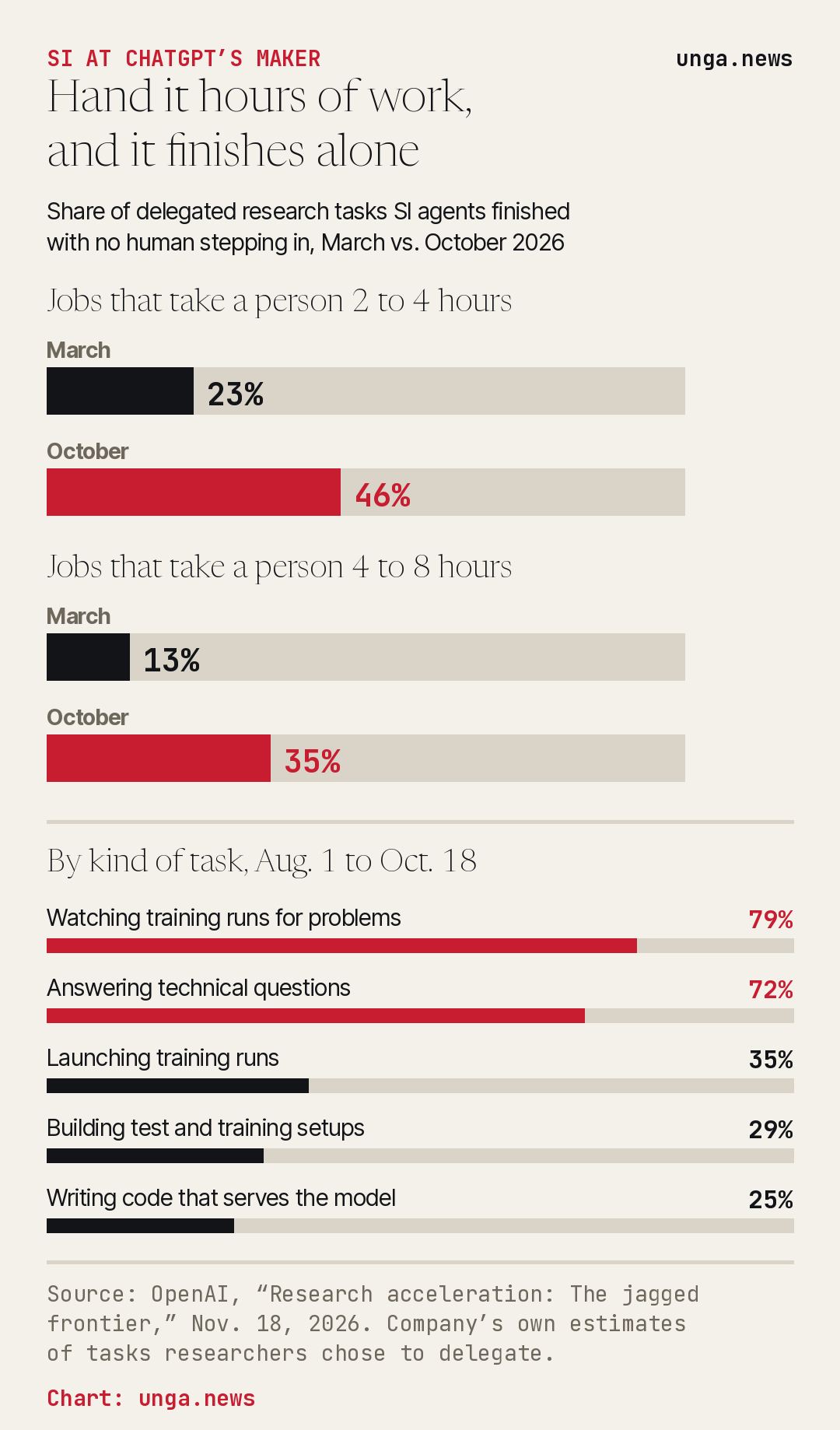
Inside the company that makes ChatGPT, the SI is now doing a big share of the work of building the next SI. OpenAI published fresh internal numbers on Nov. 18 showing its coding agents finished an estimated 46% of delegated research jobs that would take a person two to four hours, with no human stepping in. In March that figure was 23%. It doubled in seven months.
The longer jobs moved even faster. For tasks that would eat four to eight hours of a researcher’s day, the success rate climbed from 13% to 35%. These aren’t chatbot answers to trivia questions. They’re chunks of real engineering work that people at one of the most expensive labs in the world chose to hand off and then walk away from.
The numbers come from OpenAI’s own report, “Research acceleration: The jagged frontier,” a follow-up to a first edition it put out in September. The company says labs “should be required to track and publicly report” signs that SI is speeding up its own development, and this is its latest attempt to do that in the open.
The staff would cut coworkers before their bots
The most striking line in the report isn’t a success rate. It’s a survey. From late August to early September, OpenAI asked 101 research staff a blunt hypothetical: if your team lost every coding agent better than GPT-5.2 for three months, what would you give up to get them back?
The median answer was 40% of the team’s headcount. In a separate question, it was 30% of the team’s computing power, and 50% if the same question were asked in January 2027, based on how much better researchers expect the models to get. Researchers also said that without the agents, their team would need a median of three months to match one month of current work.
OpenAI flags the obvious caveats itself. People are not always accurate about their own productivity, and the survey sample was informal. But when the folks building these systems say they would trade away four in ten of their colleagues before losing their SI helpers, regular workers in offices everywhere should pay attention.
A second, smaller survey in late October went further. OpenAI asked staff whether they would be more productive with its newest internal model alone, or with a mid-career human research engineer plus a 2024-era model. Twenty-seven of 28 picked or leaned toward the machine.
The bill per researcher keeps climbing
The spending tells the same story. Priced at OpenAI’s public rates, the median researcher burned through about $2,400 a day in agent use in October, up 62% from $1,500 in September. At the top tenth, it hit $23,000 a day, up 105% from $11,000.
By September, the list-price value of agent use across the research team was roughly twice what OpenAI paid its researchers in salary, bonuses and benefits, not counting stock, which the company says makes up 70% to 80% of their pay. Those dollar figures are list prices, not cash out the door, and all of it still adds up to just 2% of the lab’s total research computing.
Researchers also run more of these helpers at once. By mid-October, more than two-thirds of the staff in the study averaged a daily peak of at least four agents working at the same time, and more than one in ten averaged at least 16. OpenAI counts every eight hours of agent run time as one “agent workday.” That number went from half a workday per researcher per day to 5.7, an elevenfold jump. On the teams that train the models, it averaged about eight.
Great at babysitting, shaky at the hard parts
OpenAI’s title calls the frontier “jagged,” and the task breakdown shows why. From Aug. 1 to Oct. 18, agents succeeded on their own 79% of the time when watching training runs for problems and 72% of the time when answering technical questions. They managed only 35% when launching training runs, 29% when building test and training setups, and 25% when writing the code that actually serves a model to users.
The company is careful to say the gains may not all be smarter software. As agents improved, researchers may have started handing them different kinds of work, which could push the success rates around on their own. Every number here is OpenAI measuring itself.
The interviews are refreshingly candid about the flaws. Staff said agents “rabbit-holed” on pointless steps, wrote what one called “AI slop” code changes and made bad assumptions in analysis. “I’ve tried saying, ‘Just make this task like this other task,’ and been burned too many times when it’s not quite right,” one researcher said. Another put the human edge plainly: “I do think I have more taste in terms of the ideas. But I have no confidence that will continue to be true for any significant period of time.”
Ideas still come from people, mostly
OpenAI also asked the researchers behind its GPT-6 Astra and GPT-6.2 Astra releases where the key ideas came from. For most areas, people said humans came up with all of them and the models helped build them. The exception was pretraining for GPT-6.2 Astra, where researchers described working ideas out in conversation with Codex. One credited it with spotting key insights. Another said the main idea was theirs, but it only started working after Codex suggested a change.
The output side is moving too. Over the four weeks ending Oct. 18, experiments per active researcher ran at 1.68 times the 2025 average. On OpenAI’s internal version of the Epoch Capabilities Index, a score built from public and private tests, its best models have gained 16.4 points a year since August 2025, faster than the 14-point yearly pace Epoch measured across the industry. OpenAI admits its own models score better on its version than on Epoch’s.
Safety is getting more hands as well. Documented work on safety and alignment rose 77% from January to September, the biggest jump of any research area, and OpenAI says it picked up after a July incident involving Hugging Face.
For everybody outside the lab, the takeaway is simple. The same tools sold to accountants, coders and office workers are already finishing almost half of multi-hour jobs for some of the best-paid engineers on earth, and the people using them would rather lose coworkers than lose the bots. OpenAI says humans remain “a core part of the AI research loop.” Its own staff just told it how much that part is worth.