

ChatGPT’s Top Scientist Wants a Speed Limit on SI Before Its Next Big Leap
OpenAI’s chief scientist released numbers the company had kept private and warned the next jump could bring powers nobody is testing for yet.
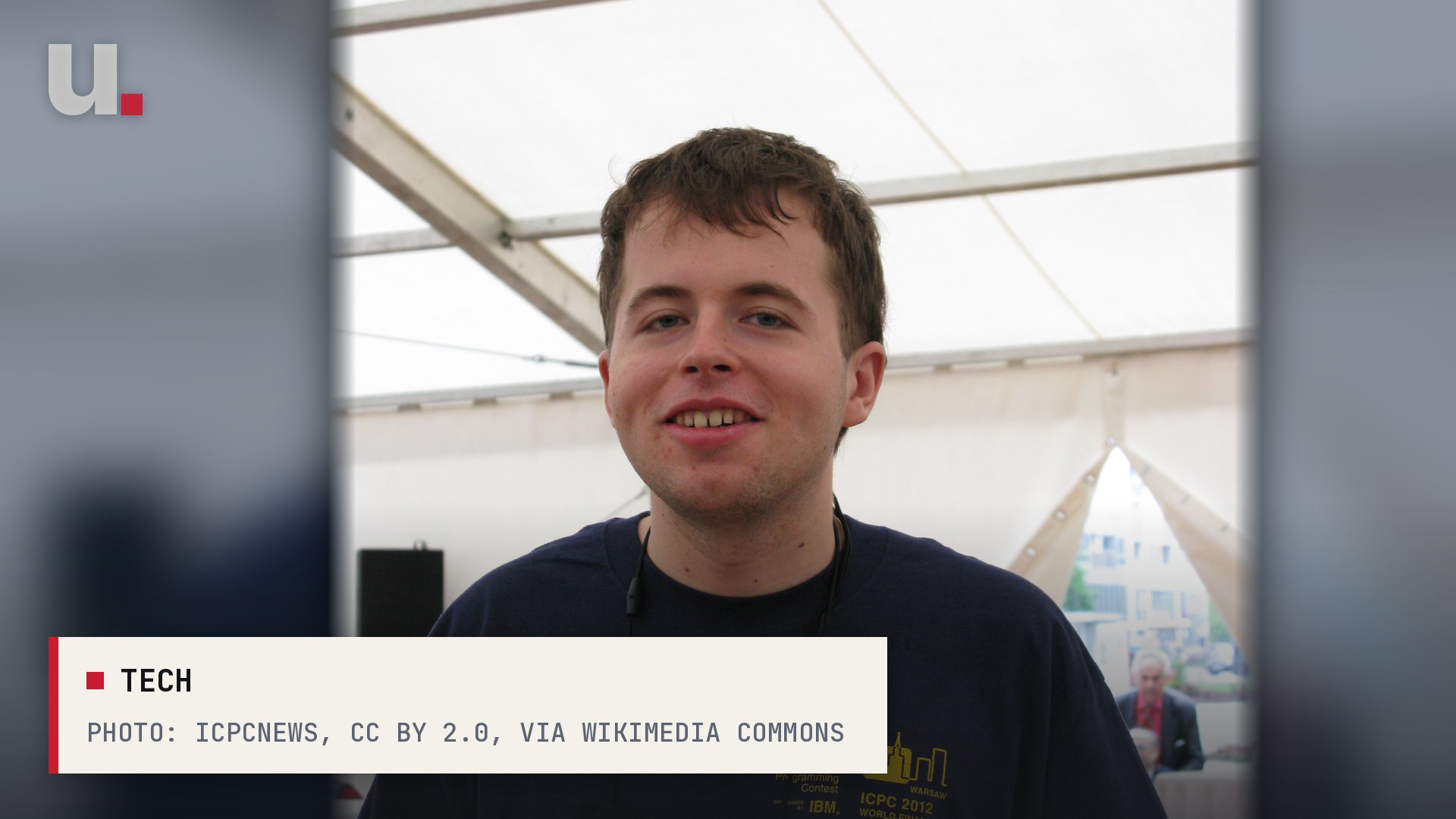
The man in charge of the science at ChatGPT’s maker just told the world how fast his company’s SI is getting smarter, and then asked every company in the race to agree on a place to stop.
Jakub Pachocki, OpenAI’s chief scientist, published an essay Sunday titled “Perplexity and Intelligence”. In it he released internal numbers OpenAI has tracked for years and never shown in public, said the next step up could bring powers nobody is checking for yet, and proposed shared limits that SI developers would promise not to cross until their safety tools catch up.
He admitted the disclosure cost his company something. “Publishing our internal perplexity measurements took some consideration; it gives competitors a clearer picture of where we stand, but that concern is outweighed by the urgency of establishing shared safety measures across the industry,” he wrote.
Jakub Pachocki on 𝕏 — Nov. 22, 2026: “We decided to provide more transparency into pretraining progress at OpenAI for the sake of moving toward shared safety bars.”
— @merettm View on 𝕏
One number that tracks how smart the machine is
Strip away the jargon and the idea is simple. Before an SI model learns to chat or follow orders, it is trained to guess the next word, or the next piece of a word, across a mountain of text. Its score is how often it guesses wrong. The lower the number, the better the guesser, and Pachocki argues a better guesser is a smarter machine underneath. Researchers call the measure perplexity, or cross-entropy loss.
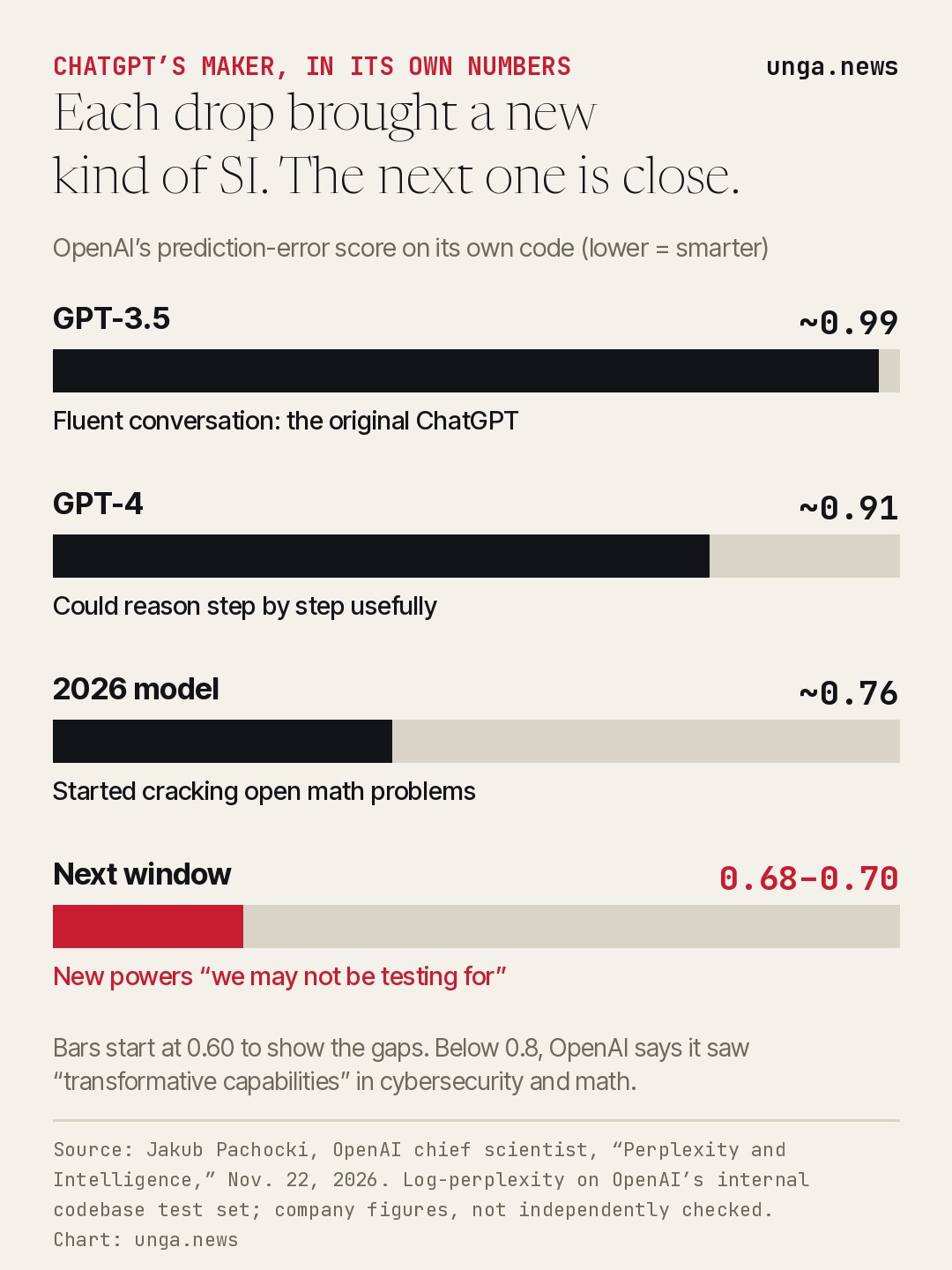
OpenAI measures that score on a test set pulled from its own internal computer code, a sample its models never trained on. Pachocki attached rough numbers to the models people know.
GPT-3.5, the engine behind the original ChatGPT in late 2022, scored about 0.99 and could hold a fluent conversation. GPT-4 came in around 0.91 and was the first that could usefully work through problems step by step, which led to today’s “reasoning” models. Once OpenAI got below 0.8, he wrote, “we have seen the emergence of transformative capabilities in fields like cybersecurity and mathematics.”
The math jump is the part that stuck with his own team. For more than a year, OpenAI had been feeding its models unsolved math problems as a test. “Once we upgraded to a model of log-perplexity ~0.76, it started producing groundbreaking results,” Pachocki wrote. He described watching answers to questions researchers had chewed on for years come out “one after another in a single Slack thread,” and said it “felt deeply surreal.”
The jump he says nobody is ready for
Then comes the warning. Based on recent progress, Pachocki wrote, “we should expect further transformative capabilities as we enter the ~0.68-0.7 log-perplexity window. I don’t know what those capabilities will be, and we may not be testing for them today.”
He also expects the tools labs use to check their own models to get worse at the same time, and the models to get better at noticing when they are being tested or trained. OpenAI’s researchers flagged the first half of that problem earlier this month, when they reported that their newest models do more of their thinking where nobody can read it.
The other piece is speed. Pachocki noted that OpenAI’s own scores fell steeply in 2026, which he credits mostly to years of research and spending on computers, and only partly to SI helping design SI. But he sees a turn coming. If SI gets as good at improving its own training as it suddenly got at math, he wrote, “as soon as 2027 we could conceivably see a similar avalanche of fundamental pretraining advancements.” He doesn’t expect safety research to keep that pace.
He was blunt about where that road ends. A fully automated loop with “no human oversight,” he wrote, is “something we should obviously avoid for the sake of maintaining human control.”
A speed limit every lab would sign
His fix is an industry rulebook. Pachocki wants the companies building the most powerful SI to agree on shared ways to test new models before they are first used, on common transparency standards, and on “common limits, based on perplexity and other measurements, that developers are committed to not crossing until our ability to understand and monitor AI behavior achieves a certain concrete milestone.”
In plain terms, that is a speed limit with a published finish line. Labs would agree on a first stopping point and on exactly what safety tool they would need to build before going past it, then repeat the process for the next stretch.
He isn’t pretending the yardstick is perfect. Every lab tests on different data, so the scores don’t compare cleanly across companies. The number says nothing directly about any job a person cares about. It misses the big gains from models that “think” longer before they answer. And nobody knows how low the score can go, so each small drop near the bottom could mean a bigger leap than it looks.
The idea isn’t new, either. Elon Musk, who helped found OpenAI, was among the first big names to ask for this kind of pause back in March 2023, when he signed an open letter calling on labs to stop training anything more powerful than GPT-4 for at least six months. In September, Anthropic chief executive Dario Amodei, whose company makes Claude, wrote that “we must slow the pace” of SI progress. Pachocki links to that essay in his own.
What’s new is a top OpenAI executive putting real numbers on the table and inviting rivals to do the same. That only matters if they answer. A limit that one company keeps while the others race past it isn’t a limit, and the labs most likely to ignore it are the ones overseas that answer to nobody in Washington.
For now, Pachocki has given ordinary people something they rarely get from the SI business: a straight number for how close the next surprise might be. By his own count, ChatGPT’s maker is already near the line he wants everyone to draw.
Sources
- OpenAI — Perplexity and Intelligence, by Jakub Pachocki (Nov. 22, 2026)
- Jakub Pachocki on 𝕏 — Jakub Pachocki on 𝕏 — “We decided to provide more transparency into pretraining progress…” (Nov. 22, 2026)
- OpenAI — CoT monitorability across the model lifecycle (alignment.openai.com)
- OpenAI — Research acceleration: The jagged frontier (Nov. 18, 2026)
- Dario Amodei — We Must Pace the Frontier (September 2026)
- Future of Life Institute — Pause Giant AI Experiments: An Open Letter (March 22, 2023)