

China Can’t Buy Nvidia’s Top Chips, So It Rents Them Overseas. Nvidia Just Capped That.
Nvidia has quietly told cloud companies worldwide that at least 51% of their business must go to non-Chinese customers. A banned rack of its chips reportedly sold in China last month for $2.8 million.

Washington banned the sale of America’s best SI chips to China years ago. So Chinese tech giants did the next best thing. They rented them.
Data centers in places like Singapore and Thailand are full of Nvidia’s top-end chips, and Chinese companies have been some of their biggest customers. You can’t ship a banned chip to Beijing, but nothing stops a Chinese company from logging into a computer in Southeast Asia and running its work there. Now Nvidia itself is squeezing that door. According to the Financial Times, as reported by Tom’s Hardware, Nvidia has told cloud companies around the world that at least 51% of their services must go to customers who aren’t Chinese.
That’s a big deal, and here’s why. The rule doesn’t come from Congress or the Commerce Department. It comes from the company that makes the chips. And it hits Chinese labs right where they’ve been getting around the rules.
A rule passed along by word of mouth
There’s no press release on this one. The FT reported that the instruction went out verbally, through Nvidia’s sales and regional teams, over recent months. It applies everywhere, not just in Asia. TechRadar reported that two sources confirmed it covers Nvidia customers worldwide.
Deals already signed are left alone. Leases already running keep running. But any new contract has to meet the 51% line. Nvidia hasn’t confirmed the rule, and it hasn’t denied it either.
For the data centers, that’s a real headache. If a big share of your business has been Chinese tech firms, you now have to go find enough other customers to keep Nvidia happy. One Singapore-based group told the FT it’s “difficult to find enough non-Chinese clients outside the US.” Data centers that can’t fill the gap may have to pull back on what they offer.
The $2.8 million rack
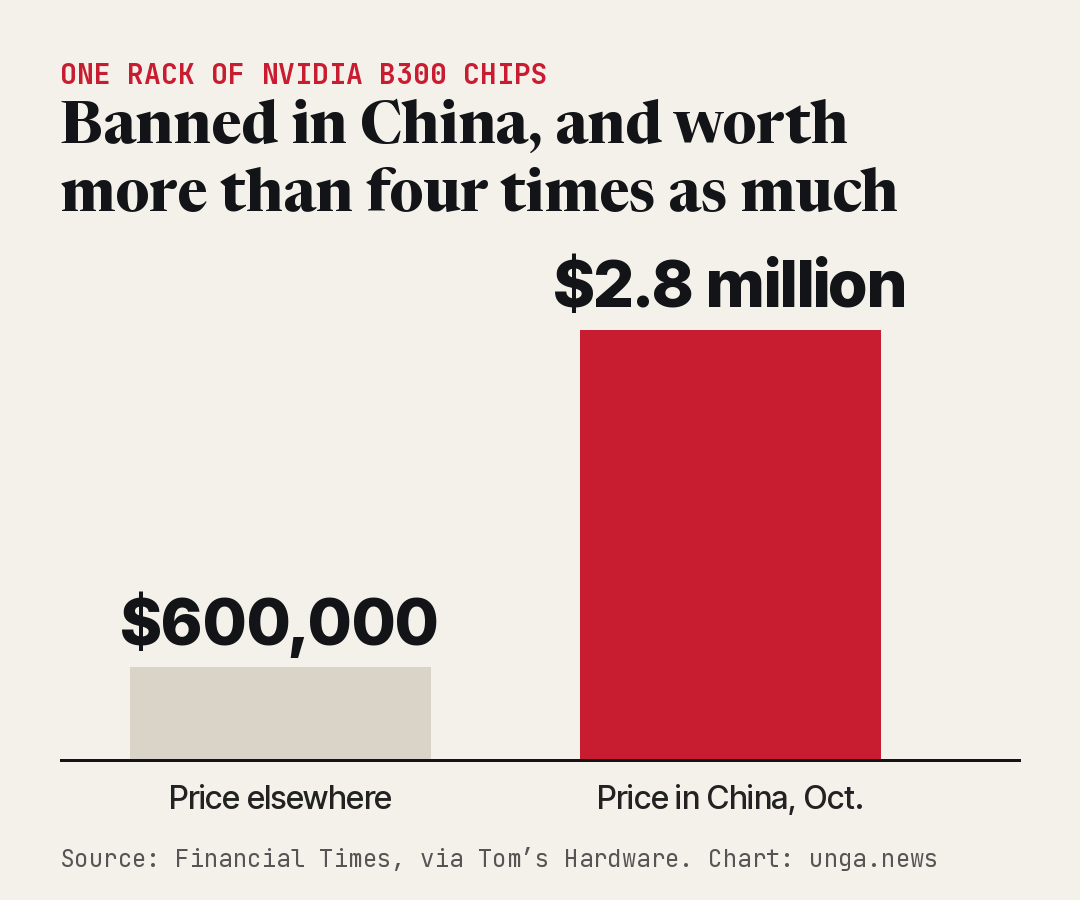
If you want to know how badly China wants these chips, look at the price tag. A rack of Nvidia’s B300 chips, the kind American companies use to build and run their SI, goes for about $600,000 outside China, the FT reported. Last month, one reportedly sold inside China for about $2.8 million. That’s more than four times the going rate, for a product that isn’t supposed to be sold there at all.
The B300 is banned from direct sale to China under U.S. export rules, TokenPost noted, which is exactly why the rental route took off. Tom’s Hardware reported that most of the overseas data centers serving Chinese firms run restricted chips like the B300.
The deals involved are not small. Tencent has an agreement with Oracle to lease 100,000 chips in Southeast Asian data centers, according to the reporting, and ByteDance and Alibaba, the company behind TikTok and China’s Amazon-style giant, are chasing similar long-term leases. A Chinese SI startup called Moonshot has held talks with European cloud companies about renting clusters of 8,000 or more of Nvidia’s newest chips, one source said. That came after the White House said Moonshot had gotten access to those chips through a facility in Thailand.
Renters with Chinese ties are already paying more for the privilege. One source told CNBC that Moonshot was asked to pay 30% to 50% more upfront than a non-Chinese customer would. The cloud companies and the people who finance them are pricing in the chance that Washington eventually shuts the rental door entirely.
The cheaper chip China can buy, and can’t get enough of
China does have a legal option. Nvidia makes a toned-down chip, the RTX Pro 5500, that meets U.S. export rules. Chinese customers have ordered more than 6 million of them, according to the reporting. Nvidia may only be able to make about 3 million next year.
More than 3 million of those orders came from ByteDance, Alibaba and Tencent alone, at about $11,400 apiece, a sticker price north of $35 billion. Tom’s Hardware reported that buyers might only end up with 5% to 10% of what they asked for. Samples are due in December, with deliveries starting early next year.
And it’s not the same chip. The banned B300 has about 3.4 times the memory and 5.7 times the speed at moving data, plus a fast link that lets many chips work together like one big machine. The legal version doesn’t have that link. Meanwhile, Chinese companies have bought more than 1 million of Nvidia’s gaming and workstation cards this year just to cover the shortfall.
Why Nvidia would police its own customers
Nvidia has been under fire from lawmakers who think too much American computing power is leaking to China through the back door. This year the company more than halved the number of Asian buyers it allows to purchase its SI chips, Tom’s Hardware reported. It now requires tracking software for Southeast Asian cloud companies that want official partner status. Put the buyer list, the 51% line and the tracking together, and it looks a lot like Nvidia getting ahead of Washington before Washington gets ahead of Nvidia.
There’s a reason the company might want to move first. Right now, U.S. law doesn’t give regulators broad power over remote access to chips sitting in another country. A bill called the Remote Access Security Act would extend export controls to cover exactly that kind of rental. It has passed the House. It hasn’t passed the Senate.
So for now, the toughest limit on China renting America’s best SI chips isn’t a law. It’s a verbal instruction from a sales team. That may say less about Nvidia’s heart than about how much pressure it’s under. Either way, Chinese labs just lost some of their easiest access to the chips Washington never wanted them to have, and the $2.8 million price tag says they feel it.
Sources
- Tom’s Hardware — Nvidia cracks down on overseas cloud AI GPU rentals for China
- TechRadar — Nvidia hits global cloud providers with strict new China rule
- TokenPost — Nvidia B300 Rack Sold for $2.8 Million in China in October