

China Races to Own the Next Phone Network. Trump’s Law Puts America’s Answer Up for Bid
Beijing just made eight regions official test zones for 6G, the wireless service after 5G, and quietly ordered them to vet everything they say about it. The same day, the FCC set April 27 for the airwaves auction Trump’s 2025 law made possible.
China’s communist government doesn’t leave the next generation of phone service to chance. On Tuesday, at a 6G conference in Shanghai, Beijing’s top tech ministry formally launched a joint push with eight provinces and big cities to build the wireless network that comes after 5G. Beijing, Shanghai, Hebei, Jiangsu, Zhejiang, Anhui, Hubei and Guangdong, home to many of China’s biggest tech makers, are now official 6G test zones for the next three years.
The approval itself went out a week earlier. In a letter dated Nov. 17, the Ministry of Industry and Information Technology signed off on each region’s plan and told them to focus on new devices, key chips and parts, operating systems and satellite internet. The goal, in the ministry’s own words, is a national 6G effort run like “one chessboard,” with every piece moved from the center.
That phrase tells you how China plays this game. In America, phone companies bid for airwaves, build towers and fight for customers. In China, the state picks the regions, the companies and the timeline, and then pours in money and land to hit it.
The letter also told them to watch their mouths
A line buried in the same Nov. 17 letter is worth reading twice. Point five orders the pilot regions to keep their 6G publicity in line. They must “distinguish between inside and outside” and apply “strict review” to anything they put out about their 6G work, research progress or meetings, and they have to clear any news touching national-level 6G plans with the ministry first.
Translated from bureaucrat: tell the world only what Beijing wants it to hear. That matters for anyone in Washington trying to judge how far along China really is. When a government is ordering its own provinces to vet every press release, the cheerful numbers that do come out should be read as the ones it wants you to see.
The letter also says no company in the program may sell 6G service to the public until it has a license, and every radio and transmitter has to be approved by the state. Nothing here moves without the party’s say-so.
A head start built on millions of towers
Even with the spin, the 5G record shows why China takes this seriously. The ministry’s own count says China had about 718,000 5G base stations at the end of 2020. By the end of September this year it had 5.25 million, about 40% of all its cell sites, after adding 416,000 more in nine months.
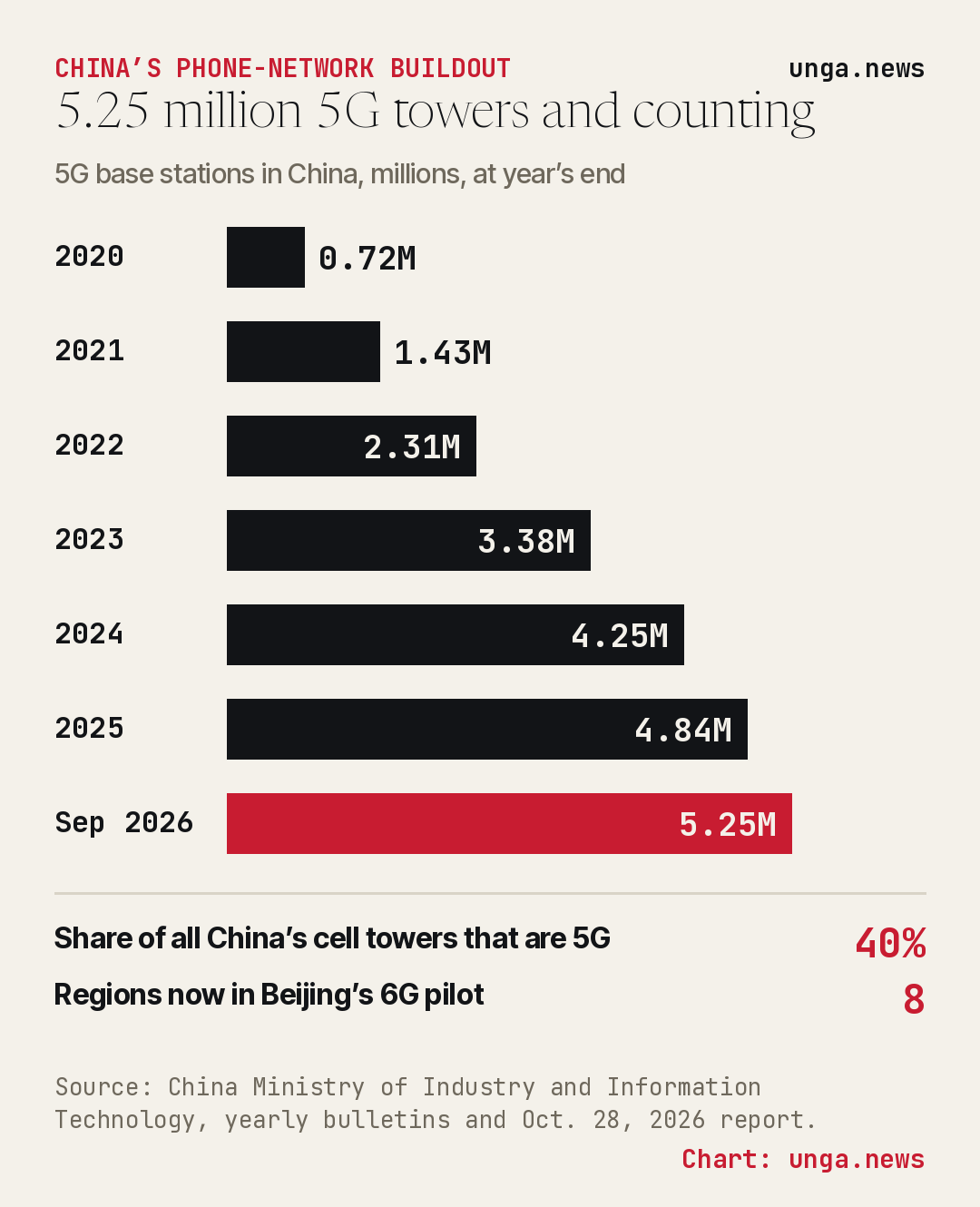
Those numbers come straight from Beijing, so take them with the same grain of salt as everything else it publishes. But nobody disputes that China built out 5G faster than anyone. It also counted 1.32 billion 5G phone accounts at the end of September, according to the same October report.
The ministry first called for the pilot back in a June 3 notice that set a 2029 target to have its own “independent” 6G technology, new kinds of devices and early business uses ready for launch. To qualify, a region needed at least one leading company in the field and three or more outfits already working on national 6G projects. The notice credits China’s “new whole-nation system,” the party’s term for throwing the full weight of the state behind a single technology goal.
At Tuesday’s launch, ministry chief engineer Zhong Zhihong said 6G is now at a critical stage of technical breakthroughs and standard-setting, Xinhua reported. That’s the real fight. Whoever writes the global rules for 6G gets to sell the gear, collect the patent fees and, in China’s case, plant its equipment in other countries’ networks. Americans already learned that lesson with Huawei.
America’s answer goes up for bid in April
Here’s the good news for our side. On Wednesday, the Federal Communications Commission published the rules for Auction 115, the sale of 3,248 new licenses in a prime slice of airwaves called the upper C-band. Bidding starts April 27, 2027.
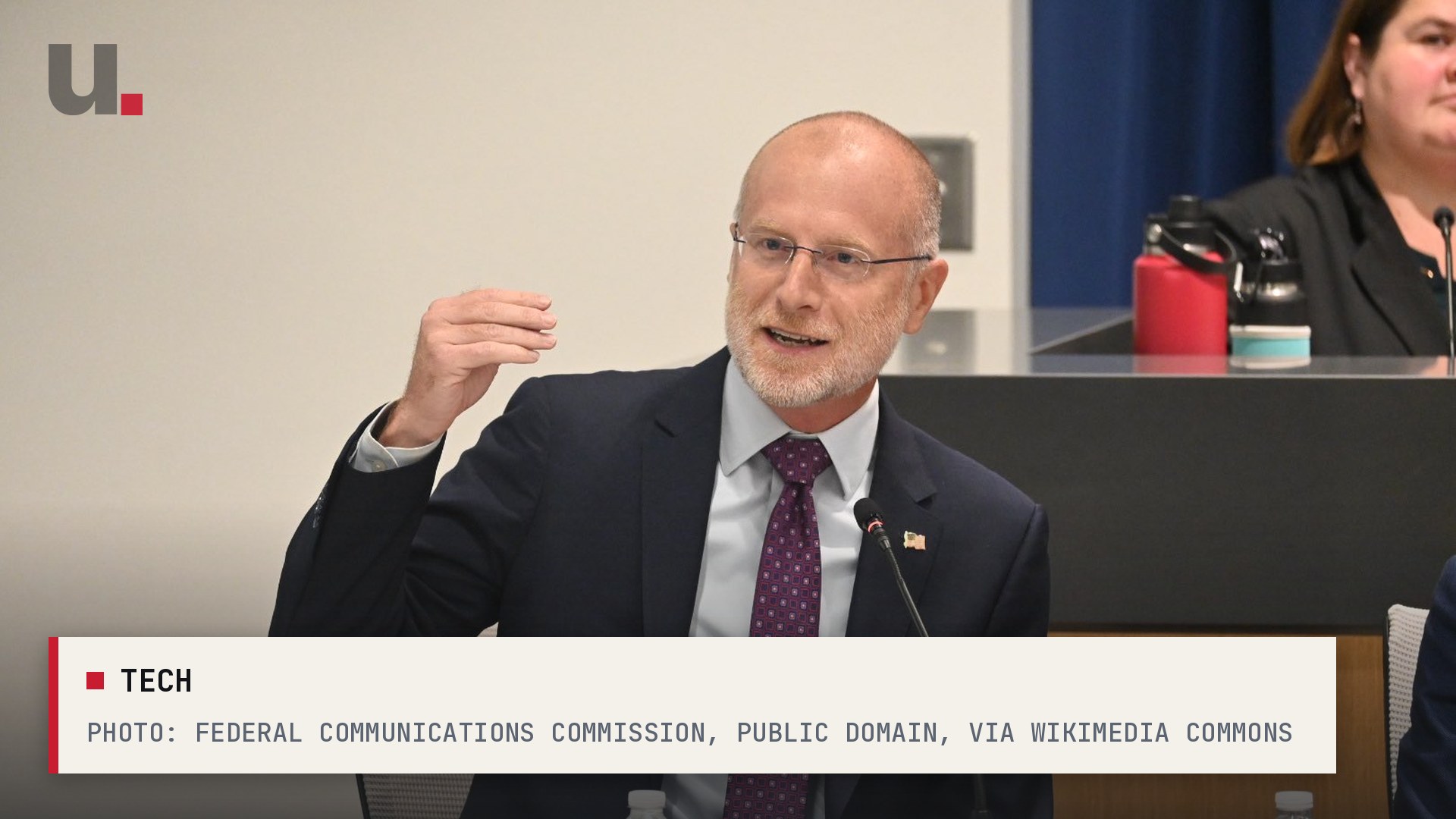
That auction exists because of President Trump. The One Big Beautiful Bill he signed on July 4, 2025, restored the FCC’s power to auction airwaves, which Congress had let lapse in 2023. It also ordered the agency to sell at least 100 megahertz of the upper C-band within two years. Chairman Brendan Carr’s FCC went further and put 160 megahertz on the block, carved into eight equal pieces in every market across the lower 48 states.
Applications are due Jan. 20, and upfront payments by March 18. The last time the FCC sold the lower half of this same band, in 2021, bidders put up more than $81 billion, the richest auction in the agency’s history. That band now carries a big share of the 5G service on American phones.
China’s state plan and America’s auction are two very different bets. Beijing is betting that a ministry can pick winners province by province. Washington, under Trump, is betting that if you hand private companies more airwaves and get out of the way, they’ll build faster than any central planner. Our wireless carriers did exactly that with the last batch of C-band spectrum.
The danger is complacency. China doesn’t have to win every lab race to win the market. It just has to show up with cheap, state-backed gear while American companies wait on airwaves. Restoring the auction pipeline fixes the biggest piece of that, and April’s sale is the first big test of it.
For now, Beijing has eight regions, a three-year clock and an order to keep quiet about how it’s going. America has a law, an auction date and a free market that has beaten central planners before. Keep the airwaves flowing to the people who build, and that’s a fight this country knows how to win.
Sources
- China Ministry of Industry and Information Technology — Reply approving 6G innovation pilots in Beijing and 7 other provinces and cities (Nov. 17, 2026)
- China Ministry of Industry and Information Technology — Notice launching the 6G ministry-province pilot program (June 3, 2026)
- Xinhua — 6G ministry-province pilot launched in Shanghai (Nov. 24, 2026)
- Chinese government portal (People’s Daily) — 8 provinces to pilot 6G innovation (Nov. 24, 2026)
- Securities Times — MIIT: 5.254 million 5G base stations at end of September, 40% of all mobile base stations (Oct. 28, 2026)
- Federal Register (FCC) — Auction 115 procedures for upper C-band licenses; bidding begins April 27, 2027 (Nov. 25, 2026)
- Congress.gov — Public Law 119-21, the One Big Beautiful Bill Act (July 4, 2025)
- Federal Communications Commission — Auction 107: 3.7 GHz Service
- Wikimedia Commons — Brendan Carr at the Consumer Protection and Accessibility Advisory Committee meeting, September 2025 (FCC, public domain)