

China’s Answer to Tesla’s Robot Starts Training as a Store Clerk Early Next Year
Chinese carmaker XPeng showed off its newest human-like robot on Wednesday, with 1,500 touch sensors and soft skin, and said it will start work in its showrooms in early 2027. Last year it promised mass production by now.
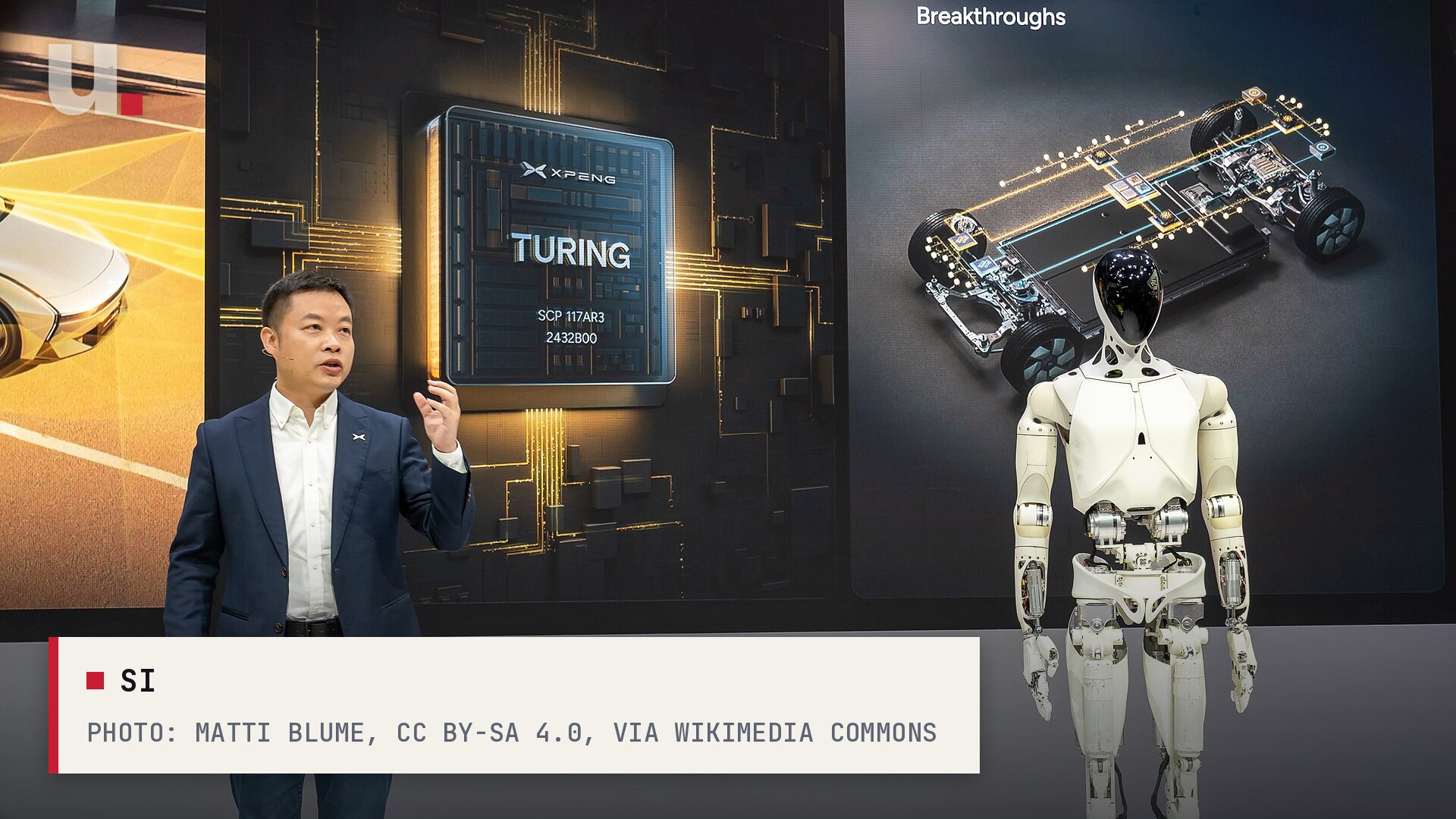
For two years, a Chinese electric-car company has been showing off a humanoid robot that moves so much like a person that people refused to believe it was real. On Wednesday, XPeng brought the newest version of that robot, called IRON, out in front of a crowd in Guangzhou and finally put a job and a date on it. Starting early next year, IRON will begin training as a sales clerk inside XPeng’s own car showrooms. The company is aiming for an official public release by the middle of 2027.
That makes XPeng one of the loudest Chinese challengers to what Tesla is building with Optimus, and it’s a reminder that the race to put working robots in American stores, warehouses and homes is not a race America gets to run alone.
The robot opened its own act. “This is my first time on a stage in front of more than 2,000 people, and I’m honestly a little nervous,” IRON told the audience, according to ITHome, which was in the room. “But you surely can’t tell. After all, I don’t have a blushing feature yet.” The outlet reported the robot worked through the appearance without anyone steering it by remote control.
A robot built to be touched
Most humanoid robots look like what they are: metal and plastic. XPeng went the other way. CEO He Xiaopeng called IRON the most human-like humanoid in the industry, and the company is designing it around the idea that people will be more comfortable working next to something that looks and feels like them.
The numbers XPeng gave are big. It says IRON has 76 degrees of motion, meaning 76 separate ways its body can bend, twist and turn, and more than 1,500 touch sensors covering over 80% of its key body areas, so it can feel friction and slipping the way your fingertips do. Its hands have 21 finger joints and are kept between 77 and 104 degrees Fahrenheit, so a handshake doesn’t feel like grabbing a cold wrench. It stands about 5 feet 7 inches and weighs about 137 pounds, roughly the size of an adult.
Under that skin, XPeng says, are a soft muscle layer whose firmness changes from one body part to another, a skeleton of high-strength steel and magnesium-aluminum alloy, and three SI chips the company designed itself. It runs on a solid-state battery that XPeng says packs 30% more power than a regular lithium battery of the same weight. Twenty minutes of charging buys about an hour and a half of work, and the robot is supposed to walk itself to the charger when it runs low.
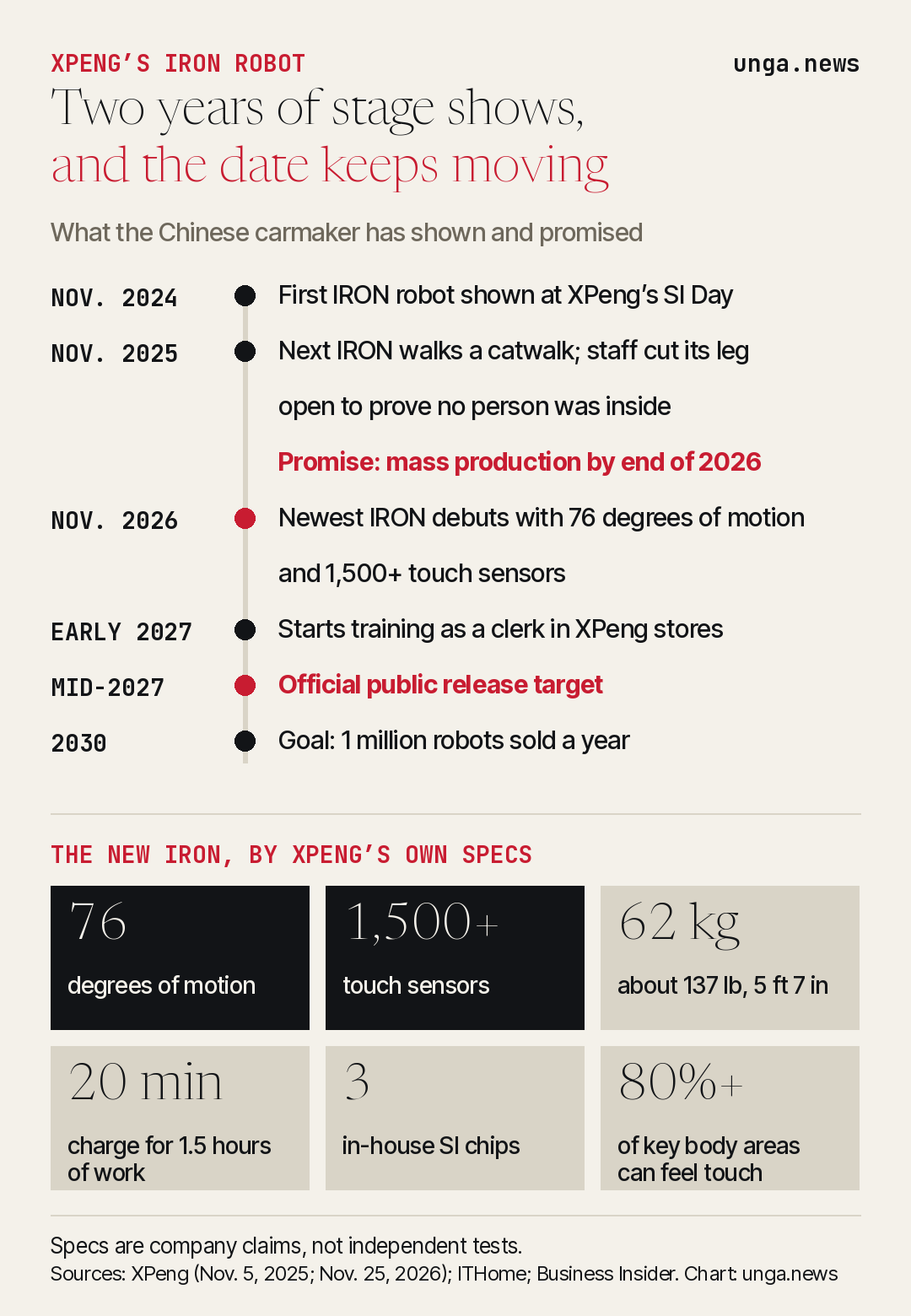
Every one of those figures comes from XPeng. Nobody outside the company has tested them yet, and stage demos are built to impress.
The job description
So what would IRON actually do? In XPeng’s showrooms it’s supposed to rotate through roles on a schedule: shopping guide, greeter, staff trainer and security guard, around the clock, seven days a week. Managers can hand it a to-do list by voice or through an app. Drop it in a building it has never seen, walk it through once, and XPeng says it maps the place on its own. If something goes wrong, it’s supposed to call for help instead of guessing.
The safety list reads like a company that knows people will be nervous standing next to a 137-pound machine. XPeng says IRON can stop within one second, has three separate emergency shutoffs, kneels and falls softly instead of toppling over, holds on to objects if it bumps into something, and checks itself after a fall. Its footsteps are supposed to stay under 55 decibels, quieter than a normal conversation.
Behind all of it, XPeng’s announcement says the company built a “Robot Data Factory” covering more than 250 situations and 15 job types to train the robot, and a dedicated assembly line that runs more than 1,000 tests on finished robots and key parts. It plans to make money three ways: selling the hardware, charging software subscriptions, and running an open platform where partners can download new skills built for their own businesses.
“For years, the AI industry has focused on making the brain smarter,” He said. “But humans do not learn through the brain alone. We learn by touching, moving, trying, failing and trying again.”
Last year’s promise was 2026
Here’s the part the stage show skipped. A year ago, at the same event, XPeng rolled out the previous IRON, which strutted down a runway so smoothly that the internet decided there had to be a person hidden inside. The next day the company cut open the robot’s leg on stage to prove there wasn’t. At that event He said XPeng was aiming for large-scale mass production of its humanoid robots by the end of 2026, and he later told analysts he wanted to sell a million a year by 2030.
The end of 2026 is five weeks away. What XPeng is offering now is a training run in its own stores starting early next year and a public release target in the second quarter. That 2025 version was billed at 82 degrees of motion, more than this year’s 76, and the company didn’t explain the change. None of that means the robot isn’t real. It means the timeline is still the company’s guess, like every humanoid timeline in this business.
XPeng isn’t only betting on robots. At the same event it said its robotaxi program went from test cars with safety drivers to fully driverless testing in eight months, with demonstration service planned in parts of Guangzhou by the end of this year and a purpose-built robotaxi model, YOYO-01, coming in 2027. It also opened public test rides of its driver-assist system at a showroom in Paris, which it calls a first for a Chinese automaker in Europe.
For Americans, the takeaway isn’t that XPeng is about to sell you a robot butler. It’s that China’s carmakers are pouring their factories, their data and their own home-built chips into humanoid robots, and they’re doing it fast. XPeng trades on the New York Stock Exchange, but its robot is being designed, trained and built in Guangzhou.
The country that figures out how to mass-produce useful robots first will own the next big manufacturing industry, the way Detroit once owned cars. Tesla is building Optimus in America to make sure that country is ours. XPeng just told everyone its first robots clock in next year. Its showroom floors will be the first real test of whether that promise holds.
Sources
- XPeng — XPENG Unveils Turing Physical AI Architecture, and Debuts Advanced General-Purpose Humanoid Robot IRON (Nov. 25, 2026)
- ITHome — XPeng IRON humanoid robot appears live at 2026 XPeng Tech Day: 76 degrees of freedom (Nov. 25, 2026, in Chinese)
- XPeng — XPENG Shares Achievements in Physical AI Emergence: Unveils XPENG VLA 2.0, Robotaxi, Next-Gen IRON, and Flying Car (Nov. 5, 2025)
- ECNS — Xpeng unveils robot IRON’s internal structure to refute doubts (Nov. 11, 2025)
- Business Insider — A Chinese Tesla Rival Is Building a Huggable Robot to Take on Optimus (Nov. 17, 2025)
- Wikimedia Commons — XPeng, IAA Summit 2025, Munich (Matti Blume, CC BY-SA 4.0)