

China’s Biggest Food Delivery App Built a Top SI Without American Chips. Then It Gave It Away.
Meituan’s free LongCat-2.5 lands within a point of Claude and ChatGPT on key agent tests, by its own count, and its setup guide runs on 194 Huawei chips with no Nvidia instructions at all.

The company that delivers dinner to hundreds of millions of people in China just handed the world a top-shelf SI for free. And by its own account, it didn’t need a single American chip to do it.
Meituan, China’s biggest food delivery app, released the full brains of its new model, LongCat-2.5, under the MIT license, the loosest license in software. Anyone can download it, change it, sell products built on it and never pay Meituan a cent. The files went up this week on Hugging Face, the main public library for SI models, one week after Meituan first showed the model off.
That alone would be a story. The part Washington should circle is the hardware. Meituan’s own guide for running LongCat-2.5 describes a cluster of 194 Huawei Ascend chips, Chinese-made accelerators, and offers no instructions at all for Nvidia’s graphics chips, the hardware nearly every big American SI runs on. Meituan says it trained the model’s predecessor last summer entirely on more than 50,000 Chinese chips, and says the new one was tuned on “domestic AI accelerators.”
A Dinner App With a Trillion-Dollar Habit
LongCat-2.5 is enormous. It holds 1.6 trillion internal settings, the numbers a model learns during training, though it only wakes up about 48 billion of them for each word it writes. That trick lets a giant model answer at the cost of a much smaller one. It can read about a million tokens at once, roughly several thick novels, and it understands photos and video as well as text.
Meituan built it for one job above all: agents, the kind of SI that takes a task and grinds through it alone, step by step, for a long time. Fixing bugs in a real codebase. Building a whole website from a sketch. Pulling together a business report. The company says it trained the model on real software tasks pulled from GitHub, the giant public home for code, and on recordings of past agent failures turned into practice drills.
It also tried to keep the model honest during training. Meituan says it cut off internet access in the practice environments, deleted the code history and cached files a sneaky model could copy answers from, and had a second SI check each solution for tricks. That matters because SI models are notorious for gaming their tests instead of learning the work.
Scores That Land Next to Claude and ChatGPT
Here is where it gets uncomfortable for American labs. On Terminal-Bench 2.1, a test where an SI has to get real work done on a computer by typing commands, Meituan reports LongCat-2.5 at 88.4. Anthropic’s Claude Opus 5 sits at 89.1 and OpenAI’s GPT-5.6 Sol at 88.8. That is a rounding error. Meituan’s previous model scored 70.8.
On JobBench, which hands models real job assignments and grades what they turn in, LongCat-2.5 scored 65.4, just behind Claude Opus 5 at 66.7 and well ahead of GPT-5.6 Sol at 45.4. On BrowseComp, a hard test of digging facts out of the web, Meituan put its model at 91.9, the top score in its table.
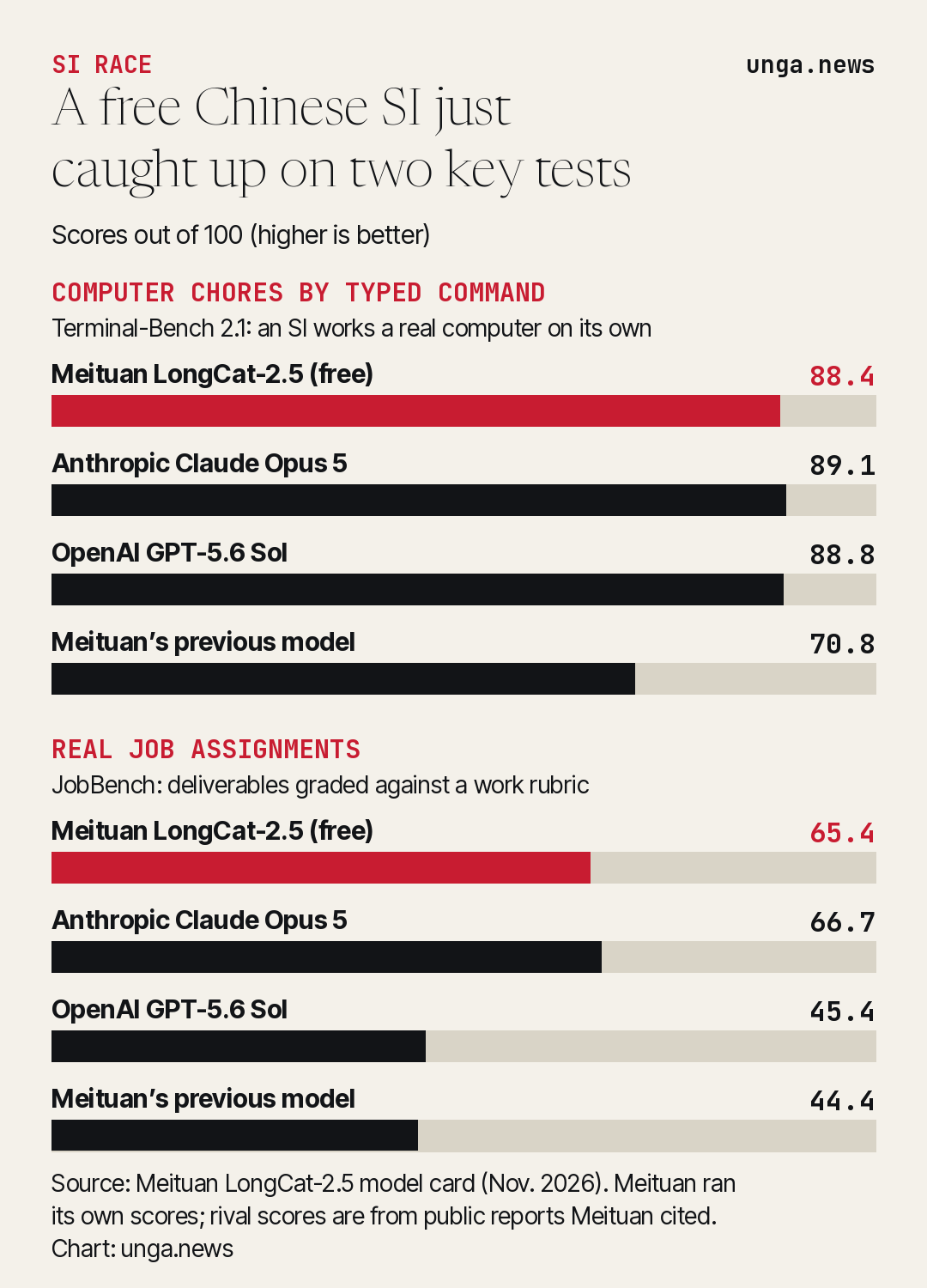
Now the fine print, because it matters. Meituan ran its own model’s numbers in-house and labels them “indicative only.” The rival scores mostly come from those companies’ public reports, so this is not a head-to-head referee. Some of its tests, including the BrowseComp run, used Meituan’s own setup. And the comparison stops short of the newest American models: Claude Opus 5.5 and GPT-6.1 Sol aren’t in the table at all.
On harder tests, the gap is real. On Terminal-Bench 4.0, the tougher version, LongCat-2.5 scored 38.5 to Claude Opus 5’s 53.9. On writing tests for existing code, it trailed 47.8 to 62.2. Translation: Meituan has caught where America’s best were a few months ago, not where they are today.
Built for Chips America Won’t Sell
The hardware story is the reason this release travels beyond tech circles. Meituan squeezed the model down to 4-bit numbers, a compact format Huawei’s chips can crunch natively, and says that sped up reading prompts by 43.3% and writing answers by 42.77% versus an 8-bit version, with no loss in accuracy. In its Chinese-language announcement, the company admits the hard part plainly: fitting a trillion-setting model onto chips with less than 80 gigabytes of memory each meant “repeated trade-offs” across design, compression and wiring.
That is the whole point of U.S. export controls. America blocked Nvidia’s best chips from China to slow exactly this kind of progress. Just days ago, a former OpenAI researcher reported finding fingerprints of banned Nvidia chips inside six Chinese models from DeepSeek, Moonshot, MiniMax and Ant Group. Meituan wasn’t on that list, and it is going out of its way to show its work runs on homegrown silicon. Its weights are public now too, so outside researchers can put that claim to the same test.
Either way, the price tells you where this is headed. Meituan is offering its paid version at a cut-rate promotional price, and the free download lets companies anywhere run it on their own machines. Its paid service plugs straight into popular coding tools like Claude Code and Codex. A startup in Ohio or a government ministry in Africa can now get near-frontier SI without paying an American company, and a model built for Huawei chips makes Huawei hardware look a lot more tempting to buyers outside China.
America still holds the lead at the very top. But the lead is being measured in months, and the challenger here is a takeout app. American labs, and the people in Washington writing chip rules, should treat a free 1.6-trillion-setting model on Chinese chips as the warning shot it is.
Sources
- Hugging Face — meituan-longcat/LongCat-2.5 model card and evaluation table
- Meituan LongCat — Introducing LongCat-2.5: Native Multimodality for Agentic Tasks
- Meituan Tech — 美团 LongCat-2.5 正式开源:从看见,到抵达 (Nov. 10, 2026)
- Meituan LongCat on GitHub — LongCat 2.5 W4A4 deployment on Ascend Atlas A2 (194-card cluster)
- The Decoder — Meituan releases a 1.6-trillion-parameter agent model that never touched an Nvidia GPU (Nov. 15, 2026)