

Chinese Spies Had a Master Key to Company Networks for Two Months Before a Fix Arrived
A China-linked hacking crew used a hidden hole in widely used VMware server software to make itself the top administrator. Google’s Mandiant caught it. Broadcom only shipped the fix on Thursday.
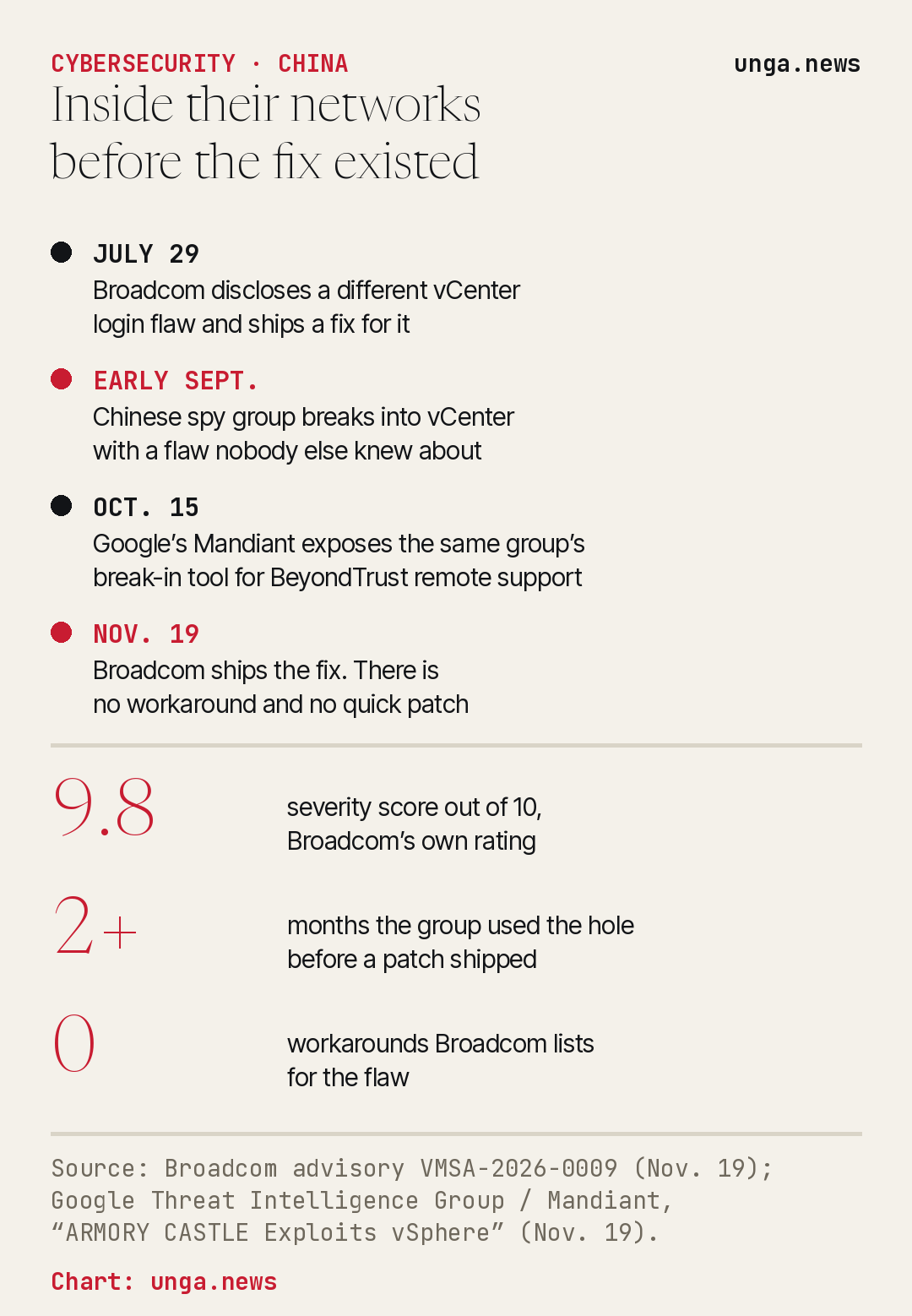
For more than two months this fall, a Chinese spy crew had a key to the room where some organizations run their entire computer operation, and nobody outside that crew knew the lock was broken. On Thursday, Broadcom finally shipped the fix. Google’s Mandiant team, which found the hole and reported it privately, says the hackers were already using it in early September.
The target was vCenter, the VMware software that IT departments use to run fleets of virtual servers from one screen. If you have never heard of it, you have almost certainly touched something that runs on it. Hospitals, banks, factories, agencies and phone companies lean on it to keep their back-end systems humming. Whoever controls vCenter controls everything sitting under it.
Broadcom, which owns VMware, rated the flaw a 9.8 out of 10 in its security advisory VMSA-2026-0009. Its own plain description is chilling enough: anyone with network access to vCenter “may exploit this issue to bypass authentication and gain unauthorized access to the system.” No password needed. Under the “Workarounds” line, Broadcom wrote a single word: “None.”
A skeleton key built for one machine
Mandiant and the Google Threat Intelligence Group laid out the break-in in a detailed report published the same day. They pin it on a suspected China-linked group they call ARMORY CASTLE, which they used to track as UNC5221. SecurityWeek notes the same crew also goes by Warp Panda.
The group didn’t walk straight in. It first broke into a BeyondTrust remote-support box using a different flaw nobody knew about, a zero-day Mandiant exposed on Oct. 15. From there it hopped to internal Linux machines that had no security monitoring on them, got full control, and started scanning the network for the specific doors VMware systems leave open.
Then came the custom tool. Mandiant calls it BONESAW, and it was written for exactly this job. It tricks vCenter into handing over a session as the top administrator account, then copies out the directory database that holds the system’s identities. With that, the hackers stole the material vCenter uses to sign logins, created their own single sign-on administrator account, and gave themselves a way to forge credentials at will.
Mandiant says the crew went further. According to SecurityWeek’s account of the report, the attackers took the vCenter master encryption key and database passwords, then moved onto an ESXi host, the machine that actually runs the virtual servers, and pulled more information. Along the way they planted five newly identified pieces of malware, including two web shells, a backdoor and a tool for faking SAML logins. One of those web shells used the password “123.” Sloppy on the surface, deadly underneath.
Patched shops weren’t safe either
Here is the part that should make every IT manager sit up. Back on July 29, Broadcom disclosed a different vCenter login flaw, and plenty of teams dutifully patched it. Mandiant says BONESAW was used against a vCenter server that already had that July fix installed. Worse, Google says it “has evidence that Armory Castle had knowledge of CVE-2026-123890 prior to the disclosure of CVE-2026-59309 on July 29, 2026.” In other words, the crew was sitting on its own private key while everyone else was busy changing the locks it didn’t need.
Rapid7, a security firm that tracks these bugs, spelled out what Broadcom’s FAQ says: every vCenter system below the new fixed versions needs this update, “including systems that already received the earlier fix.” Broadcom calls it an emergency change. The patch can’t be pushed through vCenter’s quick-patch feature, so teams have to do a full update. The good news is that running virtual machines keep working while the management screens go down for the update.
The fixed versions are vCenter 8.0 U3m, 9.0.2.0200 and 9.1.1.0200, plus VMware Cloud Foundation 5.2.5. Older vCenter 7.0 is the soft spot. Mandiant says BONESAW works against 7.x and 8.x, and Rapid7 lists 7.0 as “contact Broadcom Support,” for customers paying for extended support. SecurityWeek reports there is no public patch for 7.0, which left general support in October 2025. Anyone still running it is exposed until they get a private fix or move up.
Two zero-days and three toolkits
Mandiant doesn’t throw around words like “state-backed” lightly, and it didn’t here. It wrote that in this campaign the group “exploited two zero-days, and deployed three sets of malware specifically tailored for operating on targeted devices, indicating deep platform expertise and substantial resource backing.” That is not a teenager in a basement. That is a well-funded operation that studied VMware’s plumbing long enough to build tools for it.
Charles Carmakal, Mandiant’s chief technology officer, said on LinkedIn that the firm has investigated multiple break-ins tied to this flaw, according to SecurityWeek. His advice was blunt: “Organizations should both apply the patches and examine their systems for evidence of compromise.” Patching closes the door. It doesn’t throw out anyone already inside, especially a crew that minted its own admin account.
Broadcom’s advisory, for its part, says nothing about the flaw being used in the wild. It bundles the vCenter fix with four lesser bugs in SDDC Manager and VMware Tools, scored from 6.7 up. That leaves Google’s report as the plain-English warning that this one was already being used against real victims.
For regular people, there’s no button to press. This is a fight inside the server rooms of the companies and agencies that hold your records. But it is a sharp reminder of why the back-office software nobody talks about matters so much. China’s spies didn’t go after anyone’s phone. They went after the control panel that runs everything else, and for two months they owned it.
Sources
- Broadcom — VMSA-2026-0009: VMware vCenter, Tools, and SDDC Manager updates address multiple vulnerabilities (Nov. 19, 2026)
- VMware (GitHub) — VMSA-2026-0009 advisory notes
- Google Threat Intelligence Group / Mandiant — ARMORY CASTLE Exploits vSphere (Nov. 19, 2026)
- Rapid7 — CVE-2026-123890: Critical Authentication Bypass in VMware vCenter
- SecurityWeek — Newly Patched VMware vCenter Flaw Exploited as Zero-Day by Chinese APT