

Chuck Schumer Says ‘I Have the Votes’ to Stay Leader. Most Democrats Still Won’t Say.
Senate Democrats kept their leader vote on Dec. 1, giving Chris Van Hollen two more weeks to chase the 29 votes needed to topple Schumer.

Senate Democrats just won big in the midterms. Two weeks later, they still can’t agree on who should run the place.
On Tuesday, Democrats moved to shut down talk of holding their leadership vote early and signaled it will stay on Dec. 1, Roll Call reported. It is a rocky start for a party whose near-sweep of key races could give it 56 seats when the new Congress begins. That keeps alive a head-to-head fight between longtime leader Chuck Schumer of New York and Sen. Chris Van Hollen of Maryland, who wants his job.
Schumer sounded like a man who has done the math. “I’m confident I’ll be the next leader. I have the votes,” he told reporters after the caucus’s weekly lunch.
Van Hollen sounded like a man who thinks he’s gaining. He said his bid has “momentum at this point in time, which is why there was an effort to short-circuit the process.” He added: “And fortunately, I think that will fail.”
Inside the room, it was quieter than the headlines. Several senators leaving Tuesday’s lunch said the leadership race never came up, and neither Schumer nor Van Hollen made a pitch, Roll Call reported. “No one has ever raised that with me. I mean, I saw a rumor that some were wanting to contemplate that,” Kaine said of the earlier-vote idea.
Why the date matters
An earlier vote had been floated as a way to keep a messy fight from hobbling the new majority before the next Congress even starts. Van Hollen’s supporters, in the Senate and among activists outside it, saw it differently: as a way to stop him before he could catch up.
The bigger reason to wait is the freshmen. Democrats could have as many as 13 incoming senators, depending on how Alaska shakes out, and every one of them gets a vote. Retiring senators do not.
“Remember, they all get a vote in the leadership discussion, and it would be hard to get them here,” Sen. Tim Kaine of Virginia said. Only one senator-elect, Scott Colom of Mississippi, was at Tuesday’s lunch. “That discussion needs to have the newcomers because newcomers get votes. The outgoers don’t, right?”
Sen. Mazie Hirono of Hawaii said Democrats need time for “a robust discussion” and should be “very embracing of the new people who have been through fire to get here.”
Sen. Martin Heinrich of New Mexico agreed the new class should weigh in first. “I want to hear from the freshman class as well,” he said Monday evening. Hirono added that the newcomers have “a lot of talent to bring to the table.”
The count so far
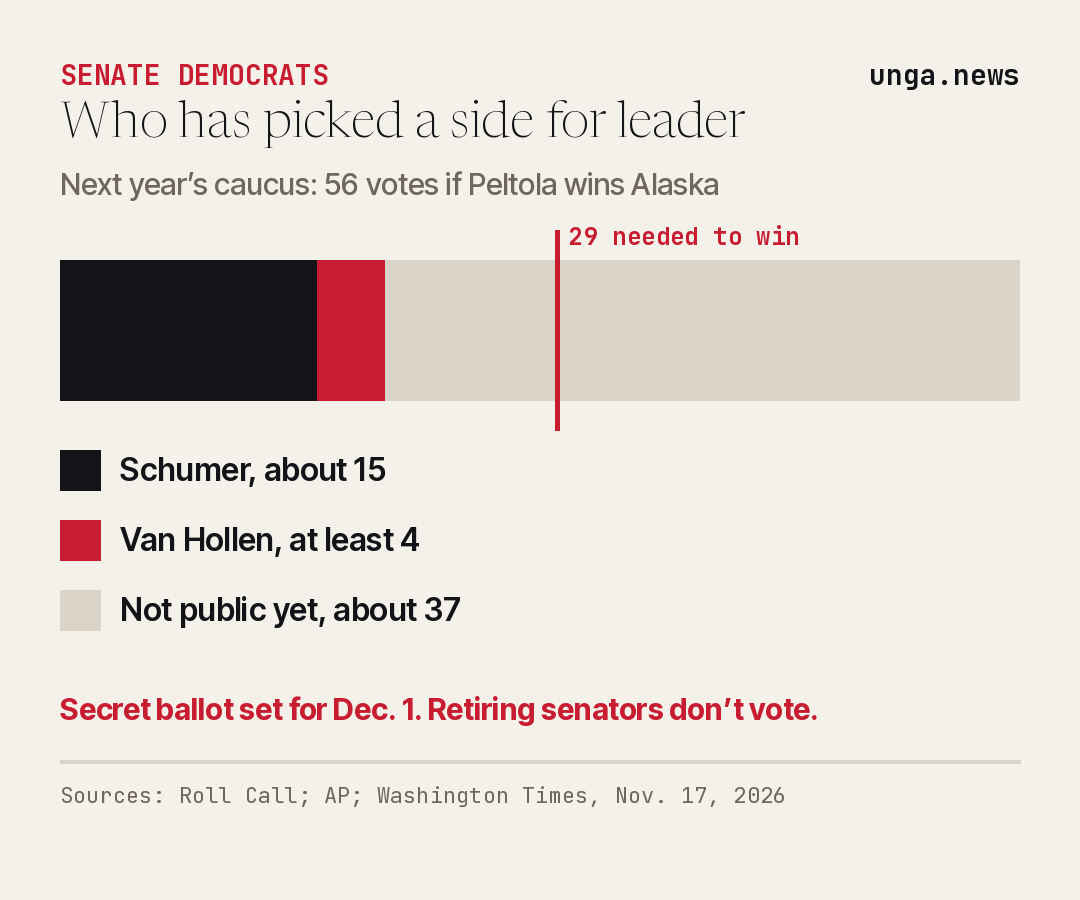
The vote is a secret ballot. To win, a candidate needs a simple majority of the Democrats who will serve in the next Congress. That would be 29 of 56 if Mary Peltola holds on in Alaska, the Washington Times reported.
About 15 Democrats have publicly backed Schumer, according to Roll Call and the AP. “I committed to Sen. Schumer literally months ago, and I continue to support him,” Sen. Richard Blumenthal of Connecticut said Monday.
Van Hollen’s public backers include Sens. Jeff Merkley of Oregon and Bernie Sanders of Vermont, plus two senators-elect, Peggy Flanagan of Minnesota and Abdul El-Sayed of Michigan. “The American people want change in the way we do business here in Washington,” Sanders said.
El-Sayed said Van Hollen brings “a willingness to take risks,” and argued Congress should stop passing giant bills “that nobody really knows what’s in them.”
“We need people who are willing to take legislative risk,” El-Sayed said at The Atlantic Summit on Tuesday. “We need to rethink the way we legislate.”
That leaves most of the caucus, roughly 37 votes, still not saying anything in public. Most Democrats are in “listening mode,” as the Washington Times put it.
Fence-sitters
Sen. Ben Ray Luján of New Mexico said he wants to hear what every leadership candidate and committee chair is committing to first, so they can build “a strong agenda that’s going to improve people’s lives.”
Kaine said he hadn’t made up his mind either, but gave Schumer credit for recruiting the candidates who won. “Schumer just delivered a major win for us,” he said.
The fight also puts the new moderate Democrats in an awkward spot, the AP reported: they have to pick a side in a leadership race before they’re even sworn in, and many of them were recruited by Schumer himself.
For everyone outside the Capitol, here’s why it matters. Whoever wins decides which bills get a vote in a Senate Democrats will control starting in January. Schumer has led Senate Democrats for about a decade. In two weeks, behind closed doors, they decide whether he keeps going.
Sources
- Roll Call — Senate Dems dismiss talk of earlier leadership election; Schumer confident
- AP — Van Hollen’s bid to replace Schumer as leader is putting pressure on Democrats to take sides
- Washington Times — Most Senate Democrats in ‘listening mode’ on majority leader race