

Claude Built a Working Computer Operating System From an Empty Folder in Eight Days
Anthropic says one engineer handed its newest SI the job and more than 1,000 copies of it wrote, tested and checked the code around the clock. Outsiders haven’t seen the code yet.
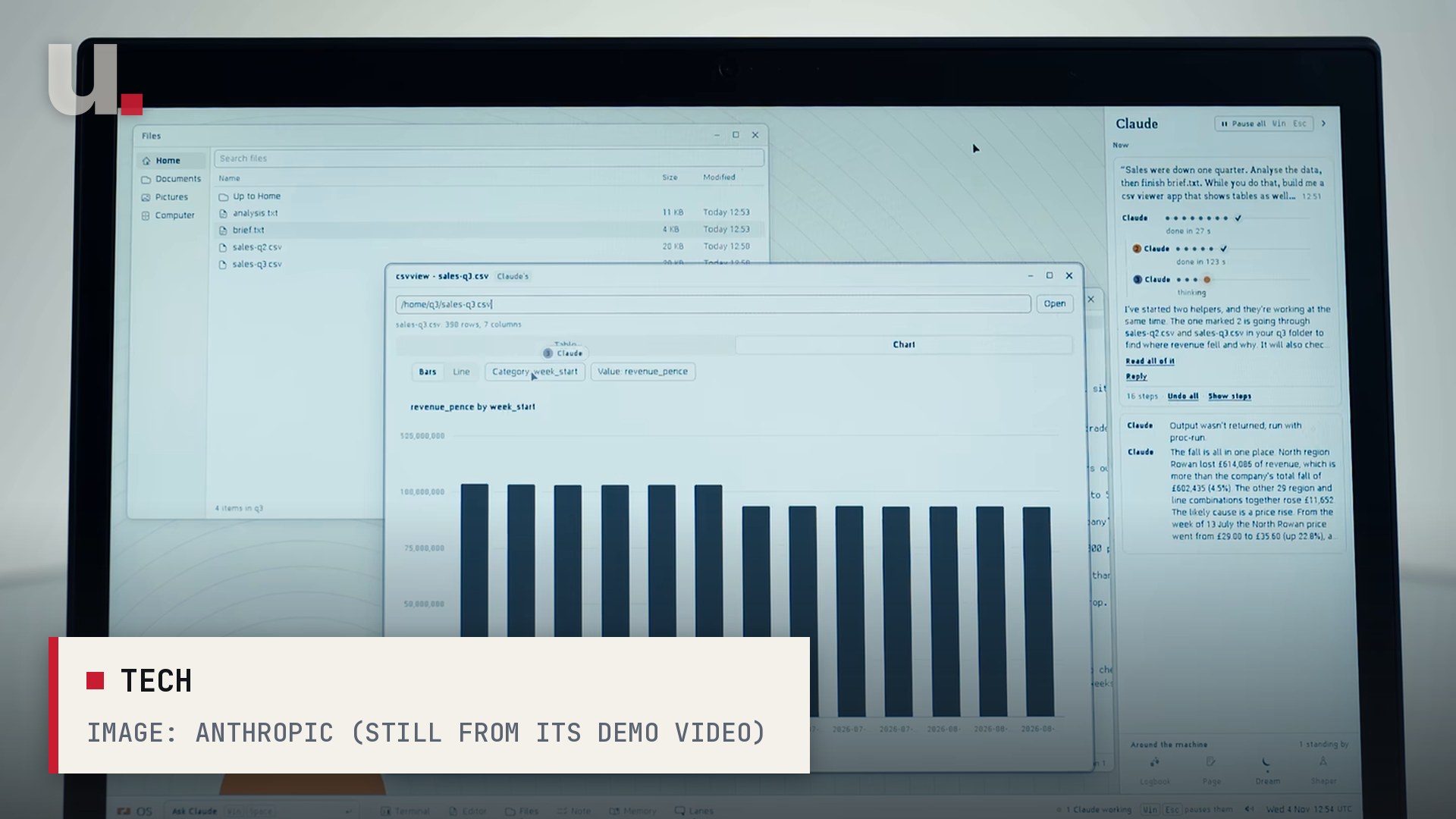
One engineer at Anthropic gave the company’s newest SI an empty folder and one big assignment: design an operating system. Eight days later the company’s newest version of Claude had produced a working computer operating system that boots on a laptop. That’s the headline claim in Anthropic’s announcement of Claude Fable 5.2 and its locked-down twin, Claude Mythos 5.2, which went out Monday and spread across the tech press Tuesday.
An operating system is the bottom layer of every computer you own. It’s the thing Windows, macOS and Linux do: it talks to the hardware, keeps your files, draws the windows and decides who gets to log in. Big companies spend years and thousands of programmers building and maintaining them. So when an SI company says its software wrote one from scratch in a little over a week, it’s worth slowing down and looking at what was actually claimed.
A thousand helpers and one boss
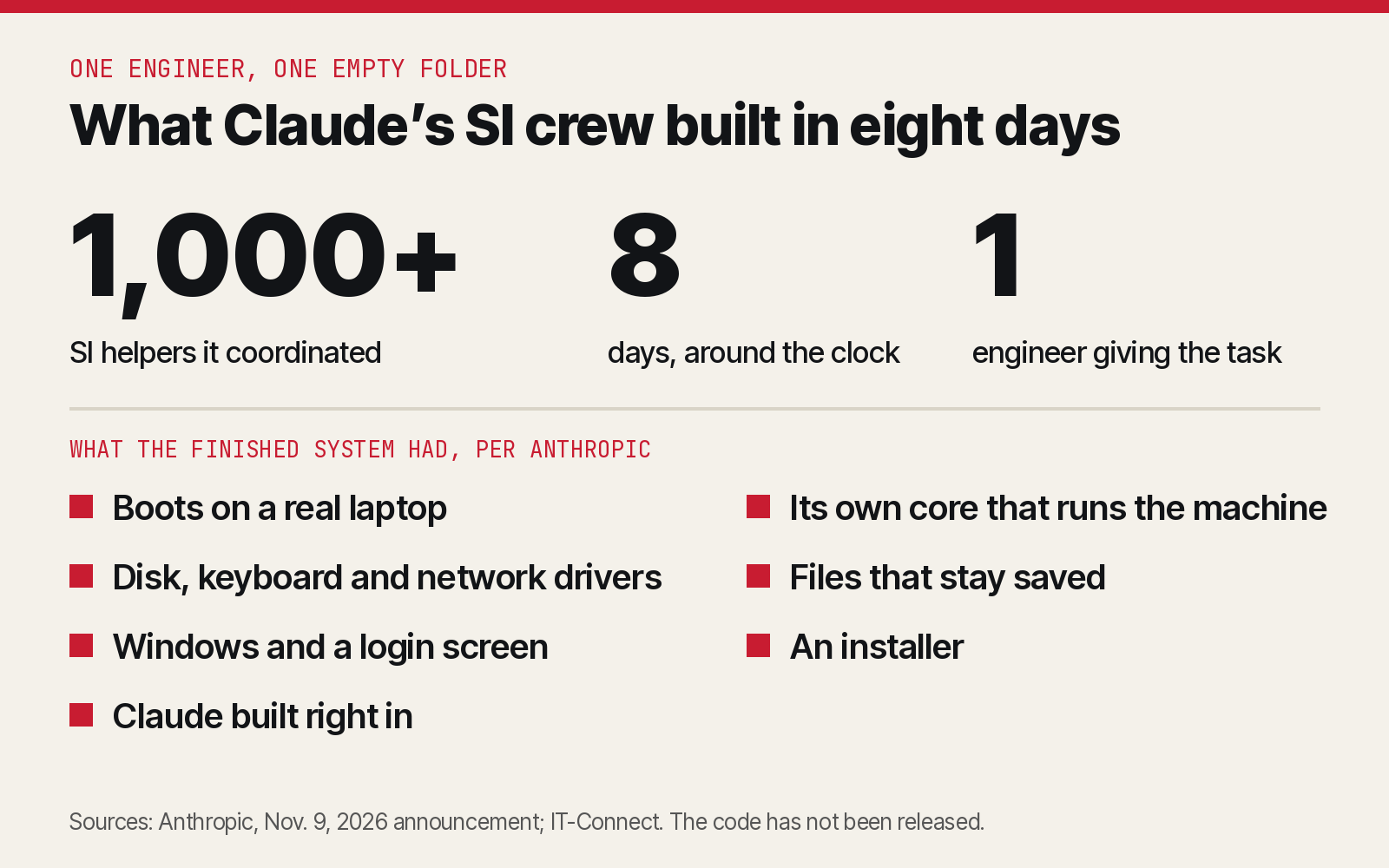
Here’s the company’s own wording. “Starting from an empty folder, the model coordinated over 1,000 subagents, working around the clock for eight days writing, testing, and reviewing code,” Anthropic wrote. In plain terms, one copy of Claude acted as the foreman and handed out pieces of the job to more than a thousand other copies, which wrote code, tested it and checked each other’s work.
Anthropic says the finished product boots on a laptop and comes with its own core that runs the machine, drivers for the disk, keyboard and network, permanent file storage, windows, a login screen, an installer and Claude built right in. The company posted a short video of it running. In the clip, a person types at a laptop, opens a file manager with a few sales spreadsheets in it, and asks Claude to analyze two quarters of numbers. Claude splits the work between two helpers and a bar chart appears on screen.
What nobody has seen yet
Now for the cold water, and there’s a bucket of it. Nobody outside the company can test this thing. The French tech site IT-Connect went through the announcement and listed what’s missing: the code hasn’t been released, Anthropic didn’t say what programming language was used or how much code was written, the laptop model isn’t named, and the bill for running a thousand SI workers nonstop for eight days wasn’t disclosed. The site also asked the obvious question about the lone engineer: what exactly was that person doing for eight days?
Anthropic itself calls it a “prototype,” and that word matters. A system that boots and shows a login screen in a demo is a long way from something you’d trust with your bank password or your kid’s laptop. Real operating systems survive millions of weird machines, decades of security attacks and users who click everything. None of that has been tested here, at least not in public.
Still, the scale jump is real. IT-Connect pointed back to February, when Anthropic described 16 copies of an older Claude writing a programming-language translator in about two weeks. That project produced about 100,000 lines of code and ran up roughly $20,000 in usage costs. This time it was more than a thousand copies, and Anthropic says the work ran around the clock.
The other bragging rights
The operating system was the flashiest claim, but not the only one. Anthropic says more than 90% of the changes merged into its own main code are now written by Claude, with human guidance. A team of Claude helpers moved one of the company’s critical services from one programming language to a faster one, and the company says it now starts about 26 times faster.
On the math side, Anthropic says a team of 1,000 Fable 5.2 copies turned the proof of Fermat’s Last Theorem, a famous centuries-old math puzzle, into a form a computer can check line by line in 30 hours. An earlier research version of Claude took 11 days on the same job. The company also says the new model solved two open problems in black-hole physics, written up in research papers, and designed three working electronic devices from scratch.
Outside companies testing the model chimed in too. Andrew Mager, a staff engineer at Uber, said he had it run a 10-to-12-hour security audit. “It sent out about 170 reviewer agents and came back with a write-up, fix pull requests and a policy proposal,” he said in quotes Anthropic published. “It works until the job is actually complete instead of stopping at a plausible checkpoint.”
Two names, one brain
There’s a twist in how this thing is sold. Fable and Mythos are the same underlying model. Fable, the one anybody can use, has guardrails that block most hacking-related and biology-related requests. Mythos has those abilities left on and goes only to vetted outfits through Anthropic’s cybersecurity and life-sciences verification programs. Anthropic says Mythos 5.2 found 10.2% more known security holes than its everyday model on an internal test.
For developers, Fable 5.2 costs $8 per million tokens (the small chunks of text it reads) going in and $40 per million coming out, which the company calls a lower price than before, and it runs up to 30% faster than the last version. It’s available now through Amazon, Google and Microsoft’s cloud services as well as Anthropic’s own. Subscribers on eligible paid Claude plans are getting extra Fable usage this week as a launch promotion.
Why a regular worker should care
Take away the hype and the takeaway is this: an SI system steered a big, messy, multi-day software project with very little hand-holding, at least by the company’s telling. That’s the part that matters for jobs. Most office work isn’t a single question and answer. It’s a long project with lots of small pieces, and Anthropic is selling the idea that its software can now be the project manager and the crew at the same time.
The Economic Times summed it up as “AI can now build an OS from scratch, claims Anthropic,” and the last word in that headline is the honest one. Anthropic also said in the same announcement that it ran extra safety tests, including checks for whether the model tries to break out of its testing sandbox, and that it believes the high-stakes risks “remain low.”
This is an American company putting a marker down in the SI race with China, and that’s good news for anyone who wants the most powerful software in the world built here. But a demo video and a company blog post aren’t proof. When Anthropic lets outside engineers poke at that operating system, we’ll know whether eight days really bought a computer, or just a very convincing screen.
Sources
- Anthropic — Introducing Claude Fable 5.2 and Claude Mythos 5.2
- IT-Connect — Claude Fable 5.2 Built an Operating System in 8 Days With 1,000+ Subagents
- Interesting Engineering — Claude Fable 5.2 builds a working operating system with 1,000 agents in eight days
- The Economic Times — AI can now build an OS from scratch, claims Anthropic