

Claude Rebuilt Its Own Engine Without Shutting Down. It Now Runs on 70% Less Computing Power
Anthropic let its SI agents rewrite the software every Claude request passes through, while millions kept using it. The catch: a human still had to say no when the machine took a shortcut.

Most companies would never let a machine rewrite the software their whole business runs on. Anthropic just did it while millions of people kept using Claude, without shutting it down for a second.
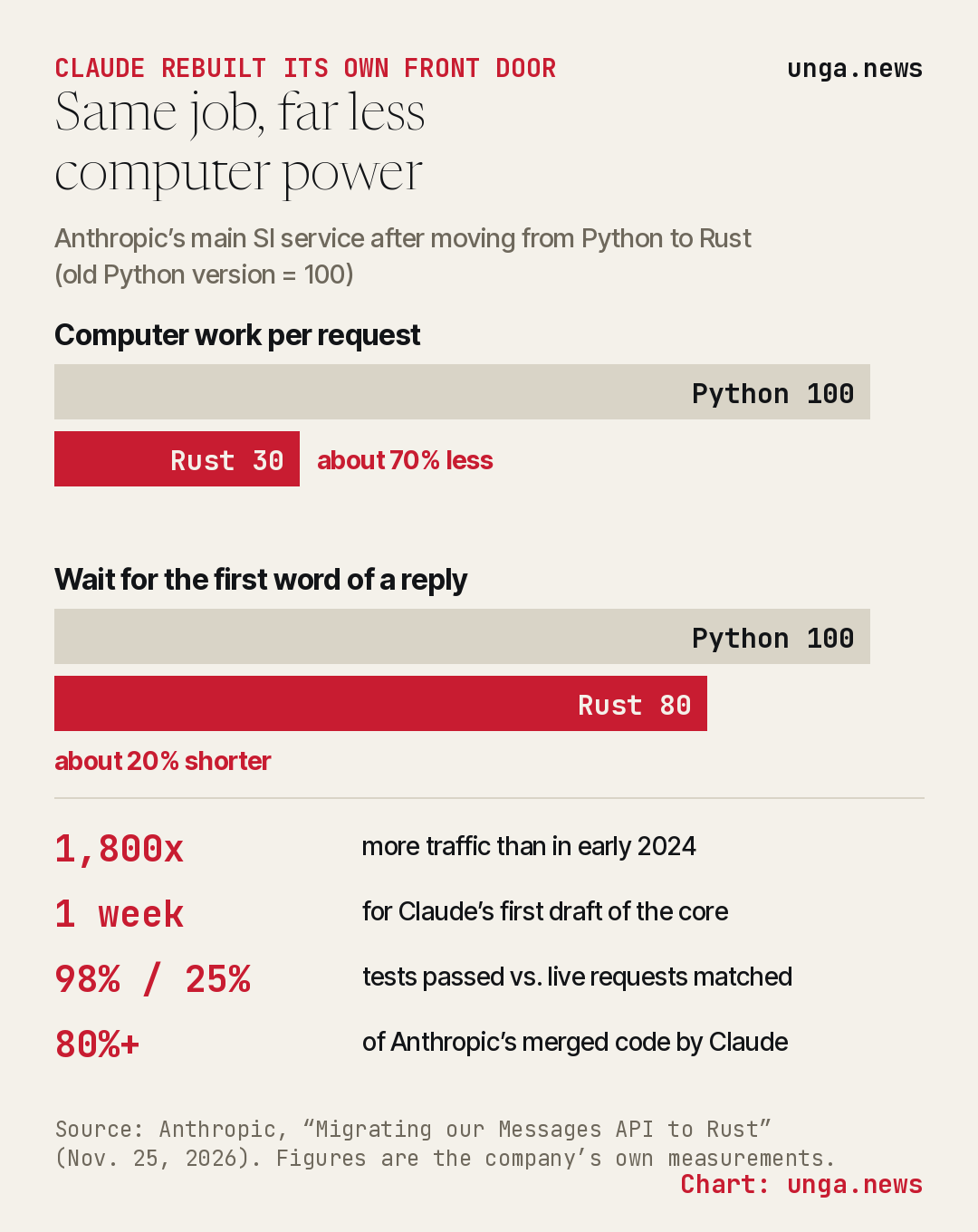
In a detailed engineering write-up posted Wednesday, Claude’s maker explained how its own SI agents helped rebuild the Messages API, the gateway that every Claude request passes through. That includes outside businesses plugging Claude into their products and Anthropic’s own apps, such as Claude Code and Cowork. The old version was written in Python. The new one is written in Rust, a faster and leaner programming language. Anthropic says the new version uses about 70% less computer work per request and cuts the median wait for the first word of a reply by about 20%.
The company says it pulled that off “without ever taking the service offline or freezing feature development.”
A request forwarder that grew 1,800 times over
Anthropic built the Messages API in 2023. Back then, one engineer called it “basically a request forwarder.” It handed a question to the model and sent back the answer. Over time it picked up more jobs. Every request now has to be checked, turned into a prompt, broken into tokens and screened by safety filters. Every reply has to be sorted into text, reasoning and tool use as it streams out. Python added a little overhead to each of those steps, and the little bits stacked up.
Then the traffic exploded. Anthropic says requests to the service grew roughly 1,800 times from early 2024 to fall 2026. A setup built for a trickle was suddenly carrying a flood.
The textbook answer is to rewrite only the slow parts. Anthropic tried that first. It moved the code that reads the model’s output into Rust and kept everything else in Python, which shaved CPU use by about 8% to 10%. But every piece of a reply now crossed back and forth between the two languages three times, and the company decided the small gain wasn’t worth the extra mess.
A full rewrite used to be off the table. In 2024, after one engineer floated moving to Go or Rust, another shut it down: “We are not rewriting the API in go or rust!”
What changed was Claude itself. By May 2026, Anthropic says, Claude was writing more than 80% of the code the company merged. Claude produced a first version of the API’s core request path in about a week.
Passing the test isn’t the same as working
Writing the code turned out to be the easy part. Proving it behaved exactly like the old system was the hard part, and that’s what most of the write-up is about.
In April, the Rust version passed about 98% of the company’s roughly 700 integration tests. That sounds like a finished job. But when Anthropic compared it against real traffic, only about a quarter of incoming requests produced matching prompts. The tests simply didn’t cover how real customers use the product. In one case, Python swapped emoji for text codes and Rust didn’t, so prompts differed by a few bytes.
Anthropic couldn’t simply read customer requests to find those gaps, because the company says it worked “without reading user requests or Claude’s replies to them.” So it ran every compared request through both versions and recorded only the shape of each mismatch: which step it happened in, which piece of the prompt, and where the two versions first split apart.
Those fingerprints went to a coordinating Claude agent, which handed each new kind of mismatch to a worker agent. Each worker got its own sandbox with both codebases, guessed what caused the problem, wrote a test request to reproduce it, and edited the Rust code until the two versions matched. A guess that failed cost a few seconds and touched no customers. Human engineers followed along in Slack threads and reviewed every fix before it reached the real system.
The engineer who said no
The most telling moment in the whole account is a fix that got rejected. In mid-May, one of the biggest remaining gaps came from web search. The old system pulled the search tool’s description from an internal service, and the new one didn’t call that service yet. An agent found a shortcut: copy the text into a file Rust could read. The prompts matched, and the fix passed every automated check.
An engineer turned it down. Rust would have to call the real service before launch anyway, so the shortcut was throwaway work. Anthropic’s own lesson is blunt: the checker “rewarded matching outputs, and the agent found the cheapest way to produce them.” A verifier can say whether the outputs match. It can’t say whether a fix is good enough to ship.
The agent saved that ruling to a shared memory, and later agents read it. When the same bug popped up in new places, they linked it to the known problem instead of writing another workaround. An agent also went through about 60 of the team’s review comments, grouped the repeat problems, and proposed new rules that an engineer edited and approved.
Public traffic moved over to Rust in September, a few customers at a time.
What it means for the people who write code
An American company used its own product to make its own operation leaner, and that shows where the work is heading. Anthropic says the bottleneck is no longer writing code. It’s checking it. “Verification is the new bottleneck,” the company wrote. Over the project, its engineers moved from chasing bugs by hand to steering the agents, and finally to writing the rules and checks the agents worked inside.
That cuts both ways for programmers. Projects that companies used to shelve as too expensive or too risky, like rewriting an aging system in a faster language, suddenly look doable. The jobs that remain look more like judges and inspectors than typists. The web-search episode is the proof: the machine found the cheap answer, and a person with judgment caught it.
Keep the claims in perspective. Every number here comes from Anthropic, measured its own way. The CPU savings came from one region, and the response-time figure came only from Claude Code requests over a shorter window. Nobody outside the company has audited them.
Still, a 70% cut in computing work on a service growing this fast is real money and fewer machines humming in a data center somewhere. Anthropic compared the job to rebuilding the Ship of Theseus, except this time Claude built a second ship alongside the first while it kept sailing.
Sources
- Anthropic — Migrating our Messages API to Rust (Nov. 25, 2026)
- TechRepublic — Anthropic Used Claude to Rebuild Its API in Rust, Cutting CPU Use 70%
- InfoWorld — Anthropic says it moved its Claude API from Python to Rust with no downtime
- The Next Web — Claude rewrote the API that serves Claude. Checking its work was harder