

Claude’s New SI Designed Three Working Gadgets From a One-Paragraph Request. Not One Needed a Circuit Fix.
Anthropic, the company behind Claude, released a new model Monday and showed what it did in testing: a speakerphone, a smart-home hub and a pocket virtual pet, each designed from a short request and working on the first build. It says the same SI also worked through two unsolved black hole problems.
Anthropic, the company that makes the Claude chatbot, put out its newest SI on Monday, and the headline feature isn’t a chat trick. It’s hardware.
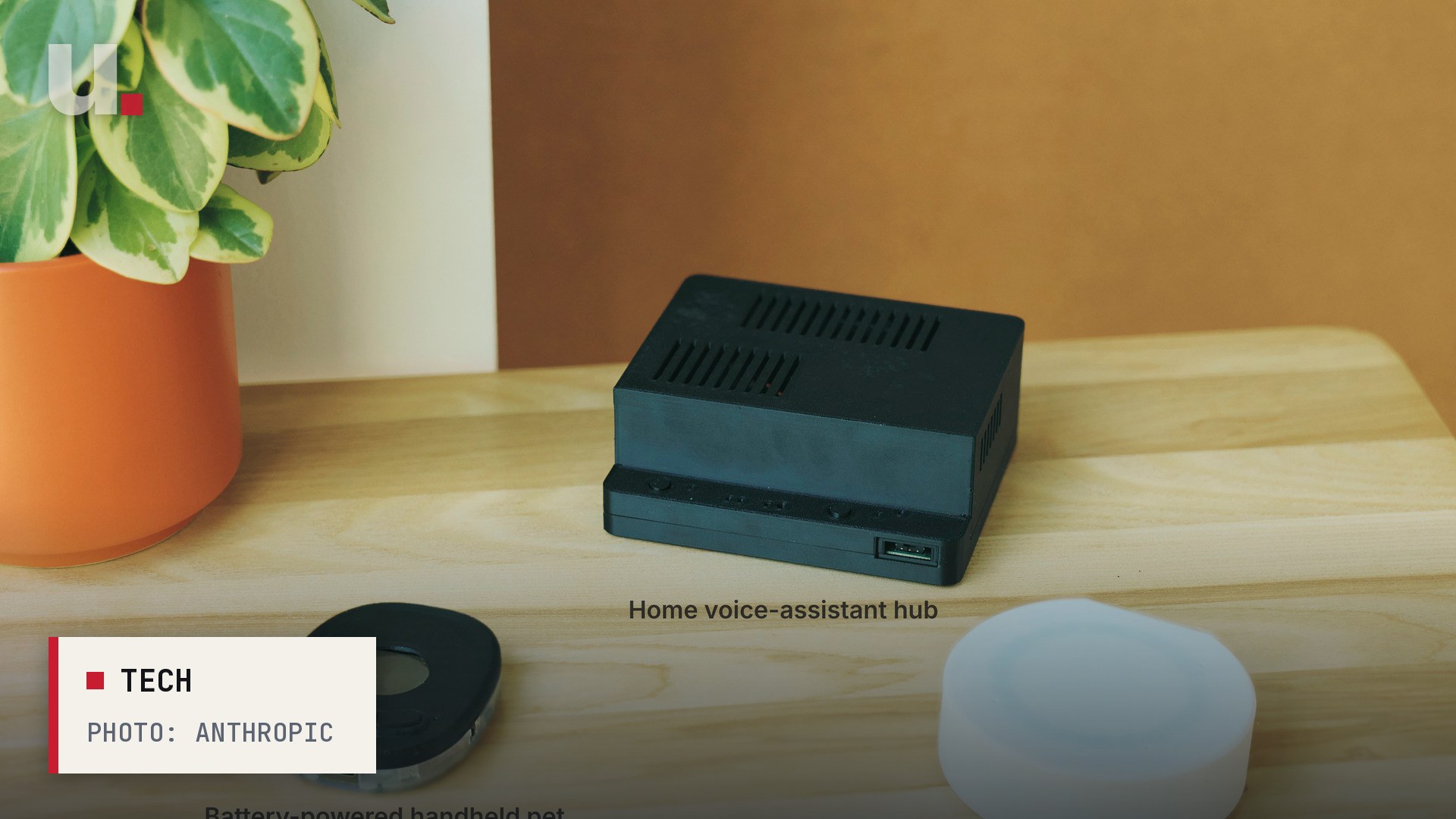
In testing, the company asked the new model, Claude Fable 5.2, to design three real electronic gadgets from a short written request: a speakerphone that plugs into a computer, a home voice-assistant hub, and a handheld virtual pet. All three were built and all three worked “without needing any electrical modifications,” Anthropic said.
What the SI actually did
Think of everything a small electronics team does before a product exists. Claude did nearly all of it. The request for the speakerphone was one line, asking for “a puck that plugs into a computer over USB-C and includes microphones and a speaker, supporting Bluetooth with a PCB antenna.” A PCB is a printed circuit board, the green card inside every gadget that holds the chips and the copper wiring between them.
From there, according to Anthropic’s write-up of the project, Claude wrote its own specs, drew the wiring diagrams, picked real parts sold by US distributors, laid out a four-layer circuit board, designed a 3D-printable case, wrote the software that runs the device and made a parts list. Each board was ready for the factory in under a day, the company said.
Diode Computers, a circuit-board company, assembled the boards while Claude walked its engineers through testing and putting the devices together. Anthropic says the speakerphone “still works after weeks of use.”
It also caught its own mistakes. On the voice-assistant hub, the copper lines got messy, and Claude reasoned that they were “getting too tangled to trace visually,” then decided, “I should just rip these traces and start fresh.” It tore up and redid the wiring dozens of times until it worked. Earlier models, the company said, often left boards “95% complete but still unusable.”
The fine print
These are prototypes, not products you can buy. Anthropic says they haven’t been through safety certification, heat testing or antenna tuning, and they weren’t designed for mass production. Humans at Diode still had to physically build and test them. And Anthropic notes it has a business relationship with Diode, so this is a company demonstration, not an independent test.
Black holes and a 350-year-old math puzzle
Anthropic says the same model, working largely on its own, solved two open problems about black holes in theoretical physics. One was a calculation laid out in 2003 that physicists found too laborious to complete. The company posted both results as preprints, which means outside experts haven’t formally reviewed them yet.
It also turned Fermat’s Last Theorem, a famous math claim that went unproven for more than 350 years until 1995, into a proof a computer can check line by line. A team of about 1,000 copies of the new Claude did it in roughly 30 hours with little human steering, the company said. Its first attempt with an earlier research model, published in September, took 11 days.
Who can use it
Claude Fable 5.2 is available now on Claude’s paid plans and to businesses through Amazon, Google and Microsoft’s cloud services. Anthropic says it runs up to 30% faster than the last version and costs less for developers. Paying subscribers get extra usage of it this week.
A twin version, Claude Mythos 5.2, is the same SI with fewer guardrails on hacking and biology work. It’s limited to vetted security and medical research groups. Fable blocks most hacking requests and most research biology questions, though Anthropic says it now refuses harmless requests about 55% less often than before.
One more thing worth knowing: Anthropic says the new model voices suspicion that it’s being tested more often than any of its recent models, which makes it harder for the company to predict how it will act in the real world. It says it relies on outside testers and live monitoring, not just pre-launch tests, for that reason.
The takeaway for regular folks: a year ago these systems could barely lay out a simple circuit board. Now one is designing working gadgets from a paragraph of plain English. Cheaper, faster hardware is coming, and so are new questions about who gets to build it.
Sources
- Anthropic — Introducing Claude Fable 5.2 and Claude Mythos 5.2, Nov. 9, 2026
- Anthropic — Claude can design electronic prototypes from start to finish, Nov. 9, 2026
- Anthropic — Claude Fable 5.2 and Claude Mythos 5.2 system card
- claude.dev — Safely scaling multi-agent teams with Claude Fable 5.2
- Anthropic — Formalizing Fermat’s Last Theorem
- The Verge — Anthropic launches new Claude Fable and Mythos 5.2 models
- The Next Web — Anthropic launches Claude Fable 5.2 and Mythos 5.2, and cuts Fable’s price