

Colorado Put Driver’s Licenses on a Phone App. Hackers Got In, and It’s Down for Thanksgiving
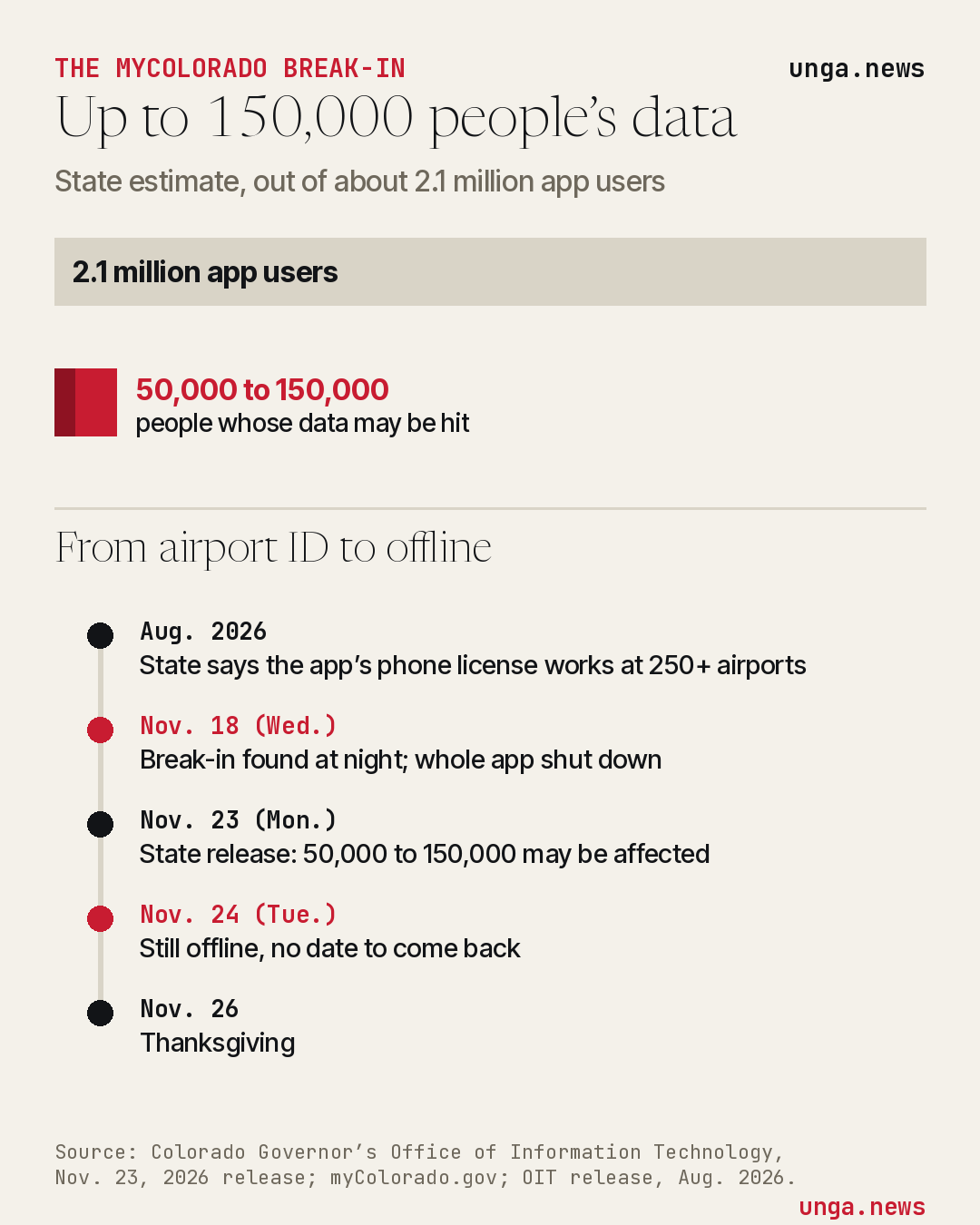
An intruder got into myColorado, the state’s digital ID app with about 2.1 million users. The state says up to 150,000 people’s data may be affected, and the app has been offline for nearly a week.

Colorado spent years telling people their driver’s license could live on their phone. This week the state is telling them to dig the plastic one out of the drawer.
Late on the night of Wednesday, Nov. 18, Colorado’s Governor’s Office of Information Technology found that “an unauthorized user was able to access platform data” inside myColorado, the state-built app that holds digital driver’s licenses and IDs for about 2.1 million users. The office quickly shut the whole app down. In a news release Monday, five days after the discovery, it estimated the break-in “may have impacted between 50,000-150,000 individuals’ data.”
As of Tuesday afternoon the app was still dark, with no date for it to come back. Thanksgiving is Thursday.
What the app holds
This isn’t a parking app. myColorado carries the state’s Colorado Digital ID, an electronic copy of your license or state ID card that businesses, state agencies and police can accept as proof of who you are, how old you are and where you live. Signing up means scanning the barcode on the back of your license and passing a selfie identity check, according to ID Tech. The app also stores vehicle registrations and insurance cards, hunting and fishing licenses, and links to more than 20 motor vehicle services.
In August, the state rolled out a mobile driver’s license inside the app that works at TSA checkpoints at Denver International Airport and more than 250 airports across the country. Gov. Jared Polis was there to announce it. Three months later, the timing could hardly be worse. Holiday travelers who planned to flash their phones at security are being told to use a plastic license, add their license to a different state-approved digital wallet, or pay TSA $45 for its ConfirmID check if they have no passport or REAL ID on hand.
What exactly got taken is still a mystery to the people it belongs to. The state has not said what kind of information the intruder reached, how they got in, or whether it was a criminal gang, a lone hacker or a foreign government. The Record, the cybersecurity news site, reported that investigators declined to say what may have been stolen.
“We know how much Coloradans rely on these services, and we understand how this is frustrating and inconvenient,” said Sarah Tuneberg, the state’s chief information officer. “Protecting our users’ data is our first priority, and we will bring systems back online as quickly as we can once security is restored.”
The office says everyone whose data was affected will be notified once the investigation is done, with steps they can take to limit the damage. Until then, roughly 2 million people don’t know whether they’re in that group.
The plastic card still wins
Here is the part that should make every digital ID booster stop and think. Buried in the state’s own outage notice is a reminder that Colorado law already requires you to carry your physical ID at all times, even when you use the digital one.
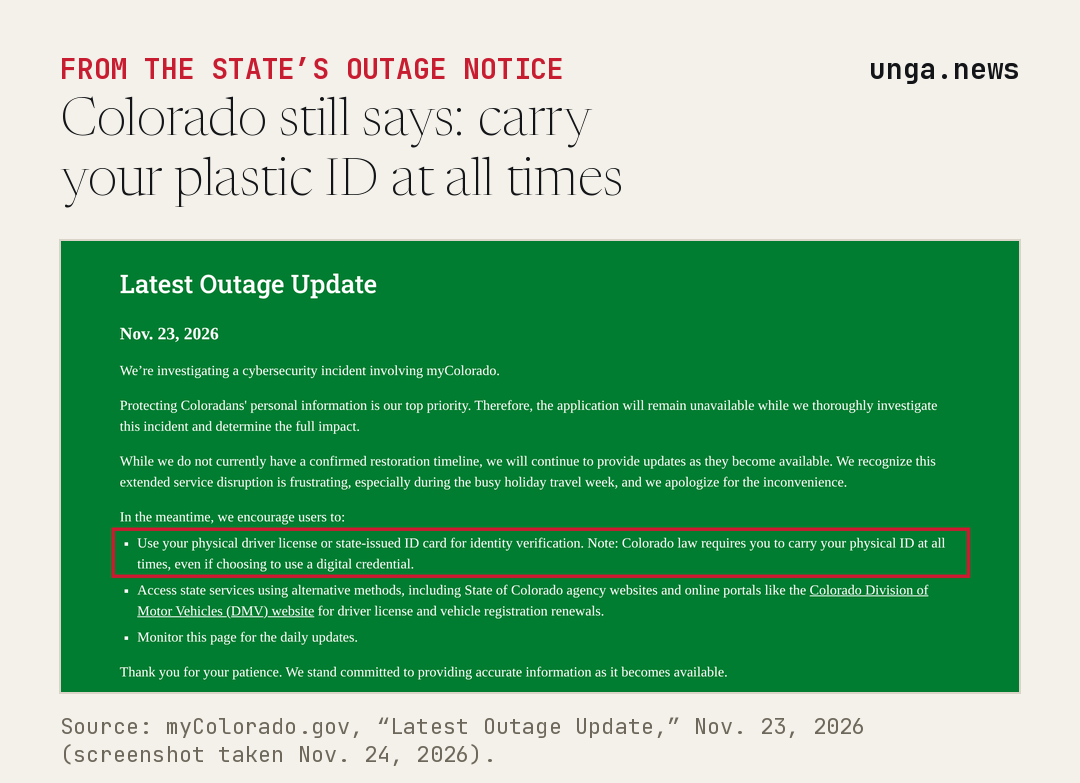
So the phone version was always an extra, a convenience layered on top of the card in your wallet. That card can’t be hacked from across the country. It doesn’t go offline. It doesn’t need a server in Denver to be up for it to prove who you are.
Convenience is real, and plenty of people like tapping a phone instead of fishing for a wallet. But when a government gathers millions of residents’ identity documents, selfies and records into one app, it builds one big target. Somebody hit it.
Not Colorado’s first data mess
Coloradans have heard versions of this before. In 2023, the Russian-speaking Cl0p gang exploited a flaw in MOVEit, a file-transfer tool used by IBM, a contractor for the state’s health care agency, and stole files on about 4.1 million Health First Colorado and CHP+ members, including Social Security numbers and medical information. The agency said its own systems were not breached, but the data still walked out the door.
In 2024, Secretary of State Jena Griswold’s office posted a spreadsheet on its public website with hidden tabs containing partial passwords for voting equipment in 34 of the state’s 64 counties. It took Republicans calling it out, days before the election, before the public heard about it. Griswold’s office said the passwords were changed and no equipment settings were altered, and a later investigation called the posting unintentional.
The state’s Department of Higher Education was also hit by a ransomware attack in 2023. None of these involved myColorado. Taken together, they’re a fair reason for skepticism when the same state government asks people to trust it with a digital copy of their identity.
Fly with the plastic, and watch for scam texts
Anyone flying this week needs the physical license, a passport or another TSA-accepted ID. Driver’s license and registration renewals still work through the Colorado Division of Motor Vehicles website, and other state services can be reached through agency websites directly, the state says.
Anyone who used the app should watch for scam emails, texts and calls pretending to be from the state or the DMV. Criminals love a fresh breach headline, because it gives them a believable excuse to ask for your information “to verify your account.” The state will contact affected people itself once it finishes its review.
Colorado’s technology office deserves credit for one thing: it pulled the plug the night it found the problem instead of leaving the app running while it figured things out. But the question it still hasn’t answered is the one 2 million users want answered most. What did the intruder see?
Until the state says, the most secure ID in Colorado is the one with a hologram on it.
Sources
- Colorado Governor’s Office of Information Technology — myColorado Mobile App Temporarily Unavailable, Office of Information Technology Thoroughly Investigating (Nov. 23, 2026)
- myColorado — Latest Outage Update (Nov. 23, 2026)
- The Record — Colorado says cyberattack took down myColorado app, warns 150,000 had data stolen (Nov. 24, 2026)
- ID Tech — Colorado Takes myColorado App Offline After Cybersecurity Incident That May Affect Up to 150,000 Users (Nov. 24, 2026)
- Government Technology — Colorado Takes myColorado App Offline After Cyber Incident (Nov. 24, 2026)
- BleepingComputer — Colorado warns 4 million of data stolen in IBM MOVEit breach (2023)
- Colorado Secretary of State — News release on voting system passwords (Nov. 4, 2024)