

Comey Charged a Third Time: DOJ Says He Had Staff Leak Classified Secrets to The New York Times in 2016
Prosecutors filed the charge 10 years to the day after the alleged leak. Comey's lawyers say that's too late. Here's what DOJ says happened, the deadline fight that will decide the case, and what other leakers got.
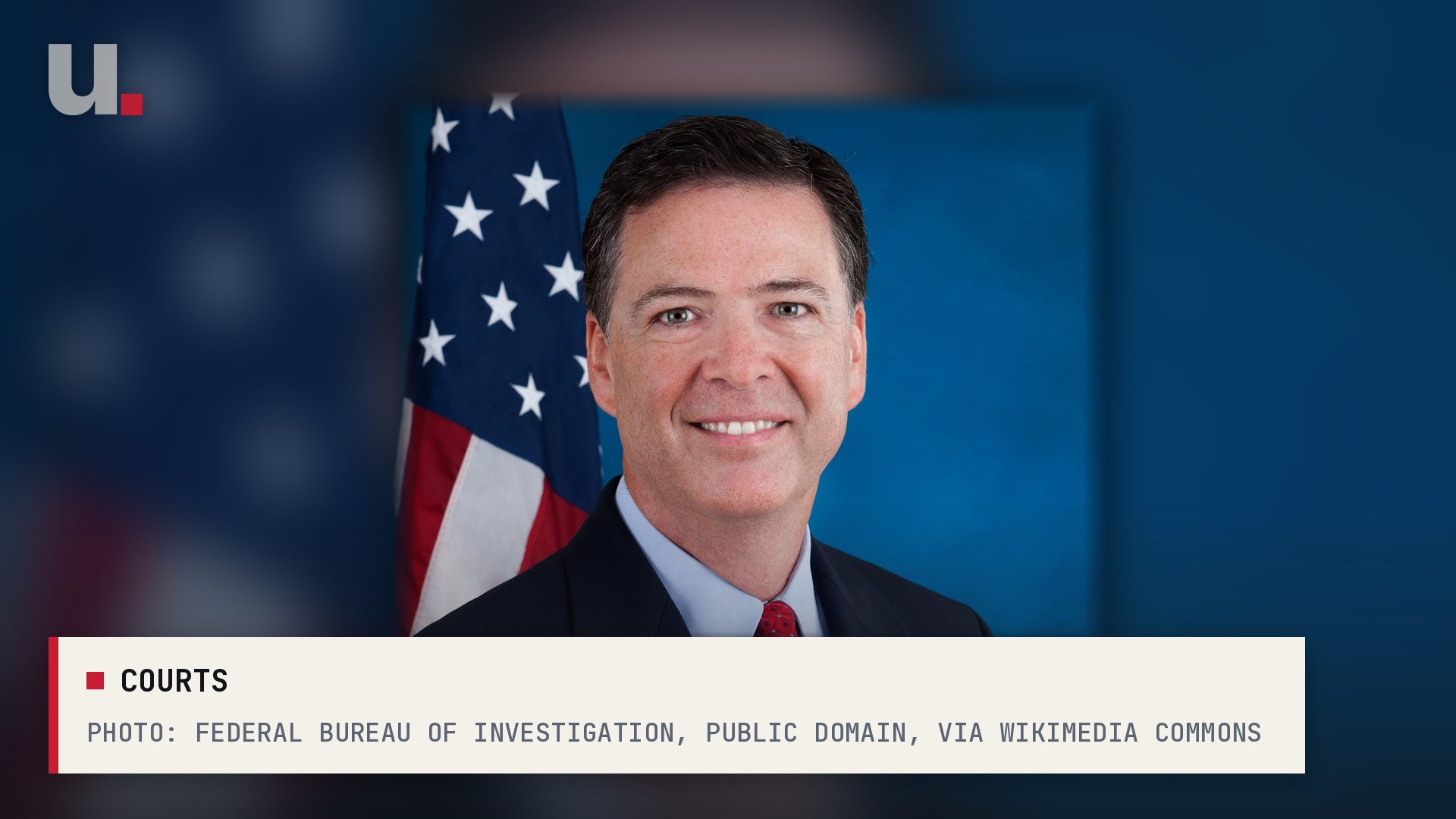
Former FBI Director James Comey has been charged with a federal crime for the third time. In a criminal information made public Monday in Washington, D.C., the Justice Department accuses him of passing national defense information to someone not entitled to it, and of conspiring with "others known and unknown" to do it. Each count carries up to 10 years in prison.
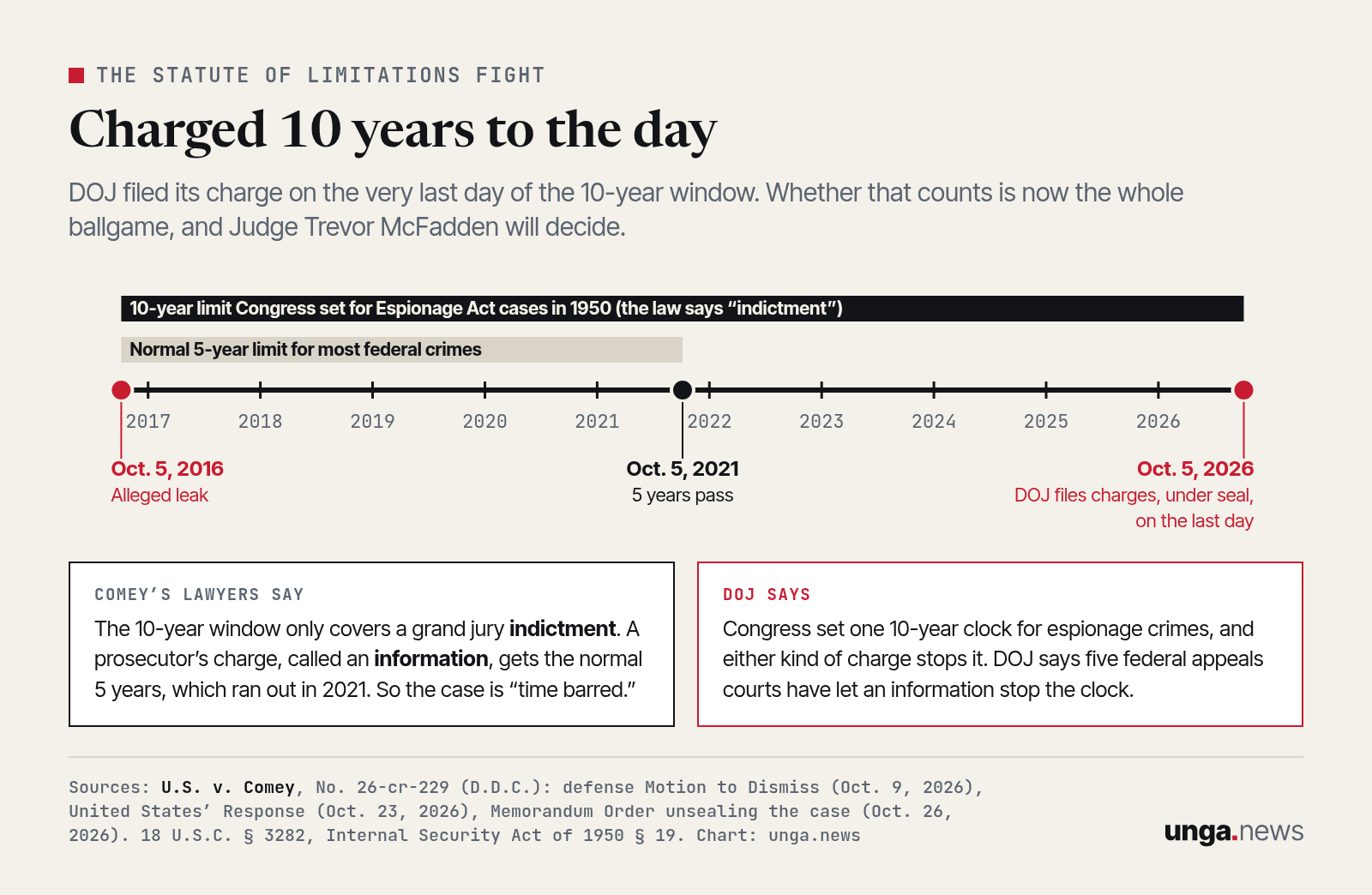
The alleged leak is a decade old. Prosecutors say that on Oct. 5, 2016, while Comey was running the FBI, he had staff give classified details to a New York Times reporter. They filed the charge on Oct. 5, 2026, exactly 10 years later, on the last day of the 10-year window Congress set for espionage cases. Comey says he is innocent, and his lawyers say DOJ missed the deadline.
What prosecutors say happened
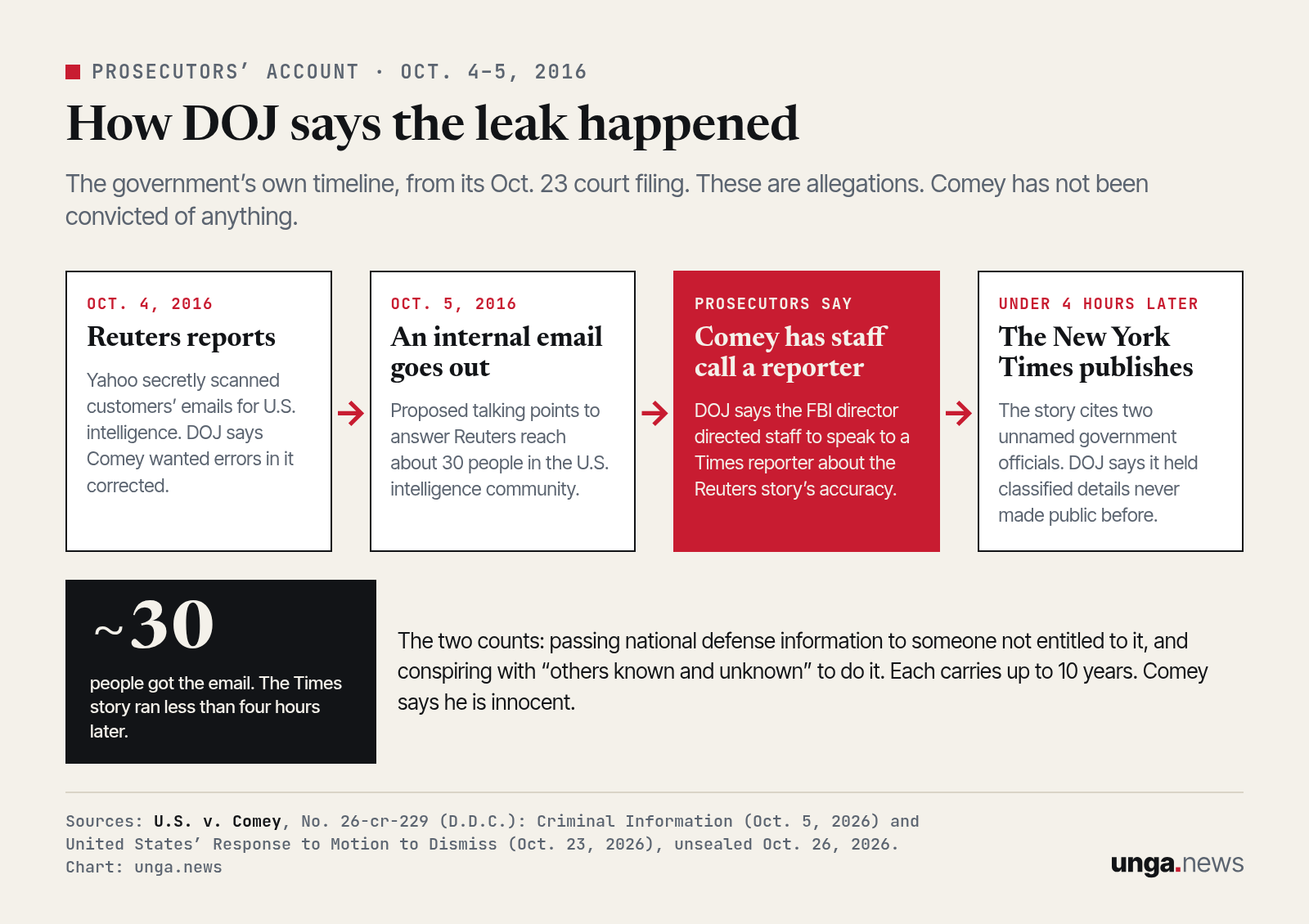
The story starts with a scoop. On Oct. 4, 2016, Reuters reported that Yahoo had secretly scanned its customers' incoming emails for U.S. intelligence. According to the government's Oct. 23 court filing, Comey wanted to correct what DOJ calls "misinformation" in that report.
The next day, an internal government email with proposed talking points to answer Reuters went to about 30 people in the U.S. intelligence community. Less than four hours later, The New York Times published "Yahoo Said to Have Aided U.S. Email Surveillance by Adapting Spam Filter," citing two government officials who spoke on condition of anonymity. DOJ says the article contained classified information disclosed for the first time and was "significantly similar" to the email.
"The investigation has uncovered evidence that Mr. Comey directed staff to speak to Mr. Savage about specific accuracy concerns related to the Reuters article, and thereby illegally transferred classified information," prosecutors wrote, referring to Times reporter Charlie Savage. The charging document says Comey, "through one and more co-conspirators," directed a person it calls Individual #1 to talk to the reporter.
Not the first time
This isn't the first time a watchdog has flagged Comey for sharing official information with the press. In August 2019, DOJ's inspector general found that after he was fired in 2017, Comey gave a friend one of his memos about conversations with President Trump, with instructions to share its contents with a Times reporter. That memo was not classified, but the inspector general's report said he broke FBI policy and his employment agreement, and kept four memos in a safe at home.
"Comey set a dangerous example for the over 35,000 current FBI employees," the report said. DOJ declined to prosecute him at the time.
The 10-year fight
The first fight is over a calendar, not the leak itself. Most federal crimes must be charged within five years. In 1950, Congress gave prosecutors 10 years for Espionage Act crimes like this one, but the law says an "indictment" can be found within 10 years. An indictment comes from a grand jury. What DOJ filed is an "information," a charge prosecutors file on their own.
Comey's lawyers say that matters. The 10-year window covers only indictments, they argue, so an information got the normal five years, which ran out in 2021. They also note that no grand jury has charged him, and say the clock has now run out for that too.
DOJ calls that a misreading. Congress set one 10-year clock for espionage crimes "and did not split that time by instrument," prosecutors wrote. They say the word "information" was left out only because the 1950 law copied an older statute, and that five federal appeals courts have recognized using an information to stop the clock. DOJ also says the motion is premature, since Comey can't be convicted without an indictment or his own waiver, and a grand jury is still investigating.
The case played out in secret for three weeks. Comey's lawyers rushed to court on Oct. 9 asking for an emergency hearing, saying they feared an arrest before the holiday weekend. Prosecutors said they had told his lawyer in writing that they were not seeking his arrest "at this time," and wrote that Comey "chose to believe 'the press' over the United States." On Monday, U.S. District Judge Trevor McFadden, appointed by President Trump in 2017, unsealed the case at Comey's request, with no objection from DOJ. He wrote that charges against a former FBI director over conduct in office "are of significant public interest." He will rule on the rest of the dismissal motion later.
Three cases in 13 months
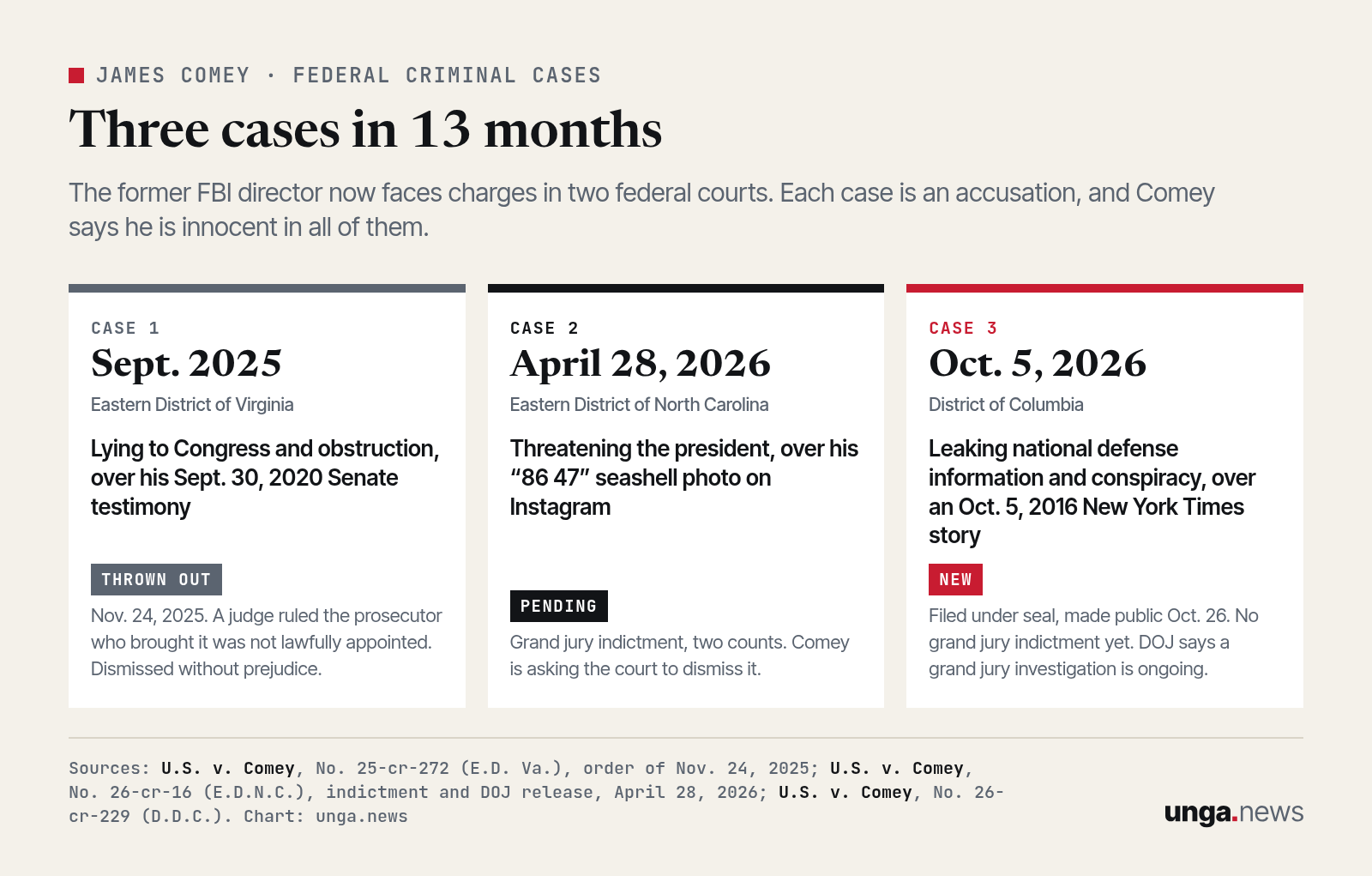
This is DOJ's third case against Comey since September 2025. The first, accusing him of lying to Congress, was thrown out in November 2025 after a judge ruled the prosecutor who brought it was not lawfully appointed. The second, filed in North Carolina in April, charges him with threatening the president over an Instagram photo of seashells spelling "86 47." He is fighting both.
Comey answered in a video posted to his Substack on Monday. "Well, they're back again. It would almost be funny if it weren't such an appalling abuse of the Department of Justice, one that we cannot become numb to," he said. "Nothing's changed with me. I'm still innocent." In their motion to dismiss, his lawyers wrote that "multiple other prosecution teams—including those led by former Special Counsel John Durham—have previously reviewed these same facts and declined to prosecute Mr. Comey multiple times."
How leakers usually fare
Leaking defense secrets has sent others to prison for years. Reality Winner, an NSA contractor who mailed a top secret report to a news outlet, got 63 months, which DOJ called the longest sentence ever for a media leak at the time. FBI agent Terry Albury got 48 months. Analyst Daniel Hale got 45 months for giving documents to a reporter. Air National Guardsman Jack Teixeira got 15 years for posting secrets online. All of them pleaded guilty.
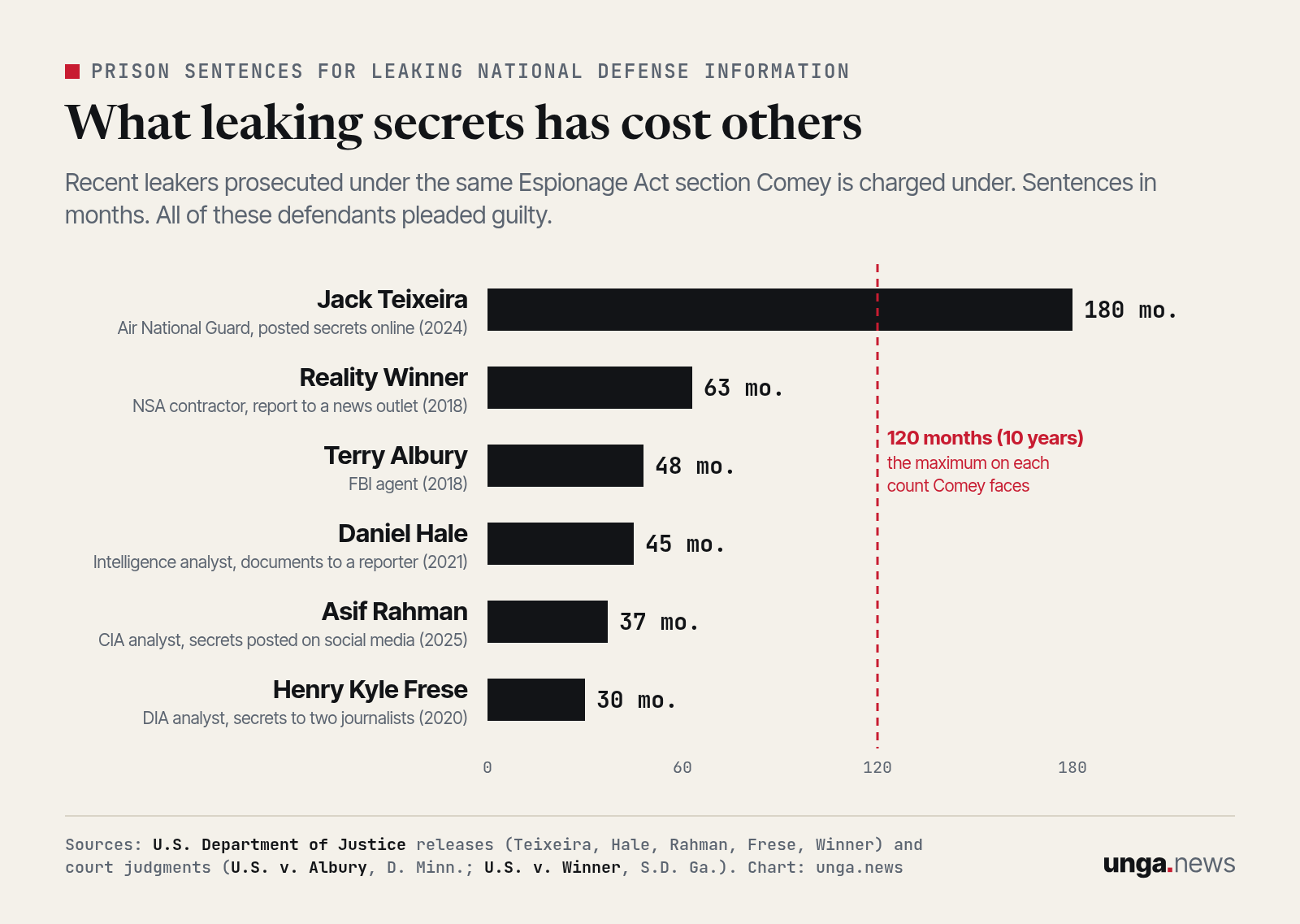
Those were lower-level employees. Comey's case is about one alleged disclosure, by the man who ran the FBI. That's what makes it unusual. If DOJ gets past the deadline fight, it would be a rare leak case aimed at the very top of the bureau.
The bottom line
DOJ says the FBI's own director had his people slip classified information to the Times to correct a story he believed was wrong. Comey says he did nothing wrong and the clock ran out years ago. Before any jury hears the facts, Judge McFadden has to decide a narrower question: did prosecutors beat the deadline, or did they miss it by filing the wrong kind of charge?
Sources
- U.S. District Court for D.C. — U.S. v. Comey, No. 26-cr-229: Criminal Information (filed Oct. 5, 2026, unsealed Oct. 26)
- U.S. District Court for D.C. — U.S. v. Comey: United States' Response to Motion to Dismiss (Oct. 23, 2026)
- U.S. District Court for D.C. — U.S. v. Comey: Defense Motion to Dismiss and for Emergency Hearing (Oct. 9, 2026), including prior declinations
- U.S. District Court for D.C. — U.S. v. Comey: Memorandum Order unsealing the case, Judge Trevor McFadden (Oct. 26, 2026)
- James Comey (Substack) — Yet another case in DC (video statement, Oct. 26, 2026)
- U.S. District Court for D.C. — U.S. v. Comey: Government Motion to Seal (Oct. 5, 2026)
- DOJ Office of the Inspector General — Report of Investigation of Former FBI Director James Comey's Disclosure of Sensitive Investigative Information and Handling of Certain Memoranda (Aug. 2019)
- DOJ Office of the Inspector General — Press release on the Comey memo report (Aug. 29, 2019)
- The New York Times — Yahoo Said to Have Aided U.S. Email Surveillance by Adapting Spam Filter (Oct. 5, 2016)
- U.S. District Court for E.D. Va. — U.S. v. Comey, No. 25-cr-272: Order dismissing the indictment (Nov. 24, 2025)
- U.S. Department of Justice — Federal Grand Jury Indicts Former FBI Director James Comey for Threats to Harm President Trump (April 28, 2026)
- Federal Judicial Center — McFadden, Trevor Neil: biographical directory of federal judges
- U.S. Department of Justice — Statement from U.S. Attorney Bobby L. Christine Regarding Sentencing for Reality Winner (Aug. 23, 2018)
- U.S. District Court for S.D. Ga. — U.S. v. Winner: Government sentencing memorandum (63 months)
- U.S. District Court for D. Minn. — U.S. v. Albury: Judgment (48 months)
- U.S. Department of Justice — Former Intelligence Analyst Sentenced to 45 Months for Disclosing Classified Information to Reporter (July 27, 2021)
- U.S. Department of Justice — Former Air National Guardsman Sentenced to 15 Years for Unlawfully Disclosing Classified National Defense Information
- U.S. Department of Justice — Former CIA Analyst Sentenced to Over Three Years for Unlawfully Transmitting Top Secret National Defense Information
- U.S. Department of Justice — Former DIA Analyst Sentenced for Leaking Classified Information to Journalists (June 18, 2020)
- Wikimedia Commons — James Comey official portrait (FBI, public domain)