

Congress Members Still Trade Stocks. 50 New Democrats Want the Ban Their Senators Killed.
A bloc of incoming House Democrats wants a stock trading ban in the House rules on day one, months after Republicans passed one and Senate Democrats blocked it.

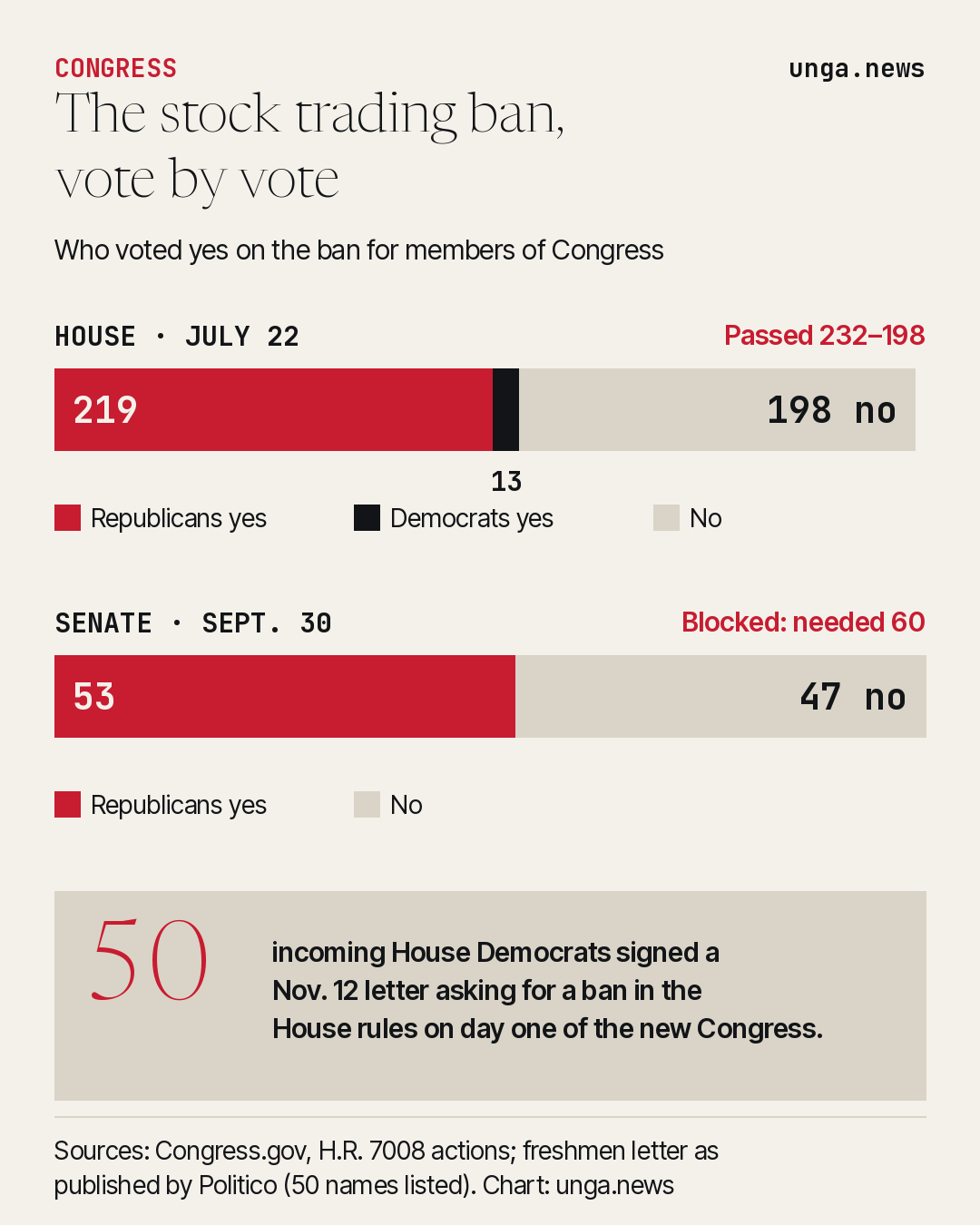
Fifty people who haven’t even been sworn in yet just told their own party’s leaders to stop stalling on the one reform almost every voter agrees on. In a letter dated Nov. 12, a bloc of incoming House Democrats asked Hakeem Jeffries and Katherine Clark to put a ban on members trading stocks into the House rules on the first day of the new Congress.
That is the new part. Last week this fight was about Rep. Anna Paulina Luna trying to force a lame-duck vote. Now the pressure is coming from inside the incoming majority, and it is aimed at the people who will run the House in January.
“Members of Congress are getting rich trading stock in the industries they regulate while the people they represent fall behind on rent and groceries,” the letter opens. A few lines later: “Nobody should leave Congress with millions more in their bank accounts.”
The Washington Times counted 51 signers, led by Reps.-elect Sarah Trone Garriott of Iowa and Jamie Ager of North Carolina. The copy Politico published lists 50 names, from Brad Lander in New York and Scott Wiener in San Francisco to Bobby Pulido and Johnny Garcia in South Texas.
A rule, not a law
What they are asking for is narrower than it sounds, and also faster. Every new Congress starts by adopting a rules package, the internal rulebook for the House. Write a stock ban into that package and it takes effect the day it passes, with no Senate vote and no president’s signature.
The letter spells out the scope. Members and their spouses could not own or trade “stocks, commodities, futures, derivatives, and other related securities,” with exceptions for things like a diversified mutual fund or a qualified blind trust. That is tougher on paper than the bill the House passed in July, which stopped new purchases but let lawmakers keep what they already held.
The catch is enforcement. A House rule binds only House members, and the only body that can punish a violation is the House Ethics Committee, which is made up of the same members it would be policing. The signers seem to know it. They call the rule “a down payment” on a real law covering “elected and appointed government officials and their spouses.”
Republicans already passed one
Anyone who follows this knows the House has been here before. The Stop Insider Trading Act, H.R. 7008, from Wisconsin Republican Bryan Steil, passed the House 232 to 198 on July 22. Republicans carried it. Only 13 Democrats voted yes.
Under the Congressional Research Service summary of the bill, members, spouses and dependent children could not buy stock in public companies and would have to give notice before selling. Break the rule and the fine is at least $2,000 or 10% of the trade, plus any profit. Broad funds stayed legal. The full text is on Congress.gov.
In the Senate on Sept. 30, the motion to take it up got 53 votes. Every Republican present voted yes. Every Democrat and independent voted no, leaving it seven short of the 60 needed to beat a filibuster.
Democrats said at the time that the bill was too weak because it let members keep existing holdings and skipped the president and vice president, and that a voter ID provision Republicans attached was a poison pill. The incoming freshmen don’t mention any of that. Their letter credits the election: “Democrats may have won the election, but we have a long way to go to earn back the trust of voters across the country.”
So the party that blocked a stock ban in September now has 50 new members arguing that blocking it cost them trust. Republicans can fairly take that as a compliment. They put the idea on the floor first and got it through the House.
Luna’s clock is still running
Meanwhile, the lame-duck fight hasn’t gone away. Luna, the Florida Republican, said in an interview published Nov. 12 that she has already filed the rule for a new discharge petition, the tool that lets 218 members force a floor vote over the leadership’s objections. Hers would extend the ban to the executive branch. “I’m actually going to be bringing one up on the executive branch being included in the insider trading ban next week,” she said. “So maybe we can get everyone to do something before this Congress ends.”
We covered her push when she announced it. The new letter changes the math around it. Fifty incoming Democrats can’t sign a discharge petition this year, since they aren’t members yet. But every sitting Democrat who wants to look serious on this issue now has a simple test in front of them in the next few weeks: sign Luna’s petition or explain why a ban is urgent in January but not in December.
There is a second test waiting in January. Jeffries posted on Nov. 9 that House Democrats “will move to ban members of Congress from trading stock,” and he and Chuck Schumer have both called a ban across all three branches a priority. The freshmen just handed him the easiest version: a rule his own majority can pass on day one without a single Republican vote or a single senator.
If the rules package comes out in January without it, these 50 will have their first fight with their own leaders before they’ve cast a vote on anything else. If it comes out with it, they’ll have adopted the core of a Republican bill they mostly ran against, and voters will get the ban either way.
Members of Congress have spent years explaining why the people writing laws on banks, drug companies and defense contractors should also be allowed to trade their shares. Voters never bought it. The only real question left is which party gets to say it finished the job, and Republicans got there first.
Sources
- Politico (document) — Letter from incoming House Democrats to Leader Jeffries and Whip Clark (Nov. 12, 2026)
- The Washington Times — Newly elected Democrats call on leaders to include stock trading ban in House rules (Nov. 13, 2026)
- Congress.gov — H.R.7008, Stop Insider Trading Act: all actions
- Congress.gov — H.R.7008, Stop Insider Trading Act: summary and text
- Where Is The Buzz — Rep. Anna Paulina Luna Moves to Extend Stock Trading Ban to the Executive Branch (Nov. 12, 2026)
- Hakeem Jeffries on 𝕏 — “House Democrats will move to ban members of Congress from trading stock.” (Nov. 9, 2026)