

Congress Strikes a Deal to Make Planes Warn Pilots About Nearby Aircraft After the DC Crash
Lawmakers agreed to require collision-warning gear on civilian planes in busy airspace, 22 months after 67 people died over the Potomac. The military’s rules are still unsettled.

Twenty-two months after an airliner and an Army helicopter collided over the Potomac River and killed 67 people, Congress says it has finally agreed on the fix the families have been begging for: making planes in busy airspace carry gear that warns pilots when another aircraft is close.
Sen. Ted Cruz, the Texas Republican who chairs the Senate Commerce Committee, announced the deal Tuesday on the lawn below the Capitol, standing with families of the victims of American Airlines Flight 5342. “The Senate and House at long last have reached an agreement in principle to mandate ADS-B In for all flights that are required to broadcast ADS-B Out,” Cruz said.
The catch is that the deal covers civilian planes only. The rules for military aircraft, including helicopters like the Black Hawk involved in the crash, are still being negotiated with the House Armed Services Committee.
What the gear actually does
Most planes flying in crowded airspace already carry something called ADS-B Out. It broadcasts the aircraft’s position to air traffic controllers and to anyone else listening. The Federal Aviation Administration has required it in much of the country’s controlled airspace for years.
ADS-B In is the other half. It lets a cockpit receive those signals and shows pilots nearby traffic with sounds and on-screen alerts. The National Transportation Safety Board has recommended requiring it since 2008, CBS News reported, but the FAA never did.
Under the Senate-passed version of the bill, known as the ROTOR Act, planes already required to broadcast their position would need to carry the receiving gear by Dec. 31, 2031, according to AeroTime. Small private planes under 12,500 pounds could use cheaper options, including portable receivers. A vintage plane or hot-air balloon flying legally without ADS-B Out would not automatically have to add it.
The warning the crew never got
The collision happened on the night of Jan. 29, 2025, about half a mile from Ronald Reagan Washington National Airport. All 64 people aboard the regional jet, operated by PSA Airlines, and all three soldiers in the Black Hawk were killed.
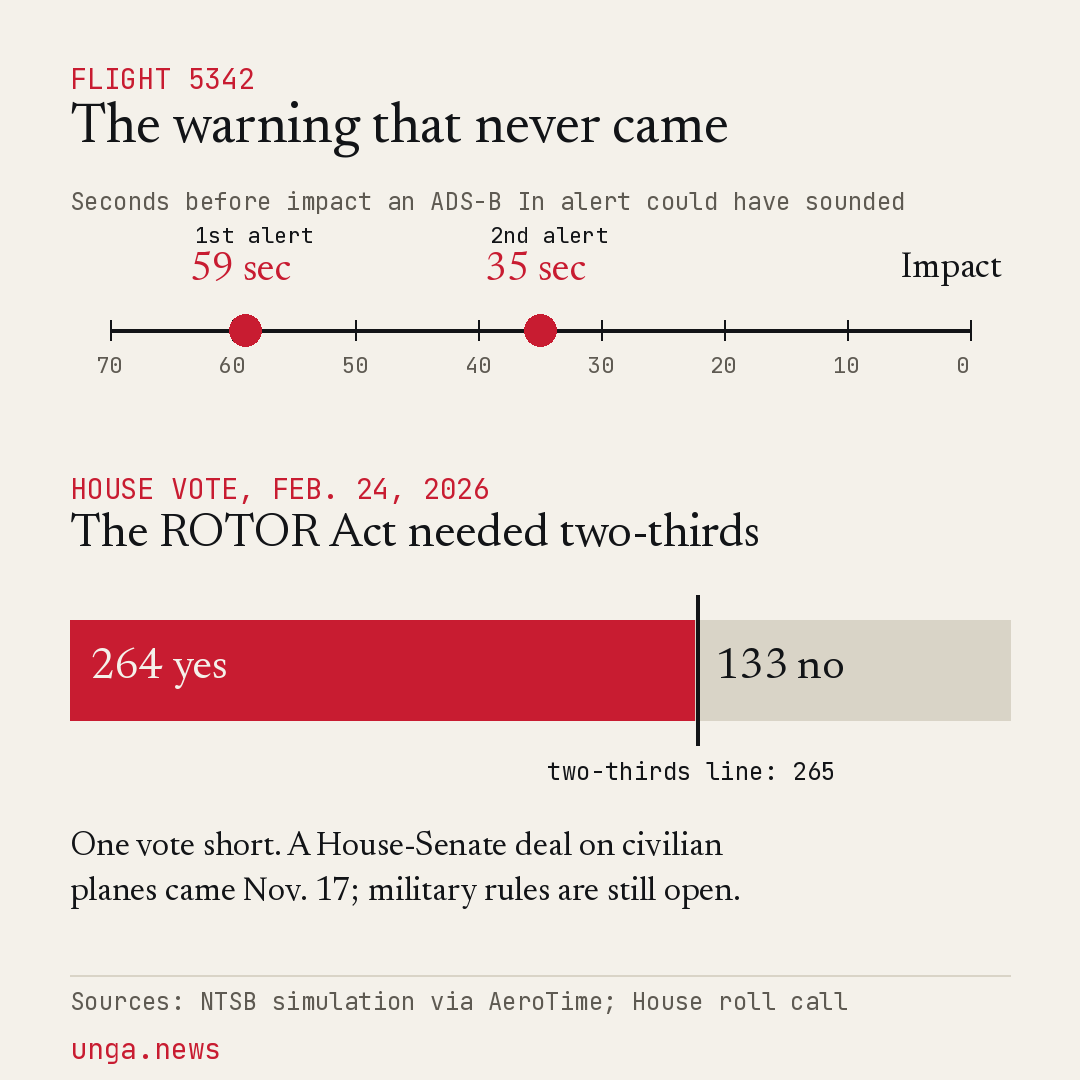
An NTSB simulation found that an ADS-B alerting system could have warned the airliner’s crew about the helicopter 59 seconds before impact, with a second warning 35 seconds out. The jet’s existing collision avoidance system worked as designed, but built-in altitude limits kept it from telling the pilots how to maneuver away. The board issued 50 recommendations after its investigation.
Cruz put it bluntly. The crash “was preventable, and we knew how to prevent it,” he said. If the aircraft had been using ADS-B In, he said, both crews “would have seen each other with plenty of time to avoid the collision.”
One vote short, then a year of waiting
The Senate passed the ROTOR Act by unanimous consent in December 2025. In February, the House took it up under a fast-track rule that needs two-thirds support. It got 264 votes to 133, one short. CBS News reported the Pentagon had pulled its support over the requirements the bill would put on military aircraft.
The House then passed its own version, the ALERT Act, from Rep. Sam Graves, a Missouri Republican who chairs the House Transportation Committee. It would make broadcasting their location the default for military helicopters except on security-sensitive missions, and also sets a 2031 deadline for civilian ADS-B In.
Sen. Maria Cantwell of Washington, the committee’s top Democrat, said the two sides reached the civilian deal last Thursday. It covers ADS-B In, helicopter routes, ADS-B Out and fees. “While we have a deal in principle on the civil provisions, we do not have an agreement on the military provisions,” she said.
Cruz said he wants the military side to step up. “The military must be a willing partner with the Department of Transportation and the FAA to make sure that what happened that January never, ever happens again,” he said.
Pilots and families push to finish
Transportation Secretary Sean Duffy and FAA Administrator Bryan Bedford joined the families at the event, which opened with 67 seconds of silence. Three chairs holding folded flags honored the soldiers lost.
“Pilots can’t avoid what we can’t see,” said Capt. Jason Ambrosi, president of the Air Line Pilots Association, the largest pilots union in the world. The union lost two of its members in the crash, and it wants the receivers built into cockpits and tied to their alarms rather than shown on a portable device.
Cruz said his goal is to pass the bill before this Congress ends. “I believe we’re going to get this bill done,” he said. “And my objective is to get it done this year, with this Congress, before we leave for the new year.”
Sources
- CBS News — Deal on stalled airline safety bill announced by Cruz with families of D.C. plane crash victims
- AeroTime — US lawmakers reach aircraft safety deal after fatal Washington collision
- Reuters via Investing.com — House, Senate lawmakers reach deal on key aviation safety provisions
- Air Line Pilots Association — ALPA Welcomes Bipartisan Agreement to Require ADS-B In, Urges Congress to Finish the Job
- Congress.gov — H.R.7613 – ALERT Act