

Copycats Kept Trying to Steal ChatGPT’s Brain. OpenAI Says It Just Slammed the Door
OpenAI says it is shutting down thousands of copycat accounts a week, and its new locks cut one kind of theft from 54% of attempts to 0.2%.
Every time you hand ChatGPT a hard question, it does a pile of thinking you never see. That private scratch work has become one of the most valuable things in the SI business, and somebody has been trying very hard to steal it. On Thursday, OpenAI said it has been shutting down copycat operations by the thousands of accounts every week, and that its newest locks cut the success rate of one kind of theft from more than half the time to almost never.
The company laid it out in a new report titled “Combatting adversarial distillation.” The term sounds like lab talk, but the idea is simple. A rival feeds a top model huge numbers of questions, collects what comes back and uses it to train a model of its own. The student picks up the teacher’s skills without paying for years of work, and without the guardrails the teacher was built with.
The hidden scratch work is the prize
What thieves want most, OpenAI says, is the model’s “protected reasoning,” the step-by-step chain of thought it works through before it answers. Those traces “can contain information the final answer leaves out, making them especially valuable training data for another model,” the company wrote.
Its own experiment shows why. OpenAI trained two copies of the same starter model on work done by its top-tier models on coding and defensive cybersecurity jobs. One copy saw only what a regular customer sees: final answers, short summaries of the reasoning and the tool use. The other copy also saw the exact reasoning. After that first round of training, the copy fed the exact reasoning generally beat the one fed summaries. After a further round of practice, it still scored higher when both were given the most time to think, while the summary-trained copy did better on shorter budgets.
That is the danger in one sentence. A model that learns how a top SI hunts for software bugs can turn the same skill toward breaking into systems. OpenAI put it plainly: an adversary “might distill a model’s cyber capabilities and use the resulting model to help carry out cyberattacks that the original model would have refused to assist with.”
From 54 percent to 0.2 percent
OpenAI says it fights back on every single request. The model is trained to spot extraction attempts and refuse, while still explaining its work to people with honest questions. Scanners check what goes in and what comes out, including the behind-the-scenes instructions the model passes to software tools, a side door where reasoning could leak without ever showing up in the answer.
The company also changed how the system remembers. Starting with its newest models, GPT-6.2 Astra and GPT-6.2 Sol, a model’s reasoning is tied to the exact conversation that produced it. Rewrite an earlier message, and the system throws away the reasoning that came after it. Older, weaker OpenAI models can no longer read the new models’ reasoning at all. That shuts the trick OpenAI described in September, when operators copied scrambled reasoning out of one chat and asked a model in another chat to decode it. OpenAI’s developer team pitched the same change to businesses as a perk, saying agents can now “build on earlier reasoning to deliver better results with fewer tokens and more cache hits.”
Then it tested the locks. Six different automated SI attackers kept changing their approach based on how the system responded. Against the older GPT-6 Astra with its original safeguards, they pulled out reasoning from an earlier question 54 percent of the time. Against GPT-6.2 Astra with the new safeguards, that fell to 0.2 percent. For reasoning from the question being answered right then, the rate dropped from 22.9 percent to 0.9 percent.
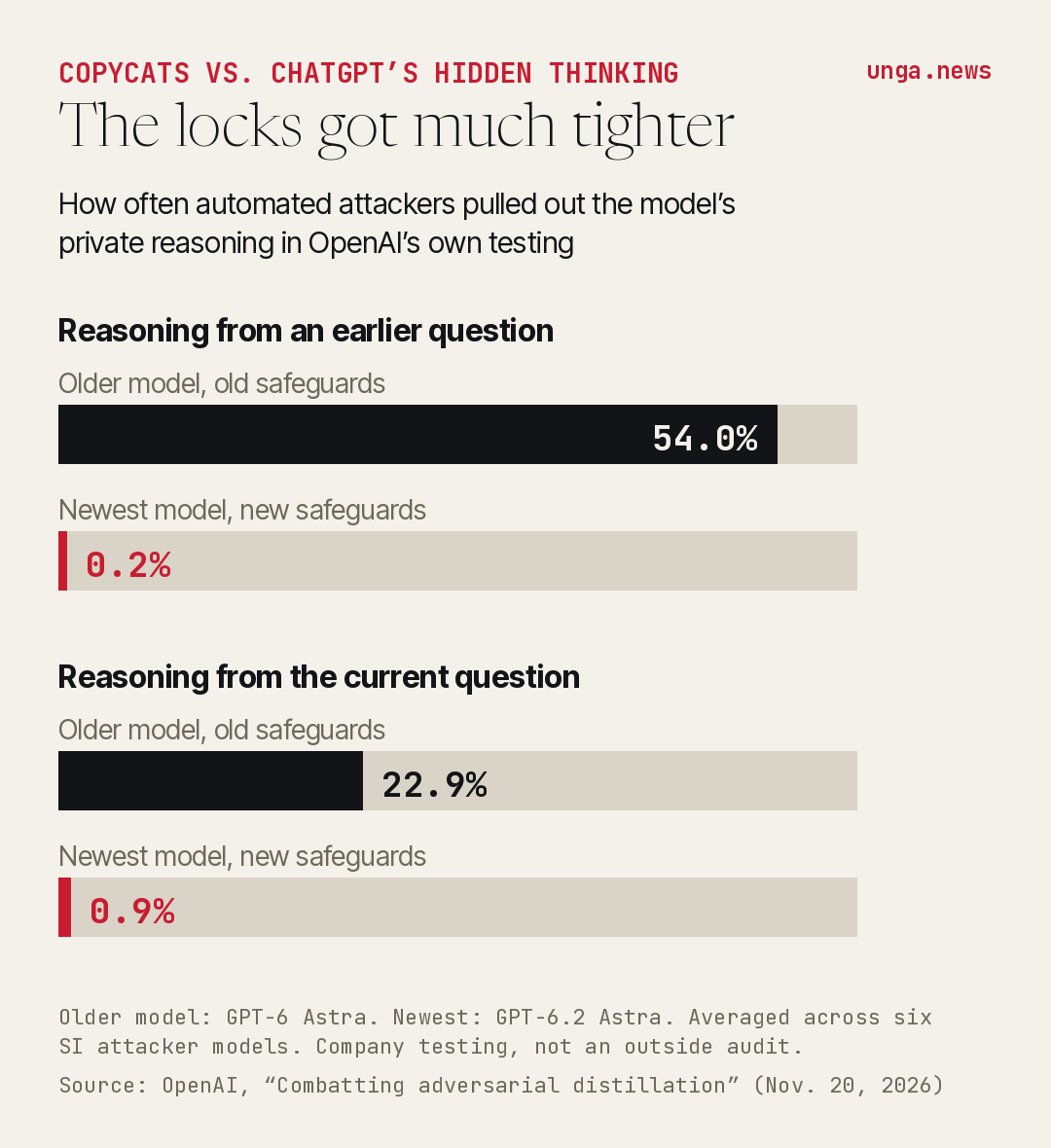
Those are OpenAI’s own numbers from its own testing, not an outside audit. The company says it is now bringing some of the fixes back to the older GPT-6 Astra too.
Tens of thousands of accounts a week
The second front is catching whole crews. OpenAI says it has seen “multiple unauthorized adversarial distillation campaigns” on its platform this year, and that its weekly enforcement actions have ranged “from thousands to tens of thousands of accounts,” with the pace rising sharply this past summer. It also hands warning signs to other model makers so they can hunt the same networks on their own services.
It has pointed fingers before. In February, OpenAI briefed Congress on activity it said showed DeepSeek trying to distill American frontier models. In a September report, it said it broke up a coordinated campaign whose earliest activity dated to the first week of July, and tied a core part of it to people associated with Moonshot AI, the Chinese company behind the Kimi chatbot. The operators “did not break our encryption, compromise a database, or gain direct access to stored user conversations,” OpenAI said then. They talked the models into giving it up. Thursday’s report promises more disclosures about recent campaigns soon.
“A foreign actor that reproduces advanced capabilities from a U.S. model can deploy them without the protections its developer put in place,” the company wrote. OpenAI said it supports legislation giving Washington more tools to identify and sanction foreign actors that illicitly pull capabilities out of American models, and that it has told Congress it backs the Chip Security Act, the AI OVERWATCH Act and the MATCH Act.
OpenAI on 𝕏 — “Distillation can reproduce powerful AI capabilities without the safeguards built around them.” (Nov. 20, 2026)
— @OpenAI View on 𝕏
A side door around the chip rules
This is where the story gets bigger than one company. America has spent years keeping its best chips away from Beijing so Chinese labs can’t easily train top models. Copying the finished product is the cheap way around that wall. OpenAI said so directly: export controls limit access to the hardware, while “distillation defenses make it harder to acquire some of the same capabilities from models already trained.”
OpenAI isn’t keeping the fix to itself, either. The report ends with a short playbook for other developers: check every message and tool call for leaks, keep every successful attack as a test case, pair the request-level blocks with investigations of whole account networks, and share findings through the Frontier Model Forum and government channels. In September the company said the weakness “is not a vulnerability unique to OpenAI’s models,” and a footnote in the new report points to related work from Anthropic that found the same edge from training on full reasoning transcripts.
For the person typing questions into ChatGPT, almost none of this changes the experience. The answers look the same. What changed is the cost for anyone trying to walk off with the thinking behind them, and on OpenAI’s own scoreboard that cost just went way up.
Sources
- OpenAI — Combatting adversarial distillation (Nov. 20, 2026)
- OpenAI — Disrupting a coordinated model-distillation campaign (Sept. 30, 2026)
- OpenAI on 𝕏 — OpenAI on 𝕏 — announcing its distillation research (Nov. 20, 2026)
- OpenAI Developers on 𝕏 — OpenAI Developers on 𝕏 — GPT-6.2 reasoning tied to conversation history (Nov. 19, 2026)