

CrowdStrike Will Pay Nearly $44 Billion for the Company Guarding Office Internet Traffic
The company behind the security software on millions of work computers is buying Zscaler, which checks the traffic going in and out. Zscaler owners get a 34% premium.
If you work for a big company, there’s a good chance two pieces of software you’ve never thought about are watching your back right now. One sits on your laptop and looks for anything strange happening on it. The other sits between you and the internet and checks every connection you make. On Monday, the company behind the first agreed to buy the company behind the second.
CrowdStrike announced before the opening bell that it will acquire Zscaler in an all-stock deal valuing Zscaler at about $43.9 billion. Zscaler shareholders will get 1.135 CrowdStrike shares for each share they own. Based on CrowdStrike’s closing price Friday, that works out to about $260.41 a share, a premium of roughly 34%.
Both boards approved it unanimously. Zscaler founder Jay Chaudhry and his affiliates, who hold about 34% of Zscaler’s shares, have already signed agreements to vote for it. When it’s done, current CrowdStrike owners will hold about 84.1% of the combined company and Zscaler owners about 15.9%.
Two guards, one gate
CrowdStrike, based in Austin, Texas, makes the Falcon software that runs on company laptops, servers and cloud machines and hunts for attackers. Zscaler, based in Santa Clara, California, does a different job. Instead of the old office firewall and VPN, it routes workers’ traffic through its own cloud and checks each connection before letting it through.
The two have worked side by side for years. CrowdStrike says they already share more than 2,000 customers and 16 product hookups, and that customers have been asking them to join forces. CrowdStrike put its reasoning in one line: “The endpoint is where the agent runs. The network is where it goes.”
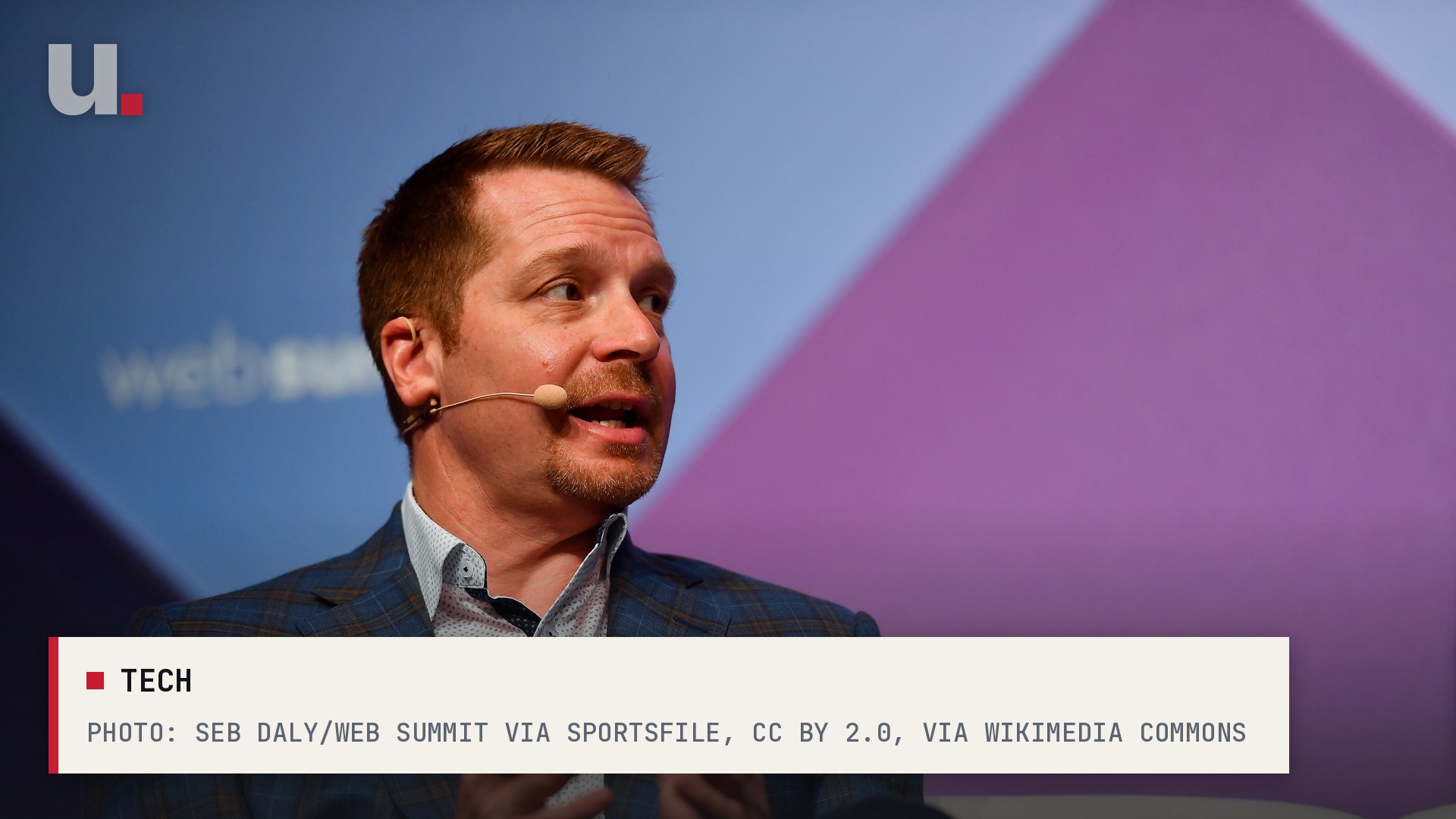
That word “agent” is the heart of the pitch. Companies are starting to turn SI agents loose to do work on their own, pulling files, sending messages and logging into systems. Every one of those agents is a new door a hacker can try. CrowdStrike chief executive George Kurtz framed the deal around that shift.
“Security used to be about keeping the adversary out. Today, safety is required to let AI in,” Kurtz said. “The network used to connect people to places. Now it connects agents to data.” He went further: “We see a path to become the largest AI safety and security company the world has ever seen.”
Chaudhry, who will keep running the Zscaler business and join CrowdStrike’s board, called it “the natural evolution of our longstanding partnership.” He also warned that “AI agents are rapidly becoming the new weakest link.” Kurtz will lead the combined company.
The numbers behind the price
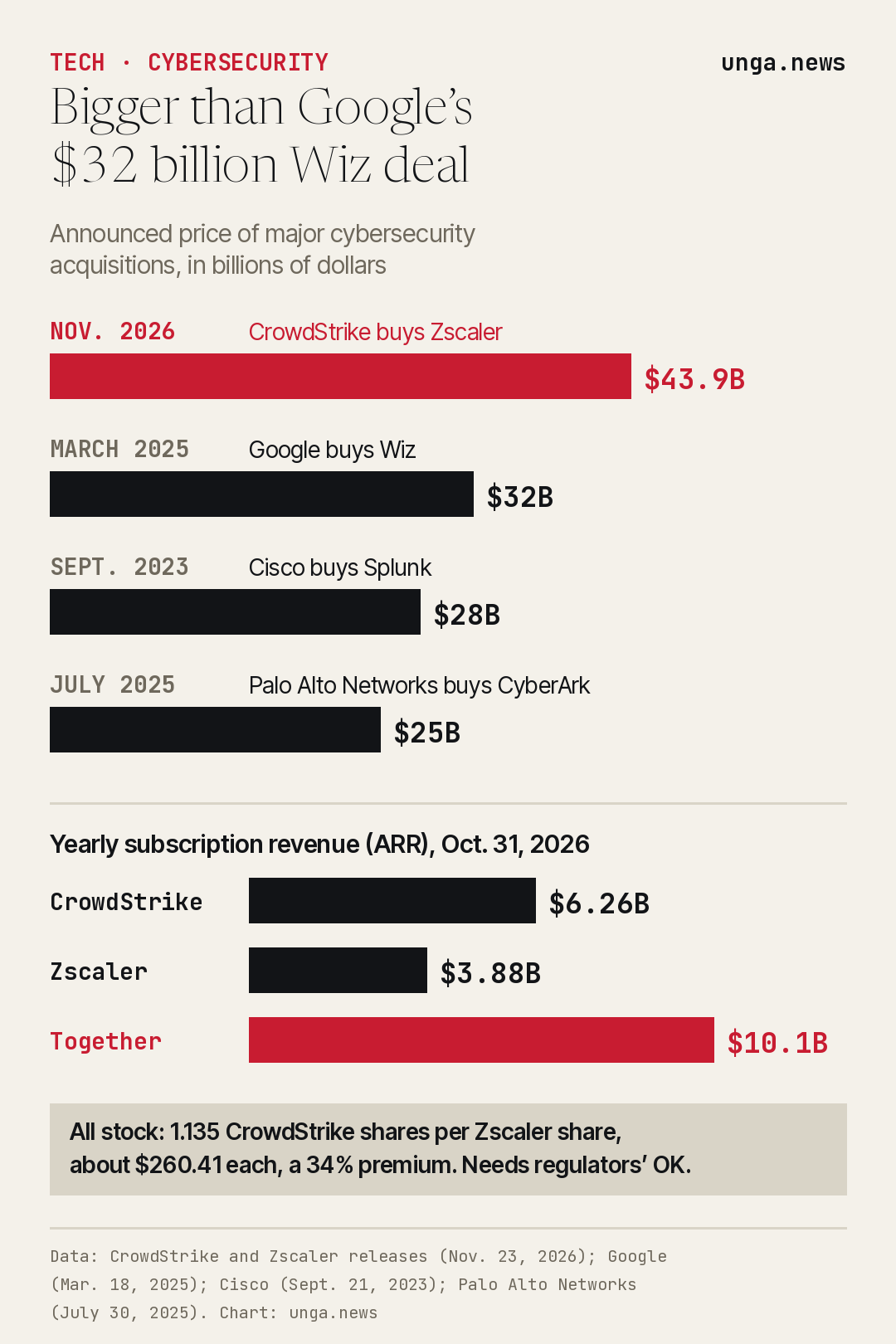
The price is bigger than the $32 billion Google agreed to pay for cloud security firm Wiz in March 2025, and well above Cisco’s $28 billion Splunk deal and Palo Alto Networks’ $25 billion CyberArk deal. CNBC called it one of the largest cybersecurity deals on record.
Both companies released quarterly results the same morning, and neither is buying or selling from weakness. CrowdStrike said its quarter ending Oct. 31 was “the best quarter in CrowdStrike’s history.” Its yearly recurring subscription revenue hit $6.26 billion, up 27%, and it added a record $419.2 million of new recurring revenue in three months. It also posted record free cash flow of $474 million and a small profit of $24.9 million under standard accounting rules, after a loss a year earlier.
Zscaler’s numbers were solid too. Revenue rose 20% to $949.3 million, recurring subscription revenue grew 21% to $3.88 billion, and free cash flow was a record $416.5 million. Zscaler canceled its earnings call and pulled its full-year forecast because of the deal.
Put together, the two companies start out with more than $10 billion in yearly subscription revenue. CrowdStrike says it can wring about $500 million a year in costs out of the combined business within 18 to 24 months, mostly from data centers and vendors, and expects about $1 billion a year in extra sales within 30 months by selling each company’s products to the other’s customers. About 8,000 Zscaler customers don’t use CrowdStrike yet, and CrowdStrike says Zscaler protects half of the Fortune 500.
Wall Street’s first read
Traders split the way they usually do in a stock deal. Zscaler shares jumped more than 13% before the market opened, CNBC reported, while CrowdStrike fell more than 8%. A buyer paying a 34% premium in its own stock tends to take that hit on day one, and this one lands while the market is already shaky. The S&P 500 slid into correction territory Friday, more than 10% off its October high, after a sell-off in SI-linked stocks, the Associated Press reported.
There’s also a long road to the finish line. Shareholders still have to vote, regulators still have to sign off, and CrowdStrike doesn’t expect to close until the second half of its fiscal 2028, a window that runs from roughly August 2027 to January 2028. Until then, the two companies keep operating separately. Their own release lists the usual risks, from winning regulatory approval to the hard work of merging two big companies.
Fewer vendors, one bill
For the companies that buy this stuff, the pitch is simple: fewer vendors, one contract and one set of data. CrowdStrike says customers of either company will be able to add the other’s products on a single Falcon Flex contract after closing. It also wants to pour Zscaler’s more than 750 billion daily transactions into the same pool as its own device data, so its security models can follow an attacker’s whole path from the network to the machine.
For everyone else, the deal is a reminder of who stands between American businesses and the hackers trying to break in. Two homegrown companies, one in Texas and the other in Silicon Valley, are betting that the next wave of break-ins will come through software agents moving around company networks. They are building one shop to stop them. If the regulators let it through, the guard on the laptop and the guard at the gate will finally answer to the same boss.
Sources
- CrowdStrike — CrowdStrike to Acquire Zscaler, Bringing Network Security and Zero Trust to the Falcon Platform (Nov. 23, 2026)
- CrowdStrike — CrowdStrike Reports Third Quarter Fiscal Year 2027 Financial Results (Nov. 23, 2026)
- Zscaler — Zscaler Announces First Quarter Fiscal Year 2027 Financial Results (Nov. 23, 2026)
- CNBC — CrowdStrike to buy Zscaler (Nov. 23, 2026)
- Associated Press — US futures climb and world shares are mixed as big tech stocks fall in Asia (Nov. 23, 2026)
- Google — Google announces agreement to acquire Wiz (Mar. 18, 2025)
- Cisco — Cisco to Acquire Splunk (Sept. 21, 2023)
- Palo Alto Networks — Palo Alto Networks Announces Agreement to Acquire CyberArk (July 30, 2025)