

Democrats Make 2028 Hopefuls Swear Off Secret Money, but Only Until They Face a Republican
The DNC set 12 primary debates starting next June and a pledge to denounce dark-money ads. The pledge ends at the general election, and in 2020 secret money backed Biden over Trump more than six to one.
The Democratic National Committee wants its 2028 presidential candidates to swear off secret money. Read the fine print and the promise has an expiration date: the day the party picks its nominee and the race against a Republican begins.
On Monday the DNC announced its framework for the 2028 primary: 12 debates, five in 2027 and seven in 2028, with the first two in June and July of next year and the last one in March 2028. Every candidate who wants a spot on stage has to sign what the party calls the Fair Campaign Practices Pledge, a promise to denounce “dark money” ads that help them or tear down a Democratic rival.
DNC Chair Ken Martin sold it as a victory lap. “Democrats are on offense after our historic victories in the midterms,” he said, “and the DNC is keeping our foot on the gas as we head into the 2028 cycle.”
A promise built to end in the fall
The DNC’s own pledge page spells out what is covered and what isn’t. The rule reaches ads paid for by 501(c)(4) nonprofits, which don’t have to name their donors, and by super PACs, which can raise unlimited sums. It covers TV, radio, digital, billboards and mail. It applies only to spending that promotes a Democratic candidate or attacks a Democratic opponent in the primary.
Spending that “only targets Republican candidates” is spelled out as not covered. The DNC also told reporters the pledge does not apply to the general election. So a group that hides its donors can spend freely against Republicans the whole cycle, and once the primary is settled it can go all in for the Democratic nominee without breaking any party rule.
Even inside the primary, the pledge doesn’t stop a dime. The candidate only has to denounce the ads. The money can keep flowing. Only a rival campaign that has signed the pledge can file a complaint, and the DNC rules on it. A candidate who refuses to denounce is disqualified from the debates until he does.
NBC News called it “a relatively symbolic pledge” that doesn’t have the teeth to stop outside spending. Axios noted that super PACs could keep spending on behalf of candidates who publicly distance themselves. Those are not conservative outlets. That is the mainstream read of the party’s own rulebook.
The party that won the secret-money race
Here is why Republicans have reason to roll their eyes. In the last open presidential race, the money that hid its donors broke heavily for Democrats.
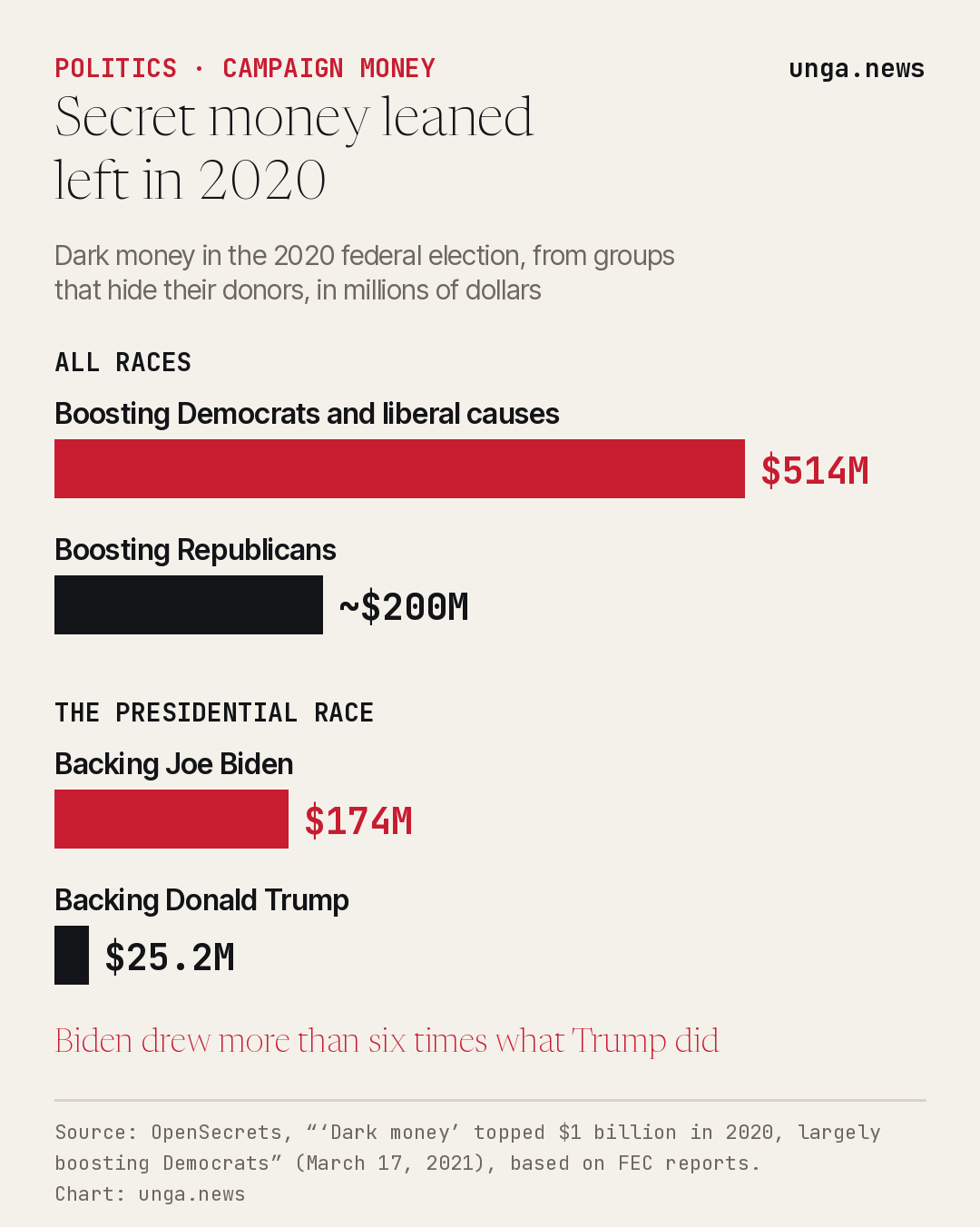
The nonpartisan watchdog OpenSecrets counted more than $1 billion in dark money in the 2020 election. Of what was reported to the Federal Election Commission, liberal groups directed more than $514 million into the race, against about $200 million that boosted Republicans. In the presidential contest alone, Joe Biden drew about $174 million in support from anonymous donors, more than six times the $25.2 million that backed Donald Trump.
OpenSecrets found that the top pro-Biden super PACs, including Future Forward USA, American Bridge 21st Century, Priorities USA Action and Unite the Country, all took multimillion-dollar checks from the Sixteen Thirty Fund, a liberal network that does not disclose its donors. Future Forward alone poured around $100 million into ads backing Biden.
So the party is now asking its candidates to reject, for a few months and only against each other, the same tool that helped carry its nominee to the White House. Once the primary ends, nothing in the pledge asks them to give it up.
Who signed on, and who runs the stage
The DNC rolled out a list of early backers. Sen. Bernie Sanders said candidates “should be chosen by the American people, not billionaires and their Super PACs.” Sen. Elizabeth Warren called it “a powerfully important step in getting big money out of politics.” Reps. Greg Casar, Maxwell Frost and Pramila Jayapal said Congress “must work to ban all Super PACs by law.”
That last line tells you a lot. The same wing of the party that wants to ban outside spending by law has to settle for a debate-stage rule inside its own primary, because, as the DNC admits on its own site, it “does not have the legal authority to ban super PACs or dark money groups.” Free speech still protects groups that want to run ads, and the Supreme Court has said so since Citizens United.
The pledge also comes with party-control rules. Candidates can’t sign joint fundraising deals with any Democratic Party committee until they become the presumptive nominee, and state and local parties are barred from running ads for one candidate over another. ABC News reported the provision follows a Supreme Court ruling earlier this year that lifted limits on coordinated spending between candidates and parties.
Then there is the stage itself. Candidates may do solo town halls and forums, but if two or more of them share a stage in a debate the DNC didn’t sanction, they lose eligibility for future DNC debates. The party will cap the field at 20, split early debates across two nights if needed, and decide qualifying rules on polling and fundraising in January. It also plans to bring “creators and influencers” into the debates to chase viewers.
Democrats have a history here. In 2024 the party held no primary debates at all while Biden ran for a second term, and challengers who wanted a stage never got one. This time the DNC is promising a big, open field. It is also making sure it alone decides who gets the microphone.
Six early states, and a crowded field
Six of the seven debates in 2028 will be held in early-voting states: South Carolina, Nevada, New Hampshire, New Mexico, Michigan and Virginia, according to ABC News. Exact dates, cities and media partners for the first two debates come in January.
The DNC’s 2028 debate team is led by senior adviser Minyon Moore and executive director Roger Lau, with alumni from the Biden, Sanders, Warren, Klobuchar, Obama, Clinton and Harris campaigns. The schedule looks a lot like 2020, when Democrats held 11 debates starting in June 2019 and more than two dozen candidates ran.
Voters of every stripe are tired of not knowing who is paying for the ads that fill their screens every fall. A rule that only lasts until the fall, and only binds Democrats against other Democrats, isn’t much of an answer to that. Republicans can judge the party by what its allies spend in November 2028, when the pledge no longer applies.
Sources
- Democratic National Committee — DNC Announces Framework for the 2028 Democratic Presidential Primary Debates (Nov. 23, 2026)
- Democratic National Committee — 2028 Democratic Primary Process: The Presidential Primary Fair Campaign Practices Pledge
- Democratic National Committee — Presidential Primary Fair Campaign Practices Pledge (PDF)
- Democratic National Committee — WTAS: Support from Every Wing of the Democratic Party for DNC Effort to Limit Dark Money in 2028 Presidential Primary (Nov. 23, 2026)
- OpenSecrets — ‘Dark money’ topped $1 billion in 2020, largely boosting Democrats (March 17, 2021)
- NBC News — Democratic National Committee sets broad rules for the party’s 2028 presidential debates (Nov. 23, 2026)
- ABC News — Democrats holding 12 debates in 2028 cycle, requiring candidates denounce ‘dark money’ (Nov. 23, 2026)
- Axios — DNC limits 2028 primary candidates’ ties to big-money groups (Nov. 23, 2026)