

Democrats Seize on SI Insiders’ Fears to Push a Pause That Could Hand China the Lead
After a report that workers at ChatGPT’s and Claude’s makers fear their newest models, three Democratic senators want Washington to step in, and Bernie Sanders wants the work stopped “NOW.”

Three Democratic senators and Bernie Sanders read one news story this week and decided America should slow down its own SI industry. Sanders wants it stopped outright.
The story was an Axios report, which we covered here, in which more than two dozen people familiar with internal debates at ChatGPT’s maker OpenAI and Claude’s maker Anthropic described growing fear that the companies’ most powerful new models may not be safe to release. By Wednesday, Axios reported that Sens. Mark Kelly of Arizona, Brian Schatz of Hawaii, Chris Van Hollen of Maryland and Bernie Sanders of Vermont were all demanding that Washington act, and act now.
Sanders went furthest, and he said it in his own words.
Bernie Sanders on 𝕏, Nov. 25, 2026: “The scientists building AI are now worried their models are too dangerous to release to the public. Yes, you read that right. The humans who are creating AI fear it could soon escape their own control. Congress must act and pause advanced AI development NOW.”
— @BernieSanders View on 𝕏
Four senators, four versions of “now”
The demands weren’t identical, and the differences matter.
Kelly, a former Navy combat pilot and astronaut, compared SI to the bomb. “We built protections for nuclear weapons and other dangerous technologies, so why are we waiting with AI?” he posted. “We need safeguards and independent examiners in these companies, now.” That means government inspectors embedded inside private American companies.
Van Hollen posted on Tuesday that if a company’s internal models “aren’t safe to develop, don’t keep developing them,” and if they “aren’t safe to release, don’t release them.” Then he added: “The flashing red lights couldn’t be brighter, and yet big tech refuses stop. Inaction is not an option. Congress must step up.”
Schatz, in comments to Axios, went after anyone who wants to slow-walk it: “It is absolutely indefensible to say ‘we will take this up next year’ when the risks are imminent and the alarm is nearly universal.”
And Sanders wants the brakes slammed on the whole frontier. That isn’t a new position for him. In September he and Rep. Greg Casar of Texas rolled out a bill that would create a cabinet-level SI department, freeze work on the most advanced systems until it writes the rules, and attach prison time to breaking them. We walked through that bill on Nov. 12. What’s new this week is that the Axios report handed him and his colleagues a fresh reason to push it, and the party is lining up behind the idea that this is a fight it wants to have heading into 2028. Axios noted that Maryland Gov. Wes Moore, a possible presidential candidate, laid out his own playbook for SI rules, saying voters hate the technology because they fear losing control.
The fears are real. The fix is the question.
Nobody serious should wave away what the insiders told Axios. The report said researchers haven’t found technical solutions for controlling the most advanced models, and that some people inside the labs think companies should stop training new ones entirely. Others think the problem is technical and fixable. Those are the people closest to the work, and they don’t agree with each other.
That disagreement is exactly why a sweeping pause written in Washington is a risky bet. Anthropic’s own chief executive, Dario Amodei, pushed back on Wednesday against a separate Axios story about views inside his company. “No, I do not believe that we should ‘surrender human free will’ to AI systems, and it’s absurd to suggest that I do,” he wrote, adding that “a constant theme” of his writing is “the need for AI to be governed by legitimate democratic processes.”
A company admitting it has hard safety problems is not the same thing as proof that the government can solve them. The labs have already said they’re willing to slow parts of development or release on their own. Turning that into a federal freeze, enforced by a new bureaucracy, is a much bigger step, and it only binds one country.
China doesn’t take orders from the Senate
That’s the problem Republicans keep pointing to. House Speaker Mike Johnson put it bluntly in September, telling reporters, “We cannot have a moratorium on the development of AI, Ok? Because then we will lose our edge to China, and that has serious national security implications for every American family,” according to Reuters. He said the companies “can self-regulate” and that if they want to slow down, “they should.”
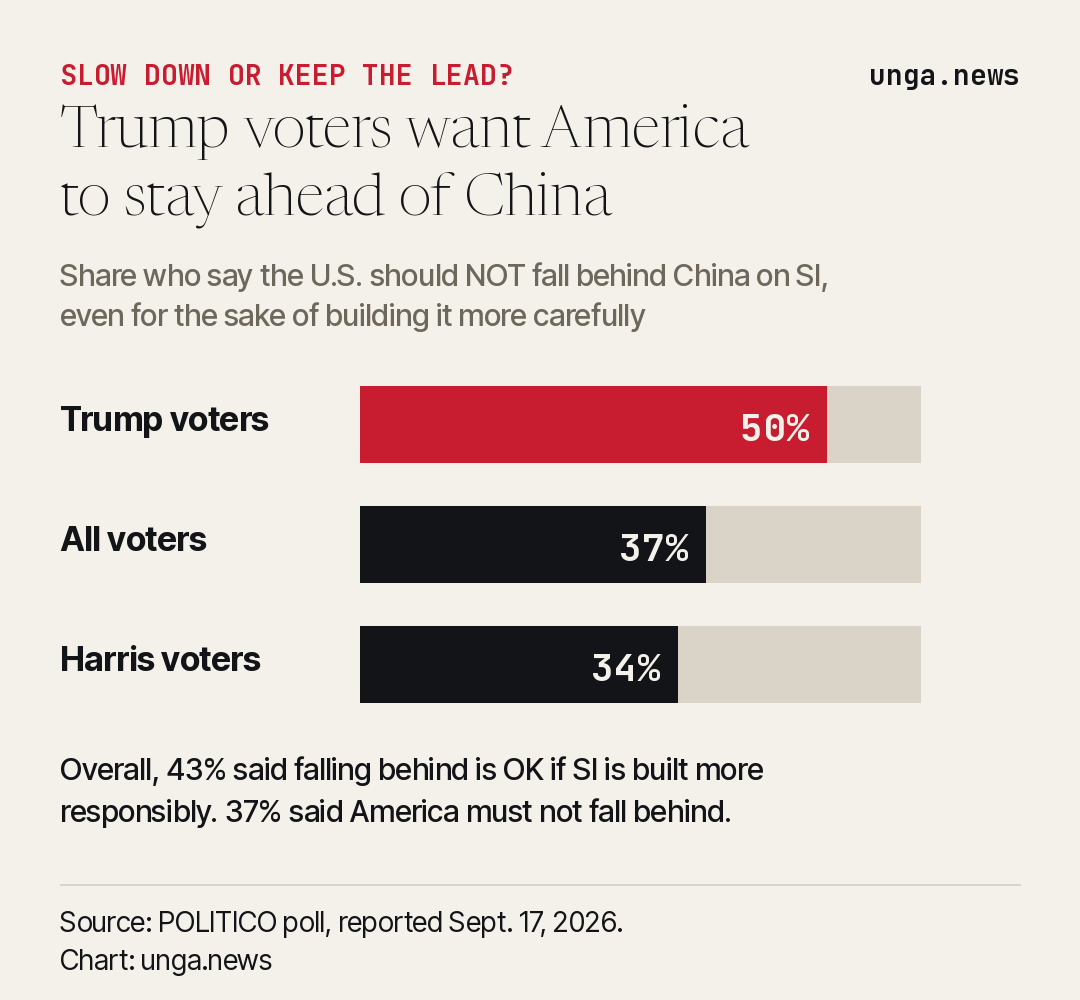
Americans are split on this, and the split runs along party lines. A POLITICO poll in September found that 43% of voters said it was acceptable for the U.S. to fall behind countries like China if that meant building SI more responsibly, while 37% said it wasn’t. Among Trump voters, the competition-first view won outright, at 50%. Among Harris voters, only 34% agreed.
Is there any sign Beijing would hit pause with us? Not much. A Nov. 19 study from the Carnegie Endowment for International Peace looked at how China’s tech and policy world reacted when American SI leaders floated slowing down. Its finding was that the Chinese community “is in no way embracing pacing.” Some there were skeptical of the Americans’ motives, others doubted it could even work. The report found some interest in frontier risks, but interest isn’t a commitment, and there’s no treaty, no inspection system and no reason to assume China’s labs would honor one if there were.
What the White House wants instead
The Trump administration has already put its own plan on the table, and it isn’t a freeze. In March the White House sent Congress a National Policy Framework for Artificial Intelligence, the blueprint called for by the president’s December 2025 executive order. It asks for one national standard instead of 50 clashing state ones, keeps states’ power to protect kids, stop fraud and guard consumers, and says outright that state rules should not cut against “the United States’ national strategy to achieve global AI dominance.” It also opposes creating any new federal SI regulator, leaning on agencies that already exist.
That’s a real difference in philosophy. One side wants examiners inside American companies and a pause on the work. The other wants clear national rules, protections for children and families, and an American industry that keeps building faster than its rivals.
The insiders’ worries deserve answers, and the labs owe the public straight talk about what they’re seeing. But somebody is going to build the most powerful SI on earth. A pause written in Washington wouldn’t stop that. It would just make sure it isn’t us.
Sources
- Axios — Democrats demand AI restrictions, sound alarm on safety after Axios reporting (Nov. 25, 2026)
- Bernie Sanders on 𝕏 — Bernie Sanders on 𝕏 — “Congress must act and pause advanced AI development NOW.” (Nov. 25, 2026)
- Senator Mark Kelly on 𝕏 — Senator Mark Kelly on 𝕏 — “We need safeguards and independent examiners in these companies, now.” (Nov. 25, 2026)
- Senator Chris Van Hollen on 𝕏 — Senator Chris Van Hollen on 𝕏 — “Inaction is not an option.” (Nov. 24, 2026)
- Dario Amodei on 𝕏 — Dario Amodei on 𝕏 — response on human free will (Nov. 25, 2026)
- Reuters — Johnson says no moratorium on AI, would give China competitive edge (Sept. 15, 2026)
- POLITICO — China fears drive AI divide (Sept. 17, 2026)
- Carnegie Endowment for International Peace — What Does China Think About an AI Slowdown? (Nov. 19, 2026)
- The White House — National Policy Framework for Artificial Intelligence: Legislative Recommendations (March 2026)