

Democrats Sued to Silence Trump’s Pro-America Ads. A Biden-Picked Judge Just Said No.
With the midterms over, a Washington judge ruled the DNC couldn’t show real harm and let her pre-election freeze on the White House ads expire. It’s the second judge in a week to turn Democrats down.
Democrats spent the fall in court trying to pull President Trump’s pro-America ads off the air. On Wednesday they ran out of road. A federal judge in Washington, an appointee of Joe Biden, refused to turn her pre-election freeze into a longer ban, ruling that the Democratic National Committee could not show any real, imminent harm now that the votes have been counted.
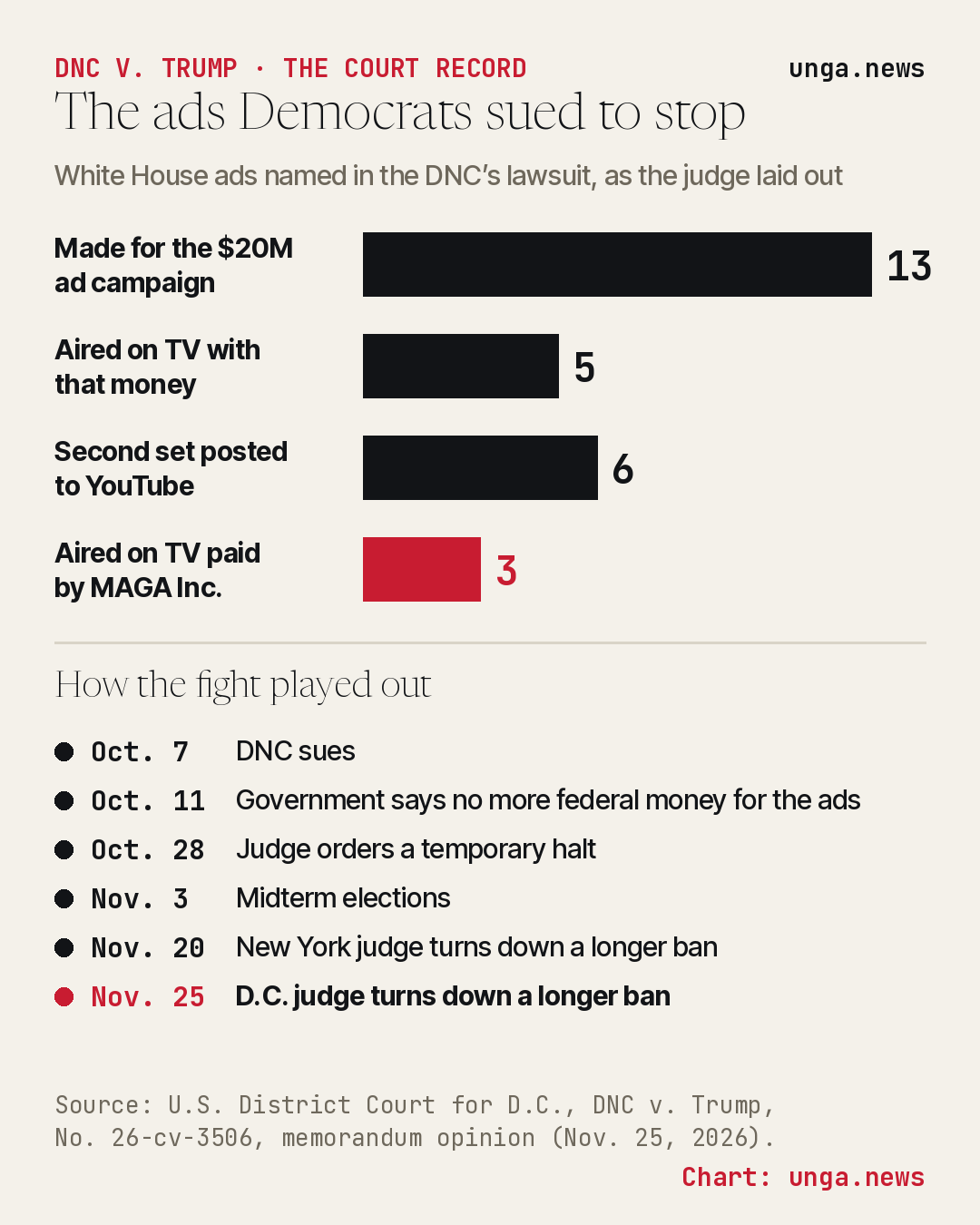
U.S. District Judge Loren AliKhan denied the DNC’s request for a preliminary injunction and a stay in DNC v. Trump. Her October 28 order, issued less than a week before the midterms, had frozen a $20 million pot of money and barred the White House budget office and the Department of Homeland Security from making or airing the challenged spots. That freeze had been stretched to Wednesday while she weighed the new request. It is now over.
Her bottom line was blunt. “At this juncture and on this record, the court is unpersuaded,” she wrote in a 25-page ruling.
This is the second time in less than a week that a judge has turned the left down on these ads. On November 20, U.S. District Judge Jennifer Rochon in New York denied a similar request from Common Cause, a group of unions and an Alabama state House candidate, for the same reason: the election was over, so the emergency was over.
Patriotic spots, paid for in the open
The ads at the heart of the fight were not hidden. Every one carried a tag reading “Paid for by the U.S. Government.” According to the opinion’s summary of the DNC’s complaint, the White House developed at least 13 spots for a national media campaign run through a $20 million DHS purchase order with LMD Agency, an advertising firm. Five aired on TV starting in September: “The Country He Loves,” “Maduro,” “Final Battle,” “Mount Rushmore” and “American Military Power.”
The money came from the One Big Beautiful Bill, from a line set aside for “commemorating efforts and events related to border security.” Democrats called that propaganda. The administration called it promoting the country. One 30-second spot paired the president’s own voice denouncing communism, socialism and Marxism with a pop song, the kind of message most Americans would have once called mainstream.
A second set of six videos went up on the White House YouTube channel in mid to late October, including “Every Democrat Voted Against No Tax on Tips,” “$5,000 to Americans,” “Man in the Arena” and “Cost of Socialism.” Three of those aired on TV, and none of that airtime was taxpayer money. MAGA Inc. paid for it.
Trump took the money question off the table weeks ago
The DNC’s whole case was about who paid. Trump answered that early. On October 5 he posted on Truth Social that he would cover the ads himself. “The Radical Left is upset with the fact that I am taking Ads, which I consider to be a positive promotion for our Great U.S.A., and paying for them with U.S.A. money,” he wrote. “Although nothing will make them happy, I have decided to do the Patriotic Ads, among others, and pay for them myself, and with money I raised for MAGA, Inc.”
The government followed through in court. In an October 11 filing, it told the judge the administration would no longer use federal funds to air the challenged ads. A DHS financial official swore in a declaration that the department had “no plans to make any additional media buys” under the order or to renew it. The DNC itself told the court that MAGA Inc. stopped buying TV time for the second set of ads after November 4.
So by the time Democrats came back asking for more, there was nothing left on the air to stop. That is the part they could not get around.
Grasping at Louisiana and 2028
After the midterms the DNC tried to keep the emergency alive by pointing to Louisiana’s December congressional runoffs and to elections in 2027 and 2028. The judge didn’t buy it. She found no real link between the ads and any harm in the Louisiana races, and she treated the later elections as too far off and too speculative to justify a court order today.
The legal standard here is not new or exotic. Courts in Washington have long held that the harm needed for this kind of emergency order must be “certain and great,” “actual and not theoretical,” and urgent enough to need relief now. A party committee that wants a judge to keep policing a president’s ads years before the next presidential race has a hard time clearing that bar, and it didn’t.
Honesty matters here, so here is the other side of the ledger. AliKhan did not bless the spending. In a footnote she said nothing in the ruling should cast doubt on her earlier view that the DNC’s administrative-law claim against the budget office and DHS was likely to succeed. The case is still alive, and she asked both sides for a joint status report by December 9 on what comes next. She also said the picture could change if evidence tied an ad to a specific candidate or race.
But a lawsuit without an emergency is a much smaller weapon, and Democrats know it. The DNC told The Hill it was “disappointed” and vowed to “fight on to put an end to the Trump administration’s attempts to undermine our democracy.” That is a lot of fire for a fight over ads that already stopped running on the public dime.
A pattern Democrats keep repeating
Step back and the shape of this is familiar. When the White House talks up No Tax on Tips, warns about socialism or salutes the military, Democrats reach for a lawyer before they reach for a better argument. Administrations of both parties have long used public money to promote their programs, and Congress has carried the same propaganda ban in spending bills since 1951. The fight is always over where promotion ends and politics begins, and the voters, not a party committee, are the ones who get to judge that.
They had their chance on November 3. Now two federal judges in two cities have told the left the same thing in the same week: the election is over, and a court is not the place to keep relitigating a commercial. Trump said he’d pay for his patriotic ads himself, his side did, and the people who wanted them banned walked away with nothing new.
Sources
- U.S. District Court for the District of Columbia — DNC v. Trump, No. 26-cv-3506 (LLA), memorandum opinion and order denying preliminary injunction and stay (Nov. 25, 2026), full text via LAWS.com
- The Hill — Judge sides against Democrats on taxpayer-funded pro-Trump ads (Nov. 25, 2026)
- Associated Press — Judge declines to issue a long-term ban on taxpayer-funded, pro-Trump ads (Nov. 25, 2026)
- Associated Press — Judge declines long-term ban on Trump’s taxpayer-funded ads that aired during the midterm elections (New York case)
- President Donald J. Trump on Truth Social — Truth Social account of President Trump (Oct. 5, 2026 post quoted in the court opinion)