

Democrats Weigh Shutting the Government Down Before Christmas to Defund the Iran Mission
Funding runs out Dec. 11. Some Senate Democrats want to spend their last weeks of leverage cutting off war money, and their own party can’t agree it’s worth the pain.

Funding for the federal government runs out on Dec. 11. That is two weeks before Christmas, and it falls squarely inside the last stretch of Republican control of Congress. A group of Senate Democrats now wants to spend those final weeks of leverage on one thing: cutting off money for the Iran mission, even if the price is the fourth partial shutdown since January 2025.
Sen. Tim Kaine of Virginia is leading the push. He wants a provision in the stopgap bill that ends war funding, and he told NPR’s Claudia Grisales that the administration has only one way to keep it going. “If you want to keep waging war against Iran, there is a path to do it,” Kaine said. “Come and seek a congressional authorization, which they should’ve done from the first day.”
Here is the problem for Kaine. The math of the Senate hands his party a veto right now, because most bills need 60 votes and Republicans don’t have 60. In about six weeks, his party takes the gavel in both chambers anyway. He is asking federal workers, and the troops whose paychecks ride on the same bill, to absorb a holiday shutdown so Democrats can do in December what they will be able to try in January with a majority.
Even Democrats can’t say it’s worth it
The clearest sign this is a reach is that Democrats are arguing with each other about it in public. “The big obstacle is that we don’t want to fund the war, we don’t want to shut down, how do you solve that,” Sen. Peter Welch of Vermont told Reuters. “That’s the Gordian knot.”
Rep. Rosa DeLauro, the top Democrat on House Appropriations, was blunter. “Shutting the government down doesn’t stop the war,” she said. “How do you strategically move to get that done? Without shutting down the government, that’s where I am on this issue.”
Colorado’s John Hickenlooper went the other way, or close to it. He wouldn’t give his own position, but he suggested high energy prices could justify cutting off the money. “A shutdown of government right before the holidays is a tough nut. You wouldn’t do it if it wasn’t dire. This is pretty dire,” he said.
The split runs straight into the Democrats’ own leadership fight. Maryland’s Chris Van Hollen backs the Kaine approach, and NPR reports it is central to his long-shot challenge to Chuck Schumer for majority leader. That vote is set for Dec. 1, ten days before the deadline. Schumer, per NPR, has not committed to a strategy. Republicans say that is the real holdup: Democrats won’t negotiate a funding deal until they settle who is in charge of them.
Senate Republicans have been saying it plainly.
Senate Republicans on 𝕏 — “Withholding pay from millions of Americans, including the military, two weeks before Christmas is not what Americans voted for.” (Nov. 20, 2026)
— @SenateGOP View on 𝕏
Majority Leader John Thune put it in the record a few days earlier, noting that Democrats “have already shut down the government twice this Congress, including the longest shutdown in history.” Reuters counts three shutdowns since Trump returned to office, including a Homeland Security funding cutoff earlier this year. “The American people don’t need another government shutdown,” Thune told reporters this week. “I think that would be a colossal mistake and a real disservice to the people of this country.”
The Republican answer: pay for the missiles
Republicans have a simple case, and it isn’t only hawks making it. Sen. Thom Tillis of North Carolina, who has been critical of the war, told NPR that pulling money suddenly puts service members in the region at risk, and that Congress has to refill stockpiles of weapons like Patriot missiles. “That’s a legitimate funding request,” Tillis said. “And if the Democrats won’t play ball with us, then we, clearly, we have to use every device we can to do it.”
That device is budget reconciliation, the process that lets the majority pass spending on party lines with a simple majority. President Trump has asked for $350 billion in new Pentagon money and has pushed Republicans to move it that way. The conference met behind closed doors for more than an hour this week. For now, Reuters reports, Senate Republicans chose to open bipartisan talks on a $1.1 trillion defense appropriations bill that carries $69 billion of that request, while keeping reconciliation on the table.
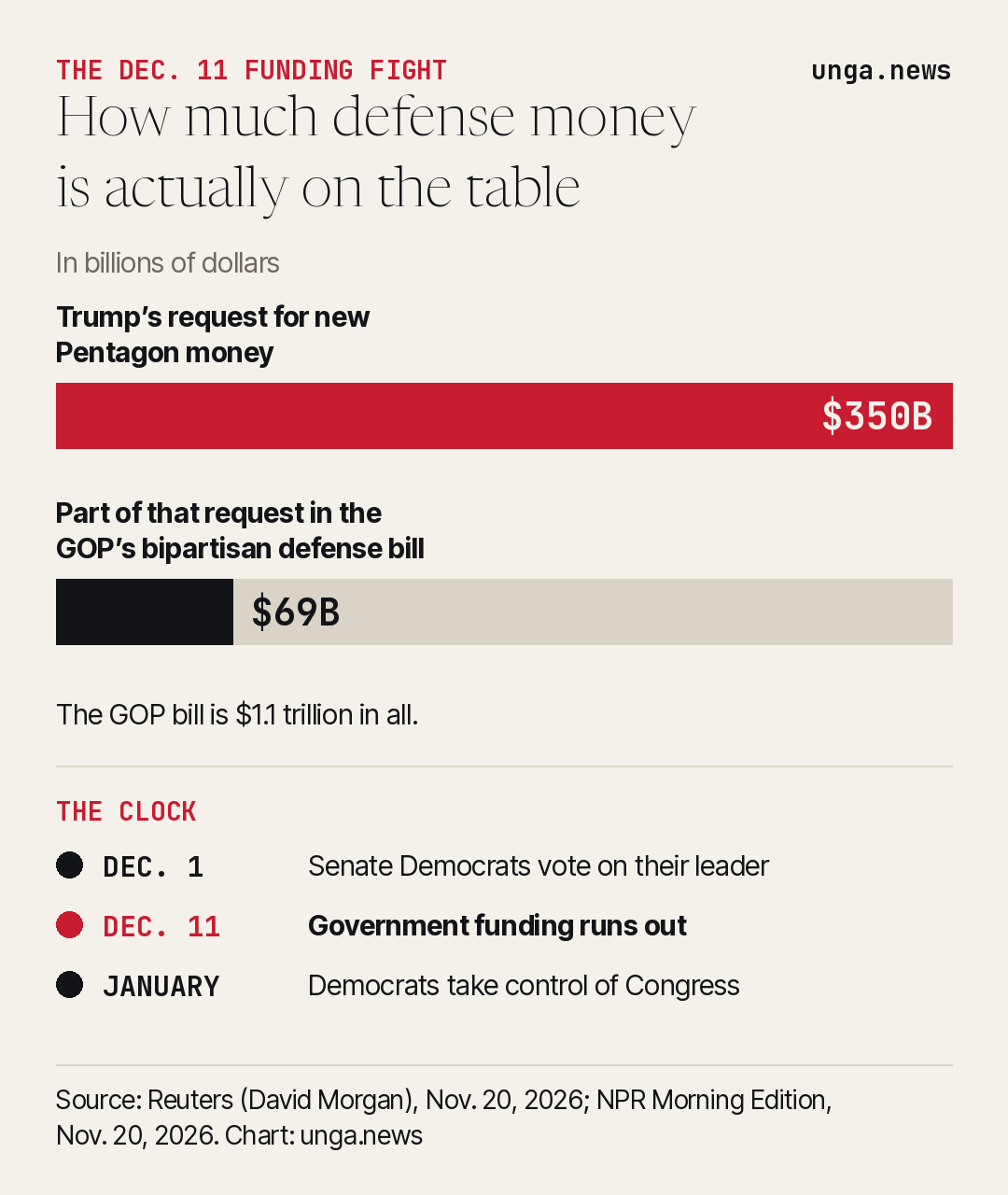
Look at that gap. Republicans walked into the talks already carrying a fraction of what the president asked for, which is about as reasonable an opening offer as a lame-duck majority makes. Democrats answered by floating a cutoff of the mission itself.
Two weeks, one holiday break, and no bill
The calendar is the other villain here. Congress is gone this week for Thanksgiving, which leaves roughly two working weeks in December to write and pass whatever comes next. Sen. Mike Rounds of South Dakota told The Hill that almost nobody expects the 12 regular spending bills to get done. “Everybody’s talking about a continuing resolution,” Rounds said, likely one running “until sometime in February or March.”
Sen. John Boozman of Arkansas said posted bills could become the frame for a hybrid package, the kind of partial deal Congress calls a cromnibus. DeLauro agreed that finishing all 12 is “not possible,” but said a number of them could get out, with a stopgap covering the rest. Rounds warned Reuters that without faster talks or a decision on reconciliation, “We’re going to run out of time.”
That leaves the country with a choice that really belongs to a handful of Senate Democrats. They can fund the government for a few months and take their war fight into the new Congress, where they will hold the majority and every committee gavel. Or they can make federal employees, military families and travelers pay for a December standoff whose outcome, by their own members’ admission, wouldn’t stop the war.
Kaine says voters sent a message this month about Iran. Maybe so. But nobody voted for missing paychecks at Christmas, and the senators who will soon have the power to hold every hearing they want don’t need to borrow it from the people who keep the government running.
Sources
- Reuters — Congress struggles to avert US shutdown as Iran war divides lawmakers, by David Morgan (Nov. 20, 2026)
- NPR — Fight over funding for Iran war could put the government at risk of a shutdown, Morning Edition (Nov. 20, 2026)
- The Hill — Shutdown fight takes shape as Democrats target Trump’s Iran war
- Senate Republicans on 𝕏 — Senate Republicans on 𝕏 — Withholding pay two weeks before Christmas (Nov. 20, 2026)
- John Thune on 𝕏 — John Thune on 𝕏 — Democrats have already shut down the government twice this Congress (Nov. 18, 2026)