

Devin’s Maker Says Its New SI Bots Built a Whole Phone App in 44 Days
Cognition’s Devin Bots take on a goal, lead teams of SI coders and check in only when they need a human. The company’s own numbers are big, and untested by outsiders.
The company that made headlines in 2024 with Devin, billed as the first SI software engineer, now says its coders can run themselves. Cognition on Tuesday launched Devin Bots, persistent SI agents that take on a goal, hand out the work to a team of Devin coding agents and keep going for days or weeks.
The headline claim comes from inside the company. Cognition says a single Devin Bot built its Android app in 44 days, after an engineer gave it one instruction and checked in about once for every six pull requests it merged.
“Self-driving software is, I think, the direction that it’s going,” CEO Scott Wu told Fortune. “But of course, it’s always up to the human where we’re driving to.”
Cognition’s launch video for Devin Bots, posted Nov. 17.
— @cognition View on 𝕏
From doing tasks to owning a job
Most SI coding tools today work like a fast contractor. You hand them a task, such as fixing a bug, and they hand back the change. A person still has to decide what comes next.
Cognition says a Bot takes the whole job instead. “A Bot is a persistent agent with its own memory and tools that can lead multiple Devins in parallel,” the company wrote. Instead of “Port this feature to Android,” you tell it, “Keep Android at parity with iOS,” and it figures out the steps.
A Bot joins a team’s Slack as its own member, remembers context across weeks and reaches out when it is blocked or needs a decision, according to Fortune. Several people can work with the same Bot, including over iMessage. Questions that need a human land in what Cognition calls a “Needs You” inbox.
The Android app, by the company’s count
Cognition said it had an iPhone app and a team of iPhone engineers, but no Android engineers and no plan for Android. On Sept. 28, an engineer named Samyok created an “Android Bot” and told it to “autonomously create the entire thing.”
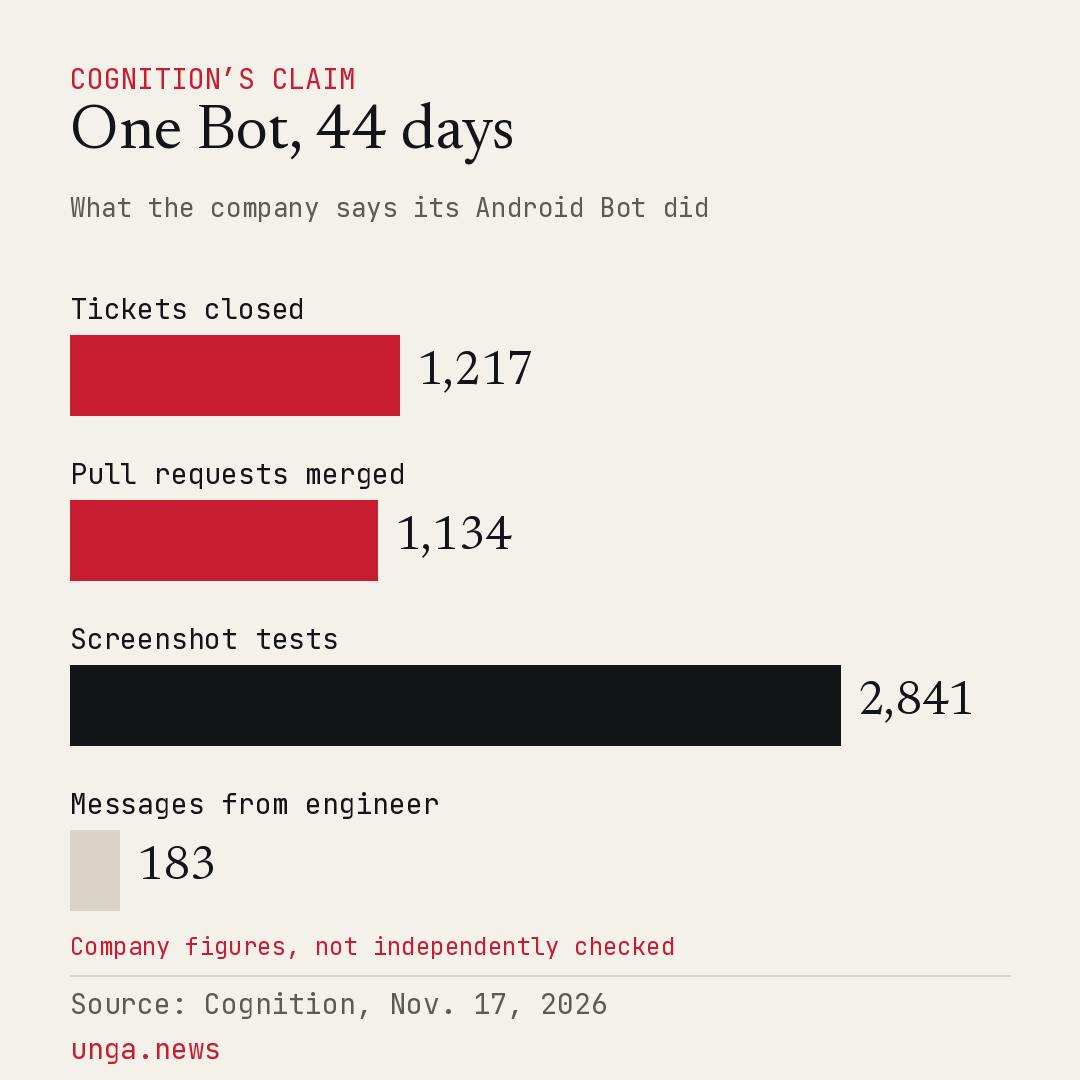
Over the next 44 days, Cognition says, the Bot closed 1,217 tickets, merged 1,134 pull requests, wrote 344,651 lines of code in the Kotlin language and added 2,841 screenshot tests. The engineer sent it 183 messages in that time and none at all on 22 of the days. The app is now in open testing on Google Play.
Those numbers have not been checked by anyone outside Cognition. Lines of code and pull request counts also say little about quality on their own, which is why early user reviews of the app will matter.
A one-person game studio
The company gave two more examples. A “Layout Bot” that hunts for parts of its web app that jump around as pages load merged 159 fixes in three weeks, and Cognition says it cut lag by 70%.
In the most striking case, Cognition said a mobile game studio run by Jenny Xu now has about 20 Bots, each owning one job, such as releases, testing or the iPhone build. One “Super Jenny Bot” sits on top and gathers decisions for her four times a day, which she answers with emoji. The studio went from about 50 pull requests a week to 1,900, the company said, and Xu has since joined Cognition full time.
The price and the competition
Devin Bots come with Cognition’s Max plan at $200 a month and its Teams plan, according to the company’s pricing page. Its basic Pro plan costs $20 a month.
The launch puts Cognition up against much bigger players. OpenAI has an always-on agent called Dots, and Anthropic has one called Duet, Fortune reported. In August, SpaceX bought Anysphere, the company behind the popular coding tool Cursor, in a deal that valued it at $60 billion.
Wu argues Cognition’s edge is that it isn’t tied to one lab. A Bot picks different models for planning, design and routine code, and each can be given its own budget. Cognition also trains its own cheaper models for writing and reviewing code.
The startup is valued at $48 billion and said in September that its yearly revenue pace had passed $1 billion, according to Fortune. Usage of Bots among dozens of early customers grew tenfold in two weeks, the company said.
Who holds the keys
Letting software run for weeks raises an obvious question about what it can touch. Wu said Bots run on separate cloud computers, away from passwords and keys on engineers’ laptops. Administrators choose which code and tools each Bot can reach, and network controls are meant to block data from leaving, even if a Bot reads hidden malicious instructions.
Teams decide which changes need a human sign-off. Small edits, such as changing a button’s color, can be set to merge on their own. Devin Bots are available now at devin.ai/bots.