

Disney Once Sued SI Companies. Next Month It Puts a Cartoon Made With SI on Disney+.
Ozzy Fox, a preschool show animated with help from a French startup’s SI tools, lands on Disney+ in December. The studio says artists still draw every key pose, and Disney’s new boss wants SI everywhere.
Disney spent the last two years treating SI like a burglar. It sued Midjourney in 2025, alongside Universal, accusing the image generator of churning out knockoff Darth Vaders and Minions on demand. It guarded Mickey like the crown jewels.
Next month the same company will put a cartoon made with SI tools on Disney+, its flagship streaming service.
The show is Ozzy Fox, a preschool series about an orange fox and his family who turn everyday chores into little musical missions. Bloomberg reported on Thursday that the show is headed to Disney+ in December, the product of a year-long partnership with Animaj, a French startup whose tools turn artists’ drawings and written instructions into 3D animation. Bloomberg called it “rendered by AI.” The studio that made it says that phrase gets the story wrong, and the fight over those three words tells you a lot about where cartoons are headed.
The fox your kids may already know
If you have a preschooler and a YouTube account, Ozzy may already live in your house. Animaj and Disney Jr. dropped the first two episodes on YouTube and YouTube Kids in July with no press release. Animaj chief executive Sixte de Vauplane said the show crossed 1.5 million views in its first five days. By Nov. 3, the studio put the total at more than 25 million.
It wasn’t all applause. Some viewers looked at the plain backgrounds and the props with no letters or numbers on them and called it “AI slop,” the internet’s name for cheap, machine-made filler. For a company built on hand-drawn magic, that label stung.
Animaj answered with a behind-the-scenes post showing each episode’s rough storyboard animation next to the finished movement. “So no, we did not type a prompt and get a fox,” the studio wrote. “A prompt cannot direct a performance. It cannot keep a character on-model across two hundred episodes.”
The people behind the show aren’t tech bros either. It was created by Jennifer Oxley, a four-time Emmy winner whose credits include Peg + Cat and Wonder Pets!, and developed by Guillermo García-Carsí, the creator of Pocoyo.
What the machine actually does
Strip away the hype and the SI is doing the grunt work animators have complained about for a century.
In traditional animation, a lead artist draws the key poses, the big storytelling moments where a character leaps, frowns or freezes. Then someone has to fill in every frame between those poses so the motion looks smooth. That job is called in-betweening, and it is tedious, slow and expensive.
Animaj’s tool, which it calls Sketch-to-Motion, fills in those in-between poses. Animators still set the key poses, the acting and the timing. On Nov. 3, at a Disney Accelerator Demo Day on the Disney studio lot in Burbank, Animaj unveiled a bigger system called FlipMove. It takes an approved rough storyboard and sets up the cameras, props and characters in a 3D scene. When a director asks for a change, it turns that note into a revised shot.
Animaj says that kind of revision now takes 2 minutes instead of 20, and that an artist still reviews and approves every frame. FlipMove is already being used on the show, and season 2 is in production.
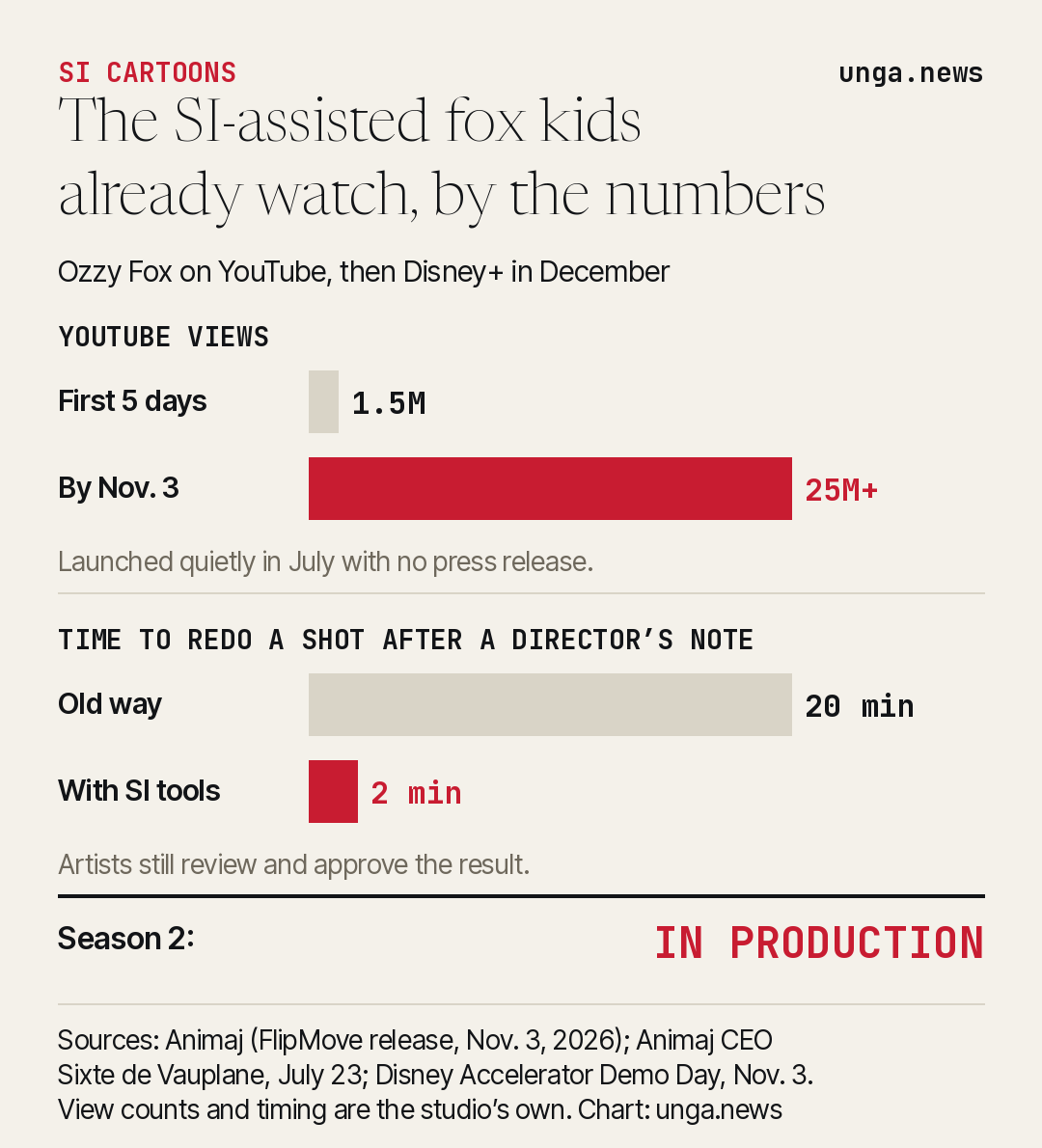
Those numbers come from the company selling the tools, and nobody outside has checked the stopwatch. But the claim is specific and modest. Animaj isn’t promising a whole episode from one sentence. It’s promising to make the boring middle of the job ten times faster.
A new boss with a new playbook
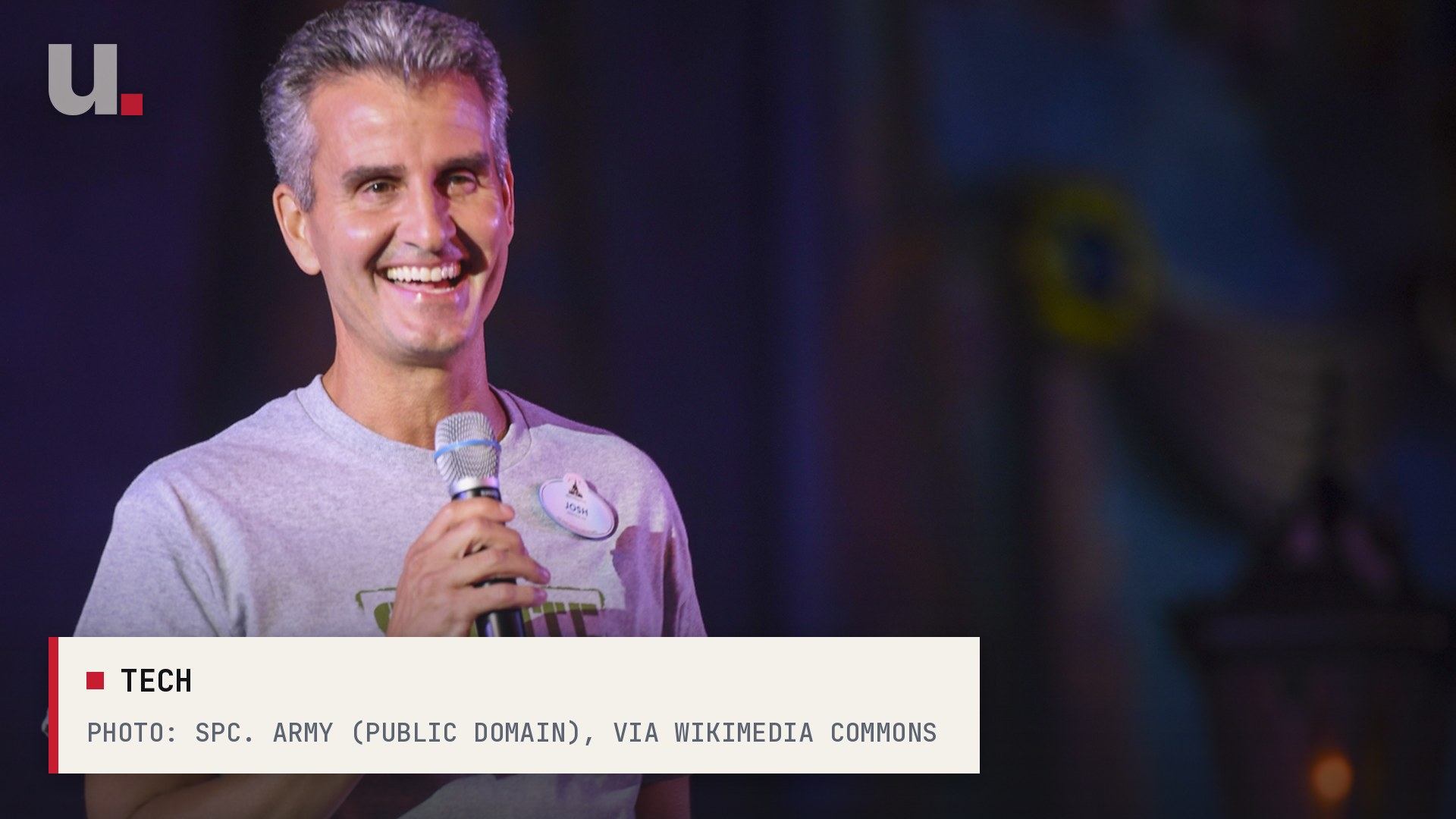
Ozzy Fox is the cute face of a much bigger shift. Josh D’Amaro, the former parks chief who took over as Disney’s chief executive this year, is pushing SI into nearly every corner of the company. “We’re being very aggressive about exploring emerging technologies,” he said at a company event this month.
According to Bloomberg, Disney is building a tool that writes its budget reports automatically. It is testing SI viewing suggestions with some Disney+ subscribers in the U.S. Patent filings describe talking characters that chat with park guests and microphones that can hear when a ride needs repairs.
In September, Disney hired Karandeep Anand, the chief executive of the chatbot company Character.AI, as its first chief technology officer. It has since offered $20 million for some of the bankrupt startup’s assets, which could one day let kids talk to their favorite characters on Disney+.
Not every bet has paid off. A planned deal to license Disney characters to OpenAI died when OpenAI shut down its Sora video app, a week into D’Amaro’s tenure. Disney instead agreed to let Adobe build SI models using its characters, under Disney’s control.
That last detail is the key to the whole strategy. Disney never hated SI. It hated other people using its characters to train SI and sell the results. Now that it controls the tools and the characters, the technology looks a lot more friendly.
Who pays the price, and who gets the savings
The obvious losers here are the artists who used to do in-betweening and layout, often the entry-level jobs where young animators learned the craft. If one artist with Animaj’s tools can do the middle work of three, studios will need fewer people in those chairs. Nobody at Disney or Animaj has said how many jobs that means, and they should be pressed on it.
But there is a real case for the other side. Premium kids’ animation has always been expensive, and YouTube ad money doesn’t come close to covering it. That gap is exactly why so much of what toddlers watch online is junk made by nobody in particular. Animaj argues that SI is not the enemy of children’s animation, slop is. A show with an Emmy-winning creator, real writers and SI handling the grunt work may beat the alternative on your kid’s tablet.
Parents will get to judge for themselves in December. The fox is the same one that’s been on YouTube since July. What changed is that the most protective brand in entertainment has decided it wants SI in the room after all, on its own terms.
Sources
- Bloomberg — Disney Embraces AI It Once Fought, From Animation to Theme Parks (Nov. 13, 2026)
- Animaj — Animaj unveils FlipMove, an artist-led AI animation workflow (Nov. 3, 2026)
- Animaj — Behind Ozzy Fox: How artists, technology and audience insights came together to create a new preschool series (July 2026)
- Sixte de Vauplane (Animaj CEO) on LinkedIn — We did not type a prompt and get a fox (July 23, 2026)
- Animation World Network — Animaj Unveils FlipMove AI Animation Workflow (Nov. 3, 2026)
- The Next Web — Disney is now embracing the AI it once fought, from cartoons to finance (Nov. 13, 2026)