

DOJ Sues to Stop Alaska From Certifying a Peltola Win Decided by the Other Sullivan's Votes
The complaint says Daniel J. Sullivan's "sole purpose" is to help Mary Peltola. Its best evidence comes from Alaska's own election chief, who found in June that he filed to confuse voters.
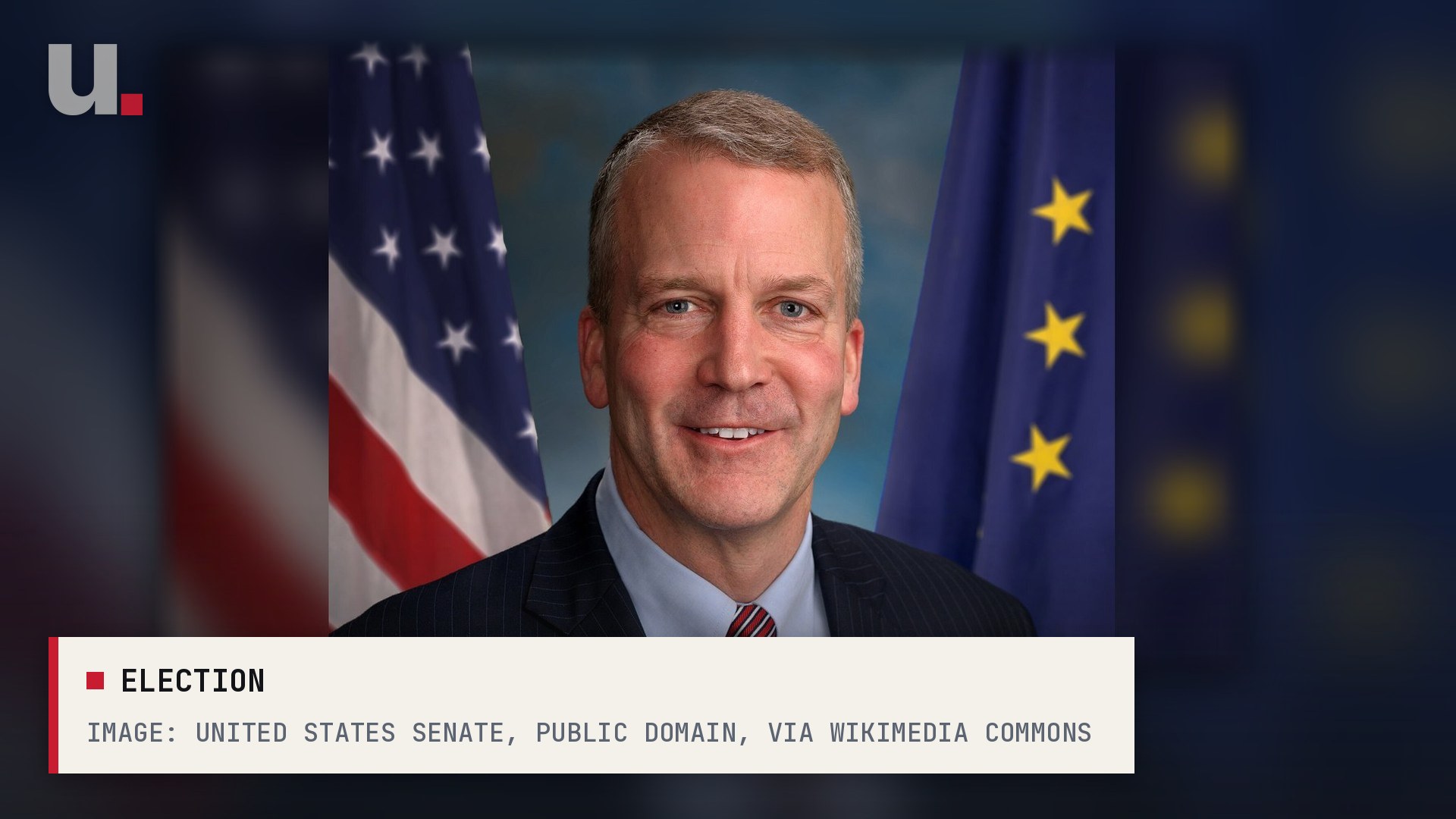
The Justice Department sued Alaska on Thursday to keep the state from certifying its Senate race if Republican Sen. Dan S. Sullivan loses to Democrat Mary Peltola only because of the other Dan Sullivan on the ballot. That is Daniel J. Sullivan Jr., a retired teacher from Petersburg whose candidacy, the complaint says, has one goal: "The sole purpose of his candidacy is to benefit the Peltola campaign by reducing the number of votes for Senator Sullivan."
The suit, United States v. State of Alaska, was filed in federal court in Anchorage and assigned to U.S. District Judge Sharon L. Gleason, Courthouse News reported. It names the state, Elections Director Carol Beecher, Alaska's precinct election boards and the State Ballot Counting Review Board. Associate Attorney General Stanley E. Woodward Jr. and Assistant U.S. Attorney E. Bryan Wilson signed it.
We laid out who the second Sullivan is, the Democratic consultant who helped him file and the federal grand jury already looking at his campaign in our earlier report. This one is about the lawsuit, and what it actually asks for.
What the DOJ wants
The ask is narrow. The department is not trying to cancel the election or pull anyone off the ballot. It wants the court to stop certification only in one case, which the complaint spells out: "(1) Senator Sullivan does not win the election; and (2) had all votes cast for Daniel J. Sullivan been cast instead for Senator Sullivan and Alaska's rank-choice process played out accordingly, Senator Sullivan would have won the election" (complaint).
If that happens, the DOJ asks the judge to block certification "pending an investigation to determine whether votes cast for Daniel J. Sullivan were meant to be cast for Senator Sullivan," along with any other steps the court finds necessary "to determine what the result would have been absent Daniel J. Sullivan's inclusion on the ballot." If the senator wins, or loses by more than the other Sullivan's votes could make up, the suit does nothing.
Think of a photo finish where a stranger in the same jersey ran in the next lane and some fans cheered for the wrong man. The DOJ is not asking to stop the race. It is asking to check the tape before anyone hands out the medal.
The law it leans on
The legal hook is the National Voter Registration Act, in which Congress listed "protect[ing] the integrity of the electoral process" as one of the law's purposes, and which lets the attorney general sue for the relief needed to carry it out. The complaint pairs that with a 1972 Supreme Court case, Bullock v. Carter, which said a state has "an interest, if not a duty, to protect the integrity of its political processes from frivolous or fraudulent candidacies" (complaint).
Because Alaska's courts already put Daniel J. Sullivan on the ballot, the DOJ argues, the only way left to make sure the winner is "the choice of a majority" is "to ensure that the certification is not impacted by Daniel J. Sullivan's frivolous candidacy." "Should Alaska certify any electoral results tainted by the inclusion on the ballot of Daniel J. Sullivan," the complaint warns, "the State and its officers will fail in its obligation to protect the integrity of its election."
The state's own election chief made the case first
The strongest evidence in the suit comes from Alaska itself. On June 15, Beecher threw Daniel J. Sullivan off the ballot after the Alaska Republican Party filed complaints. Her letter, attached to the lawsuit, concluded his declaration of candidacy "was not filed in order to declare an actual good-faith candidacy for the office of United States Senator, but was instead filed with a purpose to confuse or mislead" (Exhibit A).
She listed four reasons. He asked to be on the ballot as "Dan Sullivan," a name he had never registered under. He switched to the Republican Party two days before filing. His campaign website copied the "format, color scheme and overall theme" of the senator's. And he was working with a consultant who is "a known longtime supporter of Democratic candidates including the primary Democratic challenger to Senator Sullivan."
One line in the letter says it all. "Indeed, you yourself appeared to be confused when you initially emailed the Division asking to be listed on the ballot as 'Dan S. Sullivan,'" Beecher wrote. "'S' is Senator Sullivan's middle initial, not yours." She called the facts "utterly unprecedented" (Exhibit A).
A state judge overruled her, and on June 29 the Alaska Supreme Court summarily agreed, promising a full opinion later. The suit notes that opinion still has not been issued (complaint). The DOJ adds that Daniel J. Sullivan told The New York Times in July that he voted for Democrats in the last three presidential elections and voted for Peltola when she ran for Congress.
Why a few points can flip it
In the August primary, Peltola took 49.5%, Sen. Sullivan 41.4%, Daniel J. Sullivan 2.5% and Republican Gerald Heikes 1.1%. All four are on the November ballot, which is ranked-choice (complaint). The polling average from FiftyPlusOne has Peltola up about two points, and the Cook Political Report rates the race a toss-up, CNBC reported. The complaint says many polls put the race "within one or two percentage points."
That is smaller than the other Sullivan's primary share. The suit describes two ways the confusion costs the senator. "Some supporters of Senator Sullivan likely will inadvertently vote for Daniel J. Sullivan," it says. Others "might not rank Senator Sullivan at all, resulting in votes for Daniel J. Sullivan to be transferred to Peltola after Daniel J. Sullivan's all-but-guaranteed elimination in the first or second round of tabulations" (complaint).
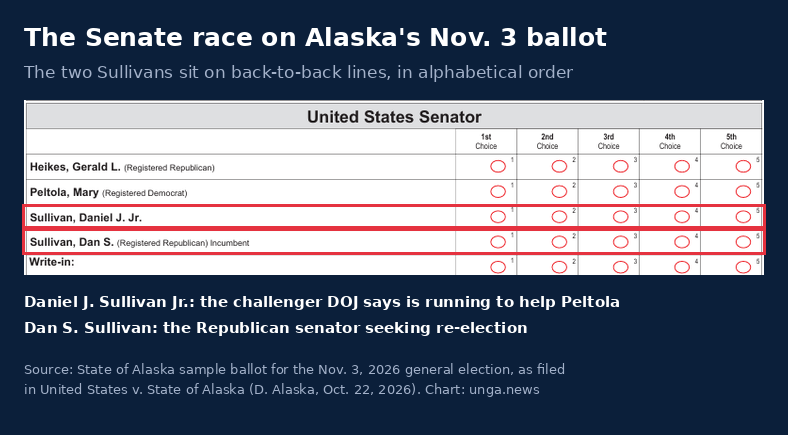
The state did what it could on the ballot itself. The senator is listed as "Sullivan, Dan S." with "Registered Republican" and, for the first time on an Alaska ballot, the word "Incumbent." The challenger is listed as "Sullivan, Daniel J. Jr." with no party at all, also a first, the Juneau Independent reported. The two names still sit on back-to-back lines.
Alaska has sorted out voter intent before. In 2010, when Sen. Lisa Murkowski won as a write-in, the state counted misspelled write-in ballots where it was clear who the voter meant, and the Alaska Supreme Court upheld that in Miller v. Treadwell. The DOJ is asking for the same basic principle: the count should reflect who Alaskans meant to vote for.
The suit spread fast on 𝕏, where one post on it drew about 50,000 views and more than 3,000 likes by Friday morning.
The lawsuit lands on 𝕏 (@EricLDaugh, Oct. 23)
— @EricLDaugh View on 𝕏
What they said
Daniel J. Sullivan told the Juneau Independent by email Friday: "This morning's news was a surprise to me and I will need some time to understand what it means." He has denied trying to confuse anyone. Peltola's campaign and the senator's campaign did not immediately respond to requests for comment, the paper and Forbes reported. Peltola's camp has previously denied any connection to him.
The suit came a day after President Trump called the second Sullivan's candidacy a "SCAM" on Truth Social and said Republicans were "looking at powerful legal options" (Courthouse News). Trump and Vice President JD Vance have both campaigned in Alaska for the senator in the past two weeks (Juneau Independent).
What's next
Judge Gleason will decide whether the case goes forward. Election Day is Nov. 3, and early voting is underway. Under Alaska law, the state ballot counting review starts no later than 16 days after the election, and only then does the elections director certify the winner (complaint). If the senator wins outright, the lawsuit never comes into play.
Alaska voters will also decide on Nov. 3 whether to repeal the ranked-choice system at the center of the DOJ's math (Juneau Independent). Until then, the advice from the senator's side is the same as it has been all fall: check the middle initial. It's S.
Sources
- U.S. District Court, D. Alaska — United States v. State of Alaska, Complaint (Oct. 22, 2026), via Democracy Docket
- U.S. District Court, D. Alaska — Complaint with Exhibit A, Division of Elections letter to Daniel J. Sullivan (June 15, 2026), via Courthouse News
- Courthouse News Service — Trump administration sues Alaska over two Dan Sullivans on ballot
- AP News — Trump administration sues to block possible Dem win in Alaska Senate race
- CBS News — Trump admin. sues to block Alaska Senate certification if Sen. Dan Sullivan loses
- CNBC — DOJ sues Alaska to block Senate race certification if Republican loses
- The Washington Post — DOJ seeks to block Alaska Senate result if Republican incumbent narrowly loses
- Juneau Independent — Trump administration sues to block Alaska's Senate result if Sullivan loses, citing namesake challenger
- Just the News — Trump admin sues Alaska election official, arguing 'voter confusion' with two Sullivans on ballot
- The Daily Signal — DOJ Sues Alaska to Block Senate Election Certification, Citing 'Voter Confusion'
- Forbes — Trump Asks Alaska To Block Democrat Mary Peltola If She Wins
- The Hill — Justice Department sues to block Alaska Senate results if Dan Sullivan loses to Mary Peltola
- Alaska Supreme Court — Miller v. Treadwell (2010)
- 𝕏 — @EricLDaugh on the lawsuit
- UNGA NEWS — Alaska Has Two Dan Sullivans on Its Senate Ballot