

Driverless Big Rigs Could Be Cheaper Than Trucks With Drivers by 2028, MIT and Kearney Say
A new cost model has robot long-haul trucks dropping from about $4 a mile today to $2.60 by 2028, when they match trucks with a driver. The catch: it only works if tens of thousands of them hit the road.

For years, the honest answer to “When will a truck with no one in it be cheaper than a truck with a driver?” was “Not yet, and nobody knows.” A new cost model puts an actual year on it, and the year is close. It’s 2028.
The model comes from the consulting firm Kearney and the MIT Mobility Initiative. They released it Nov. 5, and FreightWaves broke down the numbers this week. In plain terms: right now a driverless long-haul truck costs about $4 a mile to run, against about $2.50 for a truck with a driver. By 2028, the two meet at roughly $2.60 a mile. After that, the driverless truck keeps getting cheaper and the one with a person behind the wheel keeps getting more expensive.
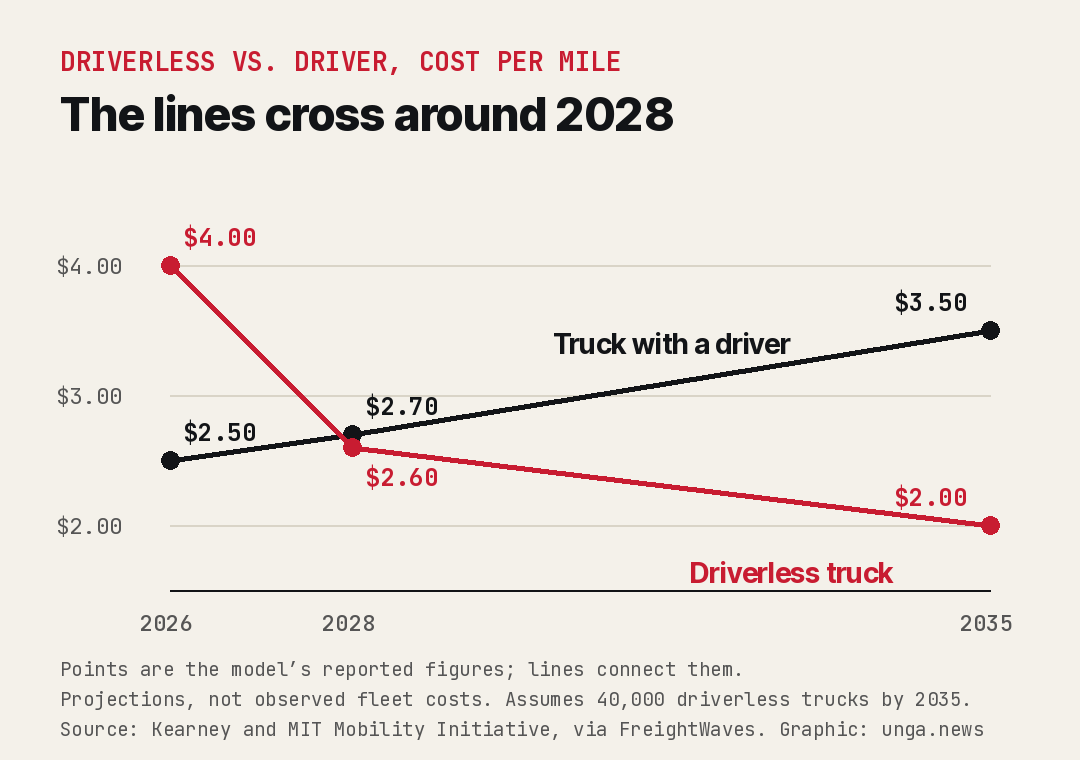
That’s the headline number. The interesting part is why the lines cross, and how much has to go right for it to happen on time.
The driver is half the bill
Start with where the money goes. According to the report, about half of what it costs to run a U.S. long-haul truck per mile goes to the driver. A fully loaded American long-haul driver, counting roughly 30% in benefits, costs a carrier about $10,000 a month. That’s about twice what the same job costs in Europe and four times the cost in the Middle East.
That’s why America gets there first. When the expensive part of a truck is the person, taking the person out saves the most money in the country that pays people the most. Kearney’s model has the U.S. crossing about two years ahead of Europe and four years ahead of the Middle East.
The report even puts a price on the prize. The human driver is worth $1.26 a mile, and that’s the pool of money every company in this race is chasing.
Kearney’s conventional-truck numbers aren’t pulled from thin air, either. The American Transportation Research Institute put the industry-average cost to run a truck at a record $2.336 a mile in 2025, up 3.4% from the year before. Kearney starts its model at $2.50 for 2026 and lets inflation carry it to about $3.50 by 2035.
The $38,000 box on the roof
The driverless side looks expensive today for a simple reason. Somebody has to pay for the robot driver, and right now there aren’t many trucks to spread that cost over.
The model counts a sensor and computer kit, which it prices at about $38,000 for four lidars, six radars, 12 cameras and an Nvidia Thor computer, according to a breakdown from Servospace. That hardware is expected to get about 15% cheaper every year. On top of it sits the cost of building the software: the model assumes about $750 million a year in research spending worldwide, paid down over five years.
Then there are the people who still matter in a driverless fleet. Remote operators watch the trucks and step in when something odd comes up. Today the model assumes one operator for every 10 trucks. By 2035 it’s one for every 20. Insurance starts out at 1.5 times what a normal truck pays and drops below a regular policy, to 0.7 times, by 2035.
Put that together and Kearney has the driverless cost falling about 49%, to roughly $2 a mile by 2035. Most of that drop comes from one thing: more trucks on the road splitting the same bills.
The catch is the fleet size
This is where you should read the fine print. The 2028 date assumes there will be 40,000 autonomous trucks on the road by 2035. If there are only 10,000, the report says U.S. cost parity could slip all the way to 2032. The year on the chart is really a bet on how fast companies build out.
Other people have tried to answer this question and come out in different places on the cost, even if they land on the same year. Goldman Sachs Research also projected U.S. cost parity in 2028, but it started from an all-in driverless cost of about $8.56 a mile in 2025. Aurora, the Pittsburgh company running driverless trucks in Texas, has published a case study on its Fort Worth-to-Phoenix route that puts its virtual driver at $1.84 a mile against $1.99 for a human. That’s one busy lane, not a full national fleet, so it isn’t the same math. But it shows the people actually running these trucks think the number is already close on the right routes.
Aurora’s trucks have logged more than 500,000 driverless miles on public roads, the report notes. That’s real, but deployment is still narrow and stuck to a few corridors.
The rules haven’t caught up
The other speed bump is the law. The report says Texas, Arizona, Florida and Georgia allow fully driverless trucks, but many interstate and cross-border routes still require a human, and there’s no settled way yet to certify a virtual driver. Nobody has worked out who pays after a crash, either: the carrier, the company that built the truck, or the company that wrote the driving software. Kearney argues that whoever ends up holding that liability probably ends up holding the customer, too.
Insurers, at least, seem interested. Servospace notes the report’s claim that about 25 insurers reportedly showed up for one driverless truck company’s policy renewal, while regular trucking insurance has shrunk from about 11 providers to four.
What this means for drivers and for prices
If you drive a truck for a living, this isn’t a pink slip. The model is about long-haul lanes between hubs, mostly in a few states, and it still has humans doing pickups, deliveries and anything tricky. The parity date leans hard on fleet growth that hasn’t happened yet.
If you’re a shipper, or just someone who buys things that ride on trucks, the bigger story is on the other line of the chart. The cost of a truck with a driver keeps going up. Freight is how almost everything gets to a store shelf. A cheaper way to move it over long highway stretches could help hold down prices on a lot of what we buy.
Kearney built the model from more than 25 interviews with self-driving developers, truck makers, carriers, brokers and investors. It’s a forecast, not a promise. But it’s the first time a big consulting shop and MIT have put their names on a specific year when the robot truck stops being the expensive option. The number to watch from here isn’t the price per mile. It’s how many of these trucks are actually out on the highway.
Sources
- FreightWaves — Kearney, MIT put US driverless truck cost parity at 2028 (Nov. 10, 2026)
- Kearney — Gaining ground with autonomous trucking
- Servospace — Kearney, MIT model: truck cost parity 2028
- The Logistic News — Kearney and MIT forecast cost parity between autonomous and conventional US trucks by 2028