

Einstein’s Genius Friend Left Hundreds of Math Discoveries Hidden in Shorthand. SI Found Them in Days.
Kurt Gödel’s 1940s notebooks took scholars a week a page. Claude digested all 1,009 pages in about two days, and a proof checker confirmed most of what it found.
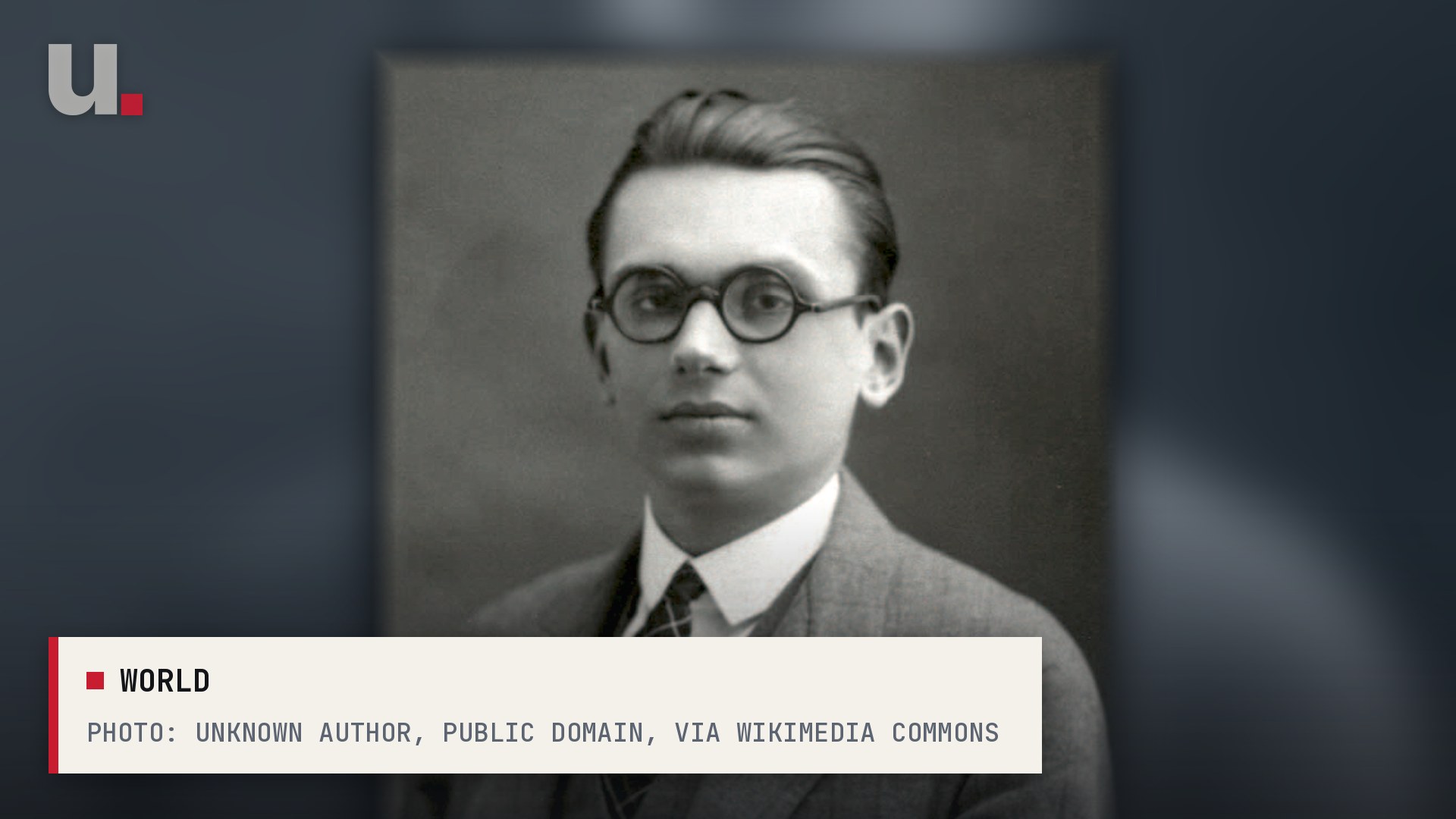
Kurt Gödel was Albert Einstein’s close friend at Princeton, and one of the most original minds of the last century. His 1931 incompleteness theorems proved that every math system has true statements it can never prove, and they helped inspire Alan Turing’s work on the first theory of computers. After that, he went mostly quiet. He published only a handful of papers for the rest of his life.
It turns out he wasn’t quiet at all. He was writing it down in a code almost nobody could read.
On Friday, The Guardian reported that a Finnish logician named Jan von Plato used Claude, the SI model from Anthropic, to work through 16 notebooks Gödel filled in the early 1940s. The result: hundreds of theorems nobody knew he had, dozens of results that other mathematicians only reached in the 1970s and ’80s, and a near-complete version of a famous proof that Gödel claimed he had and could never produce.
“I was flabbergasted,” von Plato told the paper. “Gödel was far ahead of his time.”
A page a week in a dead shorthand
The notebooks, which von Plato calls the workbooks, run 1,009 pages. Much of it is in Gabelsberger, a German shorthand that was already obsolete when Gödel used it. Von Plato started on them in 2017, facing mandatory retirement at the University of Helsinki and looking, as he joked, for a way to make himself indispensable. He won a €2.5 million grant from the European Research Council, taught himself the shorthand and built a small team. He says he’s one of only six people in the world who can read it.
Even with all that, the math went slowly. Von Plato puts it at about a page a week. “It takes us a year to read about 50 pages,” he said. “We just are not able to keep in mind all the different parts.”
In August, at a conference in France on SI and theorem proving, computer scientists suggested he try Claude. Back in Helsinki, he gave the model his own transcriptions of the notebooks, six books he had written about Gödel and other scholarship. Claude didn’t decipher squiggly handwriting off a microfilm. A human expert did the years of deciphering, and the SI did the part humans are bad at: holding a thousand pages of dense logic in its head at once.
“In a couple of days, I got to see a 650-page explanation of the workbooks,” von Plato said. “It had to be controlled page for page, but it’s basically a work that is impossible to do for human beings.” His summary of why: “The AI can connect all the pieces in a thousand pages. It can see all of Gödel’s writings as one piece.”
The proof Gödel swore he had
There’s an old grudge buried in these pages. In 1966, the American mathematician Paul Cohen won the Fields Medal, the top prize in math, for showing that two famous statements, the continuum hypothesis and the axiom of choice, can’t be proved or disproved from the standard rules of set theory. Gödel let it be known he had proved the axiom of choice part back in the 1940s. When colleagues asked to see it, he couldn’t rebuild the argument from his notes.
So that was the first job von Plato gave Claude: is the proof really in there? The answer came back yes, almost. “He was just one step away,” von Plato said. Gödel got one definition wrong, but he had used the right one two years earlier, and von Plato thinks he would have landed on it again with a few more months of work.
Claude assembled a reconstructed version of the proof, and von Plato ran it through Coq, a program that checks every step of a mathematical proof the way spell-check checks words, only with no wiggle room. It passed.
That’s the part to keep straight. The computer check proves the reconstructed argument works. It doesn’t prove Gödel finished it. Joel David Hamkins, a logic professor at Notre Dame who hasn’t seen the reconstruction yet, put it well: if it holds up, “it is remarkable and historically interesting. Although how much is Claude and how much is Gödel is a job for the historians.” He added a blunt rule of the trade: “You don’t get credit for work you don’t tell anyone about.”
Hundreds of theorems, and a scorecard
Next, von Plato asked Claude to pull out every theorem in the notebooks where Gödel had a proof, a sketch of one or just the idea for one. Claude came back with 663. Then each one went through Coq.
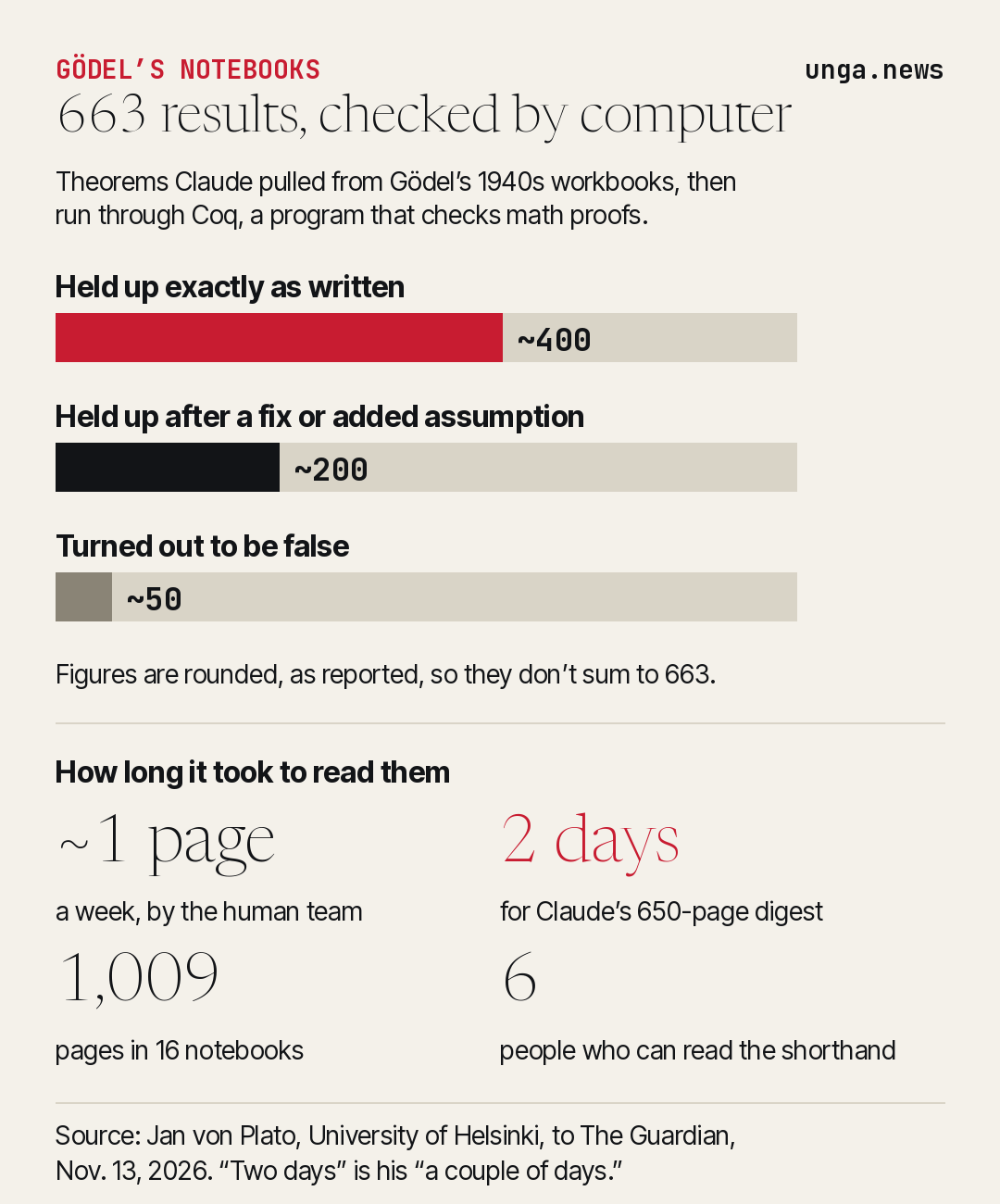
About 400 checked out exactly as written. About 200 checked out once the statement was tightened or an assumption was added. About 50 were simply false, and von Plato isn’t bothered by that. “This is no wonder,” he said. Gödel would reread his own pages and scrawl “falsch!” (wrong) or “schlecht!” (bad) in the margins. These were working notebooks, not a polished book, and a genius’s scratch paper is supposed to have mistakes on it.
That scorecard is also the honest answer to anyone worried the SI just made things up. Claude flagged the results, a strict proof checker sorted them, and a human who has spent nine years in these pages checked the 650-page digest page by page. Nobody is asking you to take a chatbot’s word for it.
What’s still missing is outside review. No paper or data has been published yet, so other logicians can’t rerun the work, and the Guardian report doesn’t say which version of Claude was used or what it cost. Von Plato’s numbers are his own, and Hamkins is right that historians will want their turn.
Nine years of work, mapped in two days
For nine years, one man and a small team ground through a dead shorthand at a page a week. In two days, an SI model handed them a map of the whole thing, including more than a dozen lines of thinking in logic that, by Claude’s count, nobody has picked up in 80-plus years. This wasn’t a machine replacing a scholar. It was a scholar who had done the hard human work finally getting a partner with enough memory to see the forest.
Von Plato says he isn’t done. Gödel also left notebooks on physics and cosmology, which von Plato calls “an unknown territory,” and he plans to open them once his logic work is finished. “I am sure that the continued study of Gödel’s manuscripts will reveal further treasures,” he said. After this week, it’s hard to bet against him.
Sources
- The Guardian — ‘Ahead of his time’: AI helps unlock discoveries hidden in notebooks of man who transformed maths, Alex Bellos (Nov. 13, 2026)
- European Commission CORDIS — GODELIANA: The Gödel Enigma, Unveiling a Hidden Logical Heritage (ERC project led at the University of Helsinki)
- Wikimedia Commons — Young Kurt Gödel as a student in 1925 (public domain)