

El-Sayed's Father Helps Run a Charity That Paid $780,000 Over Cash Sent to Saddam's Iraq
Treasury called it "egregious": the Michigan Senate candidate's father sits on the board of a charity that wired money into Iraq up to the day U.S. strikes began. Election Day is Tuesday.
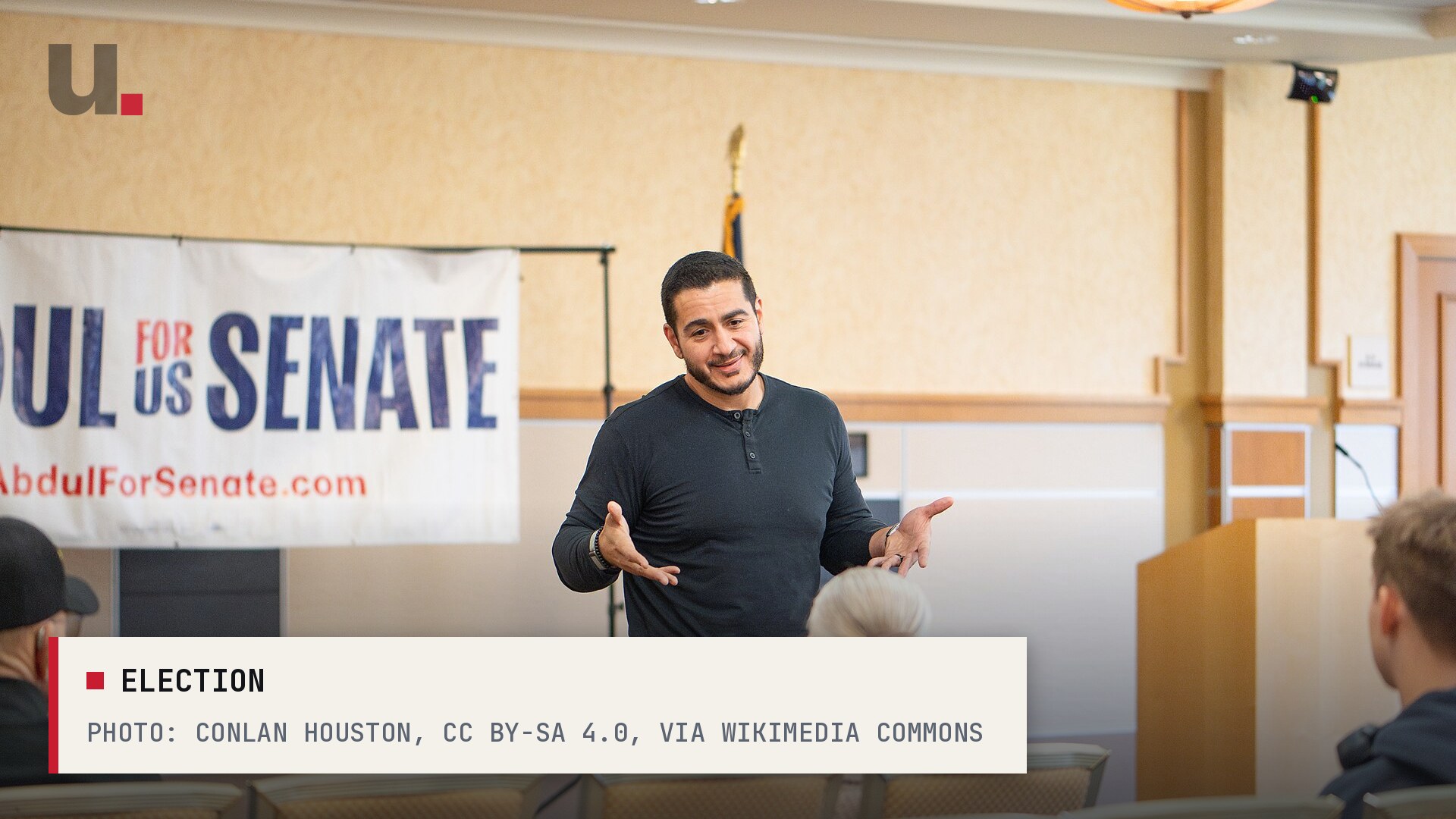
Abdul El-Sayed, the Democrat running for Michigan's open U.S. Senate seat, has a father who sits on the board of a Michigan charity that the U.S. Treasury caught sending money into Saddam Hussein's Iraq. The transfers ran right up to the day American bombs began falling on Baghdad.
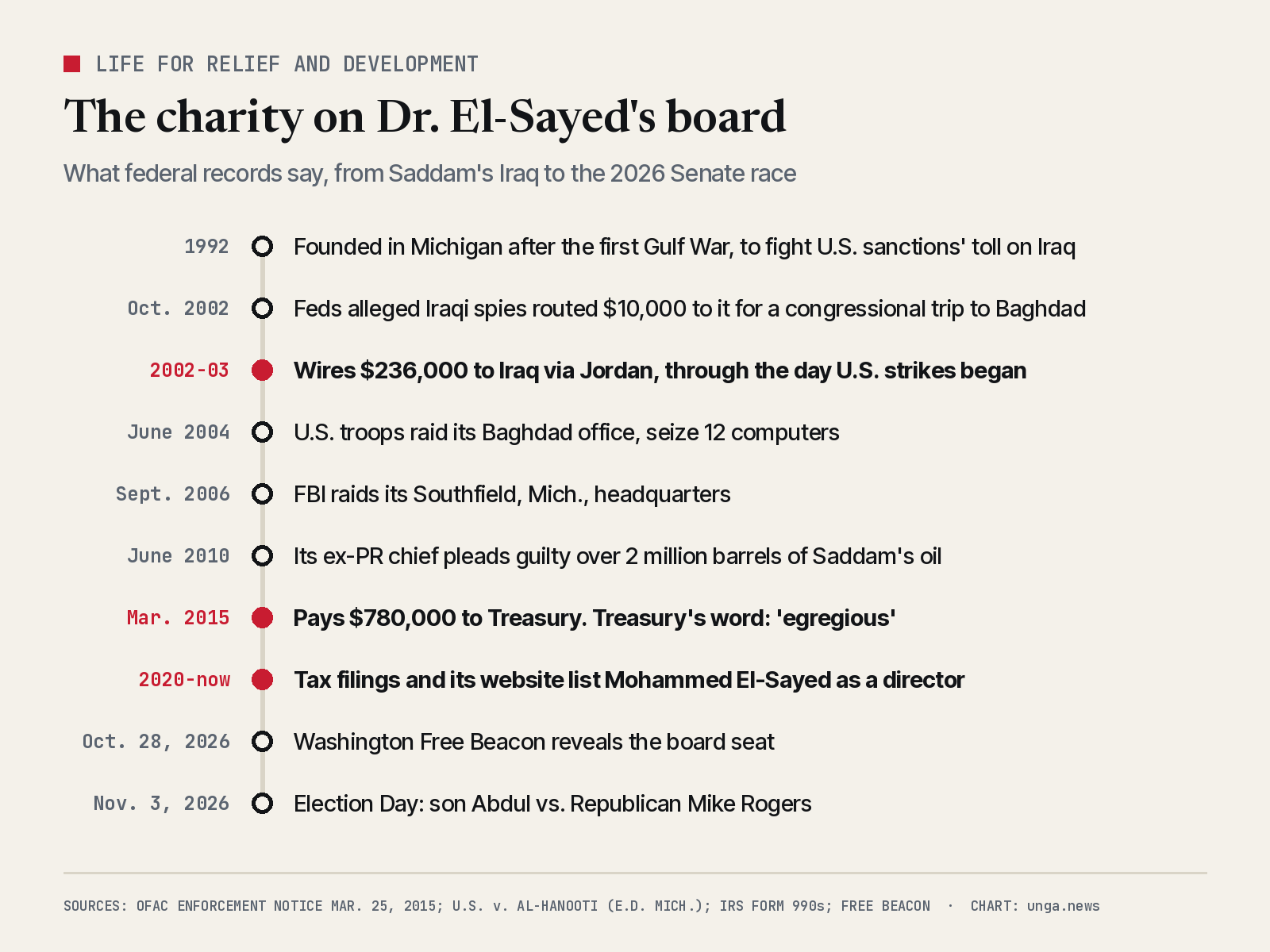
The charity is Life for Relief and Development, based in Southfield, just outside Detroit. Its own board page lists "Dr. Mohammed El-Sayed, P.E.," a professor of engineering at Eastern Michigan University who "has also served as a visiting Imam." Federal tax forms show he has been a director since at least 2020, the Washington Free Beacon reported Wednesday, when it broke the story.
Election Day is Tuesday. The race could decide which party controls the Senate.
What Treasury found
The paper trail starts with the government's own words. On March 25, 2015, Treasury's sanctions office, OFAC, announced that the charity would pay $780,000 to settle its case. The notice says the charity "knowingly and willfully formed a conspiracy for the purpose of transferring funds from the United States to Iraq, by and through Amman, Jordan."
OFAC counted three transfers totaling $236,000, made between Sept. 9, 2002, and March 19, 2003. March 19 is the night the U.S. opened the war on Saddam's regime.
Treasury didn't treat it as a paperwork slip. It called the case "egregious." It said the charity had "written notice from OFAC that such transfers were prohibited" before it sent them, and that "LRD's highest management levels—i.e., its President—knew of the conduct giving rise to the apparent violations and directed the funds transfers to Iraq via Jordan." The starting penalty was $1.3 million. It came down to $780,000 partly because the charity cooperated with the Justice Department.
Think of it like a bank that gets a letter saying "this account is frozen" and wires the money anyway, through a cousin's account in another country.
Iraqi spies and a trip to Baghdad
The charity's longtime public relations man, Muthanna Al-Hanooti, was charged in federal court in Detroit in 2008. The indictment alleged that Iraq's intelligence service "targeted LRD" and Al-Hanooti in the late 1990s, and that he handed Iraqi agents a list of members of Congress he believed favored lifting sanctions.
It also alleged that in fall 2002 an Iraqi intelligence officer had a Michigan middleman pay for a trip to Baghdad by three members of Congress, and that on Oct. 15, 2002, the middleman paid the charity $10,000 "to pay additional travel expenses" for that trip. Those are the government's charges, not findings.
What Al-Hanooti admitted is narrower, and still ugly. He pleaded guilty in June 2010 to violating sanctions law. In a 2011 sentencing memo, prosecutors wrote that Iraq's vice president had ordered him an allocation of two million barrels of Iraqi oil in December 2002, as a "payment for services rendered to Iraq." They asked for 46 months in prison.
Raids, then a board seat
U.S. troops raided the charity's Baghdad office in June 2004 and hauled out 12 computers and 20 boxes of files, the Free Beacon noted, citing the San Francisco Chronicle at the time. The FBI raided its Michigan headquarters in 2006, and its then-CEO was charged the next year, according to the Free Beacon.
Among the files agents sought, court records show, were documents tied to the Islamic African Relief Agency. That's another name for the group where El-Sayed's mother worked, which Treasury shut down for funding Osama bin Laden. We covered that in our report on his sister's essay.
The Free Beacon also reported that two current board members, CEO Hany Saqr and Mohamed Yahia Abdulrahim, appear in a 1992 directory of U.S. Muslim Brotherhood figures that prosecutors put into evidence at the Holy Land Foundation terror-financing trial. It reported that Saqr, Abdulrahim and a third board member each gave El-Sayed's Senate campaign $1,000, and that El-Sayed's father-in-law, Jukaku Tayeb, once sat on the same board.
This is no small outfit. Its 2023 tax return reports $35.7 million in revenue.
What it means
Nobody has charged Abdul El-Sayed or his father with anything, and the money transfers predate the father's time on the board. The question is judgment. The charity's own website puts his father's name on its board in 2026, and three of his father's fellow board members are listed as donors to the son's campaign.
El-Sayed has called questions about his family's ties to Islamist groups "Islamophobic," the Free Beacon reported. Neither the charity nor Mohammed El-Sayed answered its questions, and the campaign gave no response on the record. Michigan voters get the last word Tuesday.
Sources
- Washington Free Beacon — Abdul El-Sayed's father sits on board of charity with Muslim Brotherhood ties that got caught funneling cash to Saddam (Jon Levine, Oct. 28, 2026)
- U.S. Treasury, OFAC — Enforcement information for March 25, 2015: Life for Relief and Development settles for $780,000
- Life for Relief and Development — Board of Directors
- U.S. District Court, E.D. Michigan — United States v. Muthanna Al-Hanooti, indictment (2008)
- U.S. Department of Justice — Government's sentencing memorandum, U.S. v. Al-Hanooti (Mar. 11, 2011)
- IRS Form 990s via ProPublica — Life for Relief and Development Inc. (EIN 95-4402149) tax filings
- New York Post — Abdul El-Sayed's dad sits on board of Islamic charity accused of funneling cash to Saddam Hussein (Oct. 29, 2026)