

Elon Musk’s Company Handed Its Billing to Five Bots. Invoices Now Take Minutes.
SpaceXSI says five Grok Bots now run its money pipeline from new accounts to collections, while people keep the final say on refunds and credits.
Elon Musk’s SI company just showed the rest of corporate America what its own back office looks like. At SpaceXSI, five Grok Bots now run the money side of the business: setting up customer accounts, sending invoices, answering billing questions, matching payments and chasing down what’s owed.
That’s from a post the company published this week, “Building an accounting team with Grok Bot,” written by three members of its accounting staff. It isn’t a demo or a pitch deck. It’s a walk-through of the jobs, the rules and the training plan they use with their own bots.
Musk put it in seven words on 𝕏.
Elon Musk: “Grok @Bot can do your accounting”
— @elonmusk View on 𝕏
One bot per job, start to finish
The setup is simple to explain. Instead of one assistant that helps with a little of everything, each bot owns a single job a person on the team would otherwise do.
The Provisioning Bot checks a signed contract against the sales records and switches on the customer’s account, then shuts that access off when the contract ends. The Billing Bot checks the billing system against the contract, fixes mismatches, sends the invoice and pings the sales rep. The Billing Support Bot fields questions from the sales team in Slack, like why an invoice doesn’t match a customer’s dashboard. The Cash Applications Bot matches incoming payments to open invoices. The Collections Bot answers customers who write in about their bills.
Each one has a written operating manual in Notion. Every night the bots reread it and flag anything that conflicts with what they were told before. They can’t edit those manuals. Only the people responsible for each process can.
A day of work turned into minutes
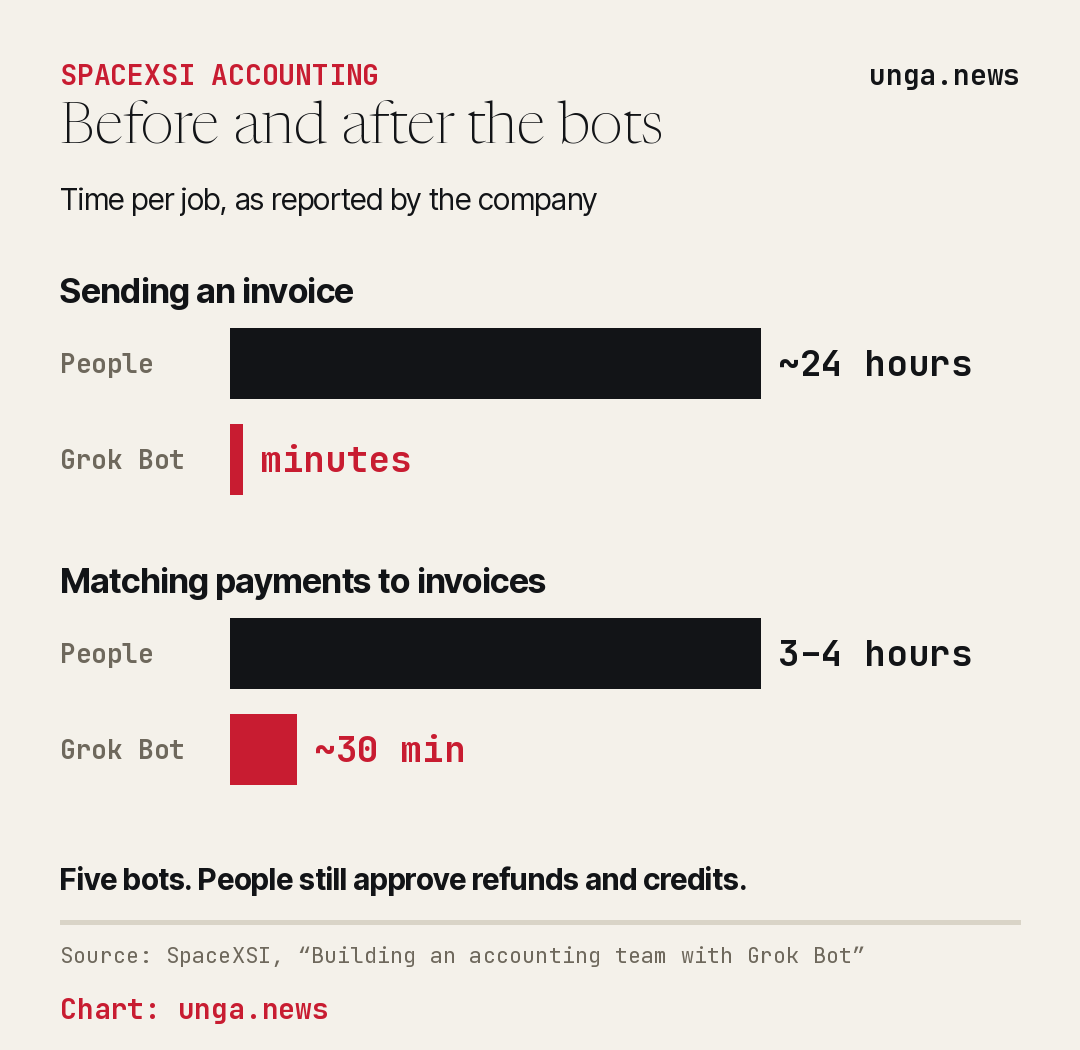
The numbers are the company’s own, not an outside audit, but they’re specific. Issuing an invoice used to take roughly 24 hours. Now it takes minutes. Matching a batch of payments to invoices ordinarily took an accountant three to four hours. The bot does it in about 30 minutes, and it checks the payment feed twice a day.
The Billing Support Bot alone frees up about eight hours a day across the team, the company estimates. And without the bots, the authors say, the work these five handle would require more than doubling the team’s headcount.
That’s the line every small business owner and every finance chief will read twice. The pitch here isn’t that the accountants are gone. It’s that the team can grow the business without hiring at the same pace, while the people who know the job best write the rules.
The bots also catch problems a busy person might let slide. If a customer hasn’t sent a VAT or GST tax number, the Billing Bot warns the sales rep before the invoice goes out and gives them 24 hours to supply it. Before, that kind of thing often got fixed only after the customer complained.
Trained like a new hire, with a short leash
The most useful part of the post is the honesty about how much setup this takes. “Bots need the same investment in documentation, onboarding, and ongoing coaching as new employees,” the authors write.
Their standard onboarding now runs about three weeks. In week one the bot builds its knowledge base and watches people do the job. In week two it proposes actions and explains them while a person approves. In week three it handles routine work on its own and passes the odd cases up. The first bots took longer. Billing Support took four to five weeks, and Collections took about three months.
Collections took longest for a good reason. It’s the first one that talks directly to customers, so it has to make sure the person asking about an account is allowed to see it. It checks the sender’s email against approved contacts in the company’s records. A look-alike domain doesn’t pass. If anything doesn’t match, it hands the message to a human.
Money moves carry the tightest rules. The bots can read what they need, but refunds and credits require sign-off from a designated person. Anyone with access can ask a bot to explain an invoice. Only certain people can authorize a change to billing records. Every action in the provisioning app is logged, so auditors can see what the bot did.
The boring work is the point
SI news usually means a new model or a big funding round. This is a different kind of story, and arguably a more important one for regular people. It shows an SI company trusting its own product with the dull, rule-heavy work that keeps a business paid, and laying out exactly how it keeps that work safe.
The company also built the tools the bots work inside. Its team used Grok Build to make internal apps that define what actions are allowed, so a bot operates a controlled system instead of improvising. That kind of guardrail is what will decide whether companies hand bots real responsibility.
Musk followed up with a bigger claim, saying Grok Bot can research every company expense and find better deals, even by calling suppliers. The accounting post is the more grounded proof. Five bots, written job descriptions, a three-week training plan and a human with the final say on the money.
Sources
- SpaceXSI — Building an accounting team with Grok Bot
- Elon Musk on 𝕏 — “Grok @Bot can do your accounting”
- Elon Musk on 𝕏 — “Grok @Bot can save you millions in corporate expenses!”