

Europe Wants Off American Tech. Poland Just Spent $300 Million on U.S. SI for Its Army
Poland signed a five-year deal for Palantir’s battlefield SI, the same system NATO and Ukraine use. The army keeps every server and key, and the minister says no rival comes close.

Much of Europe spent this year talking about weaning itself off American technology. Poland, the NATO ally that shares a border with Russia and Belarus and has had Russian missiles come down on its soil this month, just went the other way.
On Friday in Warsaw, Poland’s defense ministry signed a five-year contract with Palantir, the American data company, for its Maven Smart System, SI software that pulls together intelligence from many sources and helps commanders see threats and weigh their options faster. Defense Minister Władysław Kosiniak-Kamysz put the price at about $300 million. He called the deal “historic” and “a breakthrough,” and told reporters it “would be stupid and wrong not to use it,” according to Politico Europe.
This is not a pilot program tucked away in one office. The ministry’s own announcement lists every command that gets it: the General Staff, the operational and general commands, cyber defense, the Territorial Defense Forces and the logistics inspectorate, plus the air force, navy, land forces and special forces. Kosiniak-Kamysz called it “one of the biggest steps in the transformation of our armed forces.”
The software Ukraine leans on
Maven is already in use across NATO’s command structure and in Ukraine, which has been fighting Russia’s invasion for more than four years. The minister credited Palantir’s tools with helping Ukraine hold out. In a post on 𝕏, Kosiniak-Kamysz said the system speeds up data analysis, reconnaissance and targeting, flags threats and helps commanders decide, and that “NATO, the USA and our other allies, as well as Ukraine” already use it.
In plain terms, a modern army drowns in information: drone feeds, radar tracks, satellite pictures, intercepted signals and supply reports, all arriving in different formats from different units. Maven’s job is to put it on one screen and suggest where to look first. Kosiniak-Kamysz made the scale point himself at the signing. Poland has 225,000 people in uniform, he said, plus hundreds of thousands of reservists, and an enormous stream of information moving through its systems.
Palantir was happy to take the win in public.
Palantir on 𝕏 — We are extremely proud to stand with Poland and support its undisputed leadership in defending a free, safe, and sovereign Europe. Maven Smart System is universally recognized as the vanguard of next-generation AI warfare.
— @PalantirTech View on 𝕏
Poland’s chief of the general staff, Gen. Wiesław Kukuła, framed it as a matter of standing inside the alliance. “This tool will bring us closer to NATO and improve our position in the Alliance,” he said at the ceremony, in remarks the ministry posted. Gen. Mariusz Chmielewski, who leads Poland’s cyber forces, said the deal ends the era of military data sitting on separate islands that never talk to each other.
Poland keeps the keys
The loudest objection to the deal, in Poland and around Europe, was about control. Protesters turned out in Warsaw earlier this month, and in September Poland’s own digital affairs minister asked the defense ministry to audit the terms. Who sees the data? Could an American company, or Washington, reach in?
The ministry’s answer is blunt. The software runs on the army’s own closed network, not on Palantir’s cloud. Palantir gets no access to the data, no encryption keys and no remote access to the system. Polish business daily Puls Biznesu, citing the ministry, reports that because nothing sits on the vendor’s servers, the data can’t be handed to the U.S. government under America’s cloud data law either.
“All the keys, servers and information are, and will remain, exclusively in the possession of the Polish Army,” Kosiniak-Kamysz said. “We are buying a tool, but the information we put into it and take out of it belongs only and exclusively to Poland.” He added that the SI can help spot threats and judge risk, but a person with the authority to do so always makes the decision.
Before signing, the ministry says, the contract was checked by Poland’s military counterintelligence service and by the state’s top government lawyers under public procurement law. Kosiniak-Kamysz also said Poland got “much more favorable terms than Great Britain,” and that the yearly cost works out to about four Borsuk infantry fighting vehicles, the homegrown armored vehicle he called the army’s flagship equipment. Those comparisons are his. The contract itself hasn’t been published.
Europe’s hedge, Poland’s bet
Palantir is no stranger to European militaries. Denmark, Finland, Italy, the Netherlands, Spain and Sweden already use its software in some form, Politico reports, though not all of them run Maven. But the mood has shifted. The Dutch military said in late October it wants a European alternative by 2028, and France and Germany agreed in July to explore building their own defense software.
Poland isn’t pretending otherwise. Kosiniak-Kamysz said he would have picked a Polish supplier if one could do the job, and the ministry is building two systems of its own, called AIRON and NEFRYT, that could replace Palantir’s tools down the road. There is no automatic renewal when the five years are up. For now, though, the minister’s verdict was simple: “There is no product on the world market today that delivers such capabilities for armed forces.”
That bet fits the way Poland has armed itself since Russia’s full invasion of Ukraine. It buys what works, much of it American: F-35 fighters, two more of which landed at a Polish air base on Thursday, alongside Patriot missile batteries, Abrams tanks and Apache helicopters. And it pays for it. By NATO’s own estimates, Poland will spend 4.68 percent of its economy on core defense this year, more than the United States, Germany, Britain or France, and more than double its share in 2014.
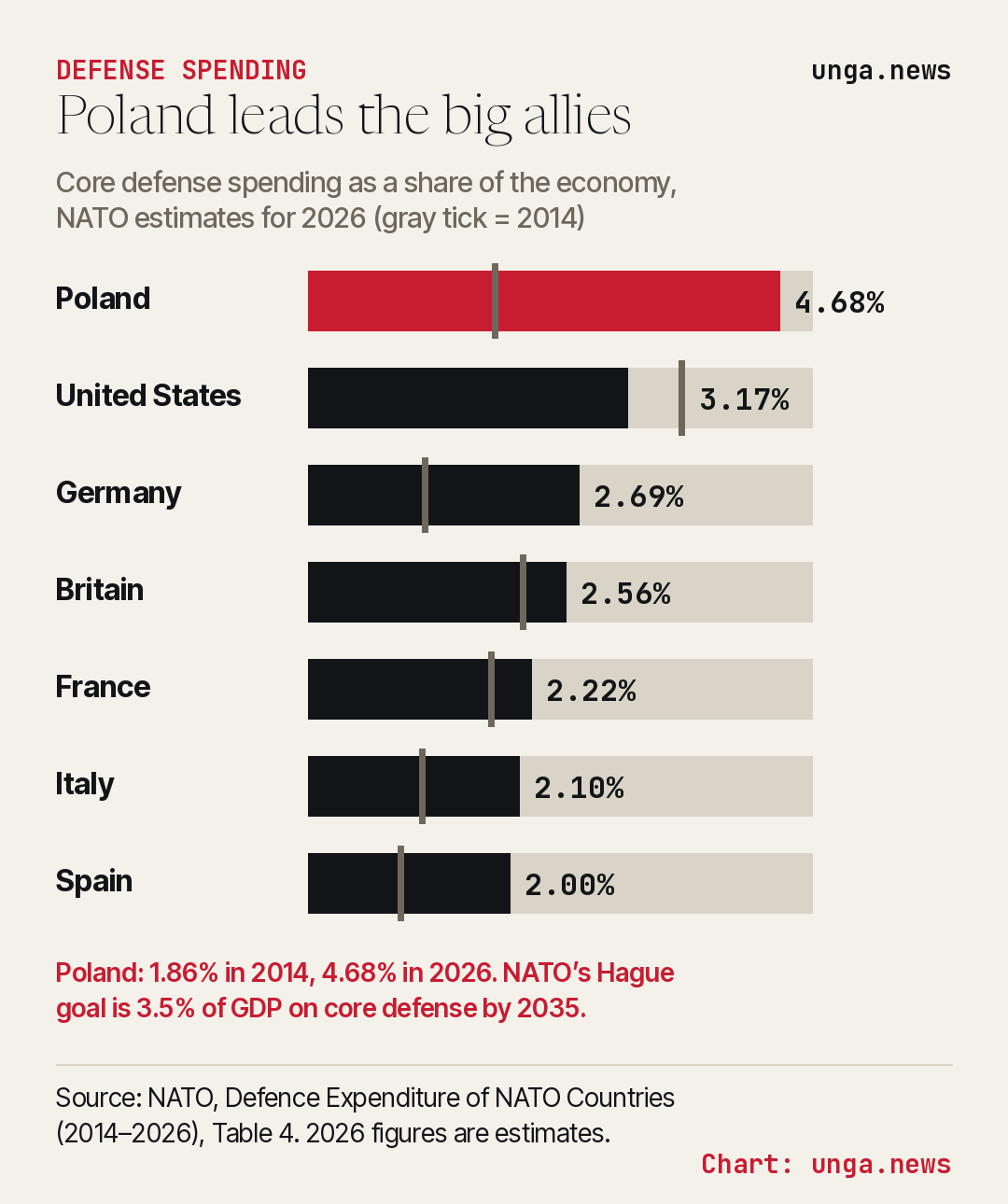
That number matters for this story. Allies that skimp on defense can afford to spend years debating whose software they’d rather use. A country that keeps watching Russian missiles cross into its territory (we covered the latest) wants the tool that already works on a real battlefield, and it wants it now.
It’s also a quiet win for American industry at a moment when Brussels is pushing “buy European.” Poland looked at the market, said nobody else was close, and signed with the U.S. company while writing its own rules on who holds the keys. Maven is now rolling out nationwide in one of the alliance’s frontline armies.
Sources
- Poland’s Ministry of National Defence — Wojsko Polskie sięga po nowoczesne i sprawdzone technologie wykorzystujące sztuczną inteligencję (Nov. 27, 2026)
- Poland’s Ministry of National Defence on 𝕏 — Signing of the agreement with Palantir Technologies Poland (Nov. 27, 2026)
- Władysław Kosiniak-Kamysz on 𝕏 — Statement on the Palantir agreement and data security (Nov. 27, 2026)
- Palantir on 𝕏 — Proud to stand with Poland (Nov. 27, 2026)
- Poland’s Ministry of National Defence on 𝕏 — Gen. Wiesław Kukuła remarks at the signing
- Poland’s Ministry of National Defence on 𝕏 — Gen. Mariusz Chmielewski remarks at the signing
- Poland’s Ministry of National Defence on 𝕏 — Kosiniak-Kamysz: 225,000 people in the Polish Army
- Politico Europe — We’d be ‘stupid’ not to: Poland defends $300M military AI deal with Palantir (Nov. 27, 2026)
- Puls Biznesu — MON ma umowę z Palantirem. Jej łączna wartość to ponad 1,2 mld zł (Nov. 27, 2026)
- Poland’s Ministry of National Defence on 𝕏 — Two more F-35A jets land at Łask air base (Nov. 26, 2026)
- NATO — Defence Expenditure of NATO Countries (2014–2026)
- unga.news — Russian Missiles Keep Crossing Into Poland. Trump Says He Told Putin to Pull Back From Europe