

Europe’s Biggest Software Company Is Drawing Up Plans to Cut 10,000 Jobs for SI
SAP has asked every department to find cuts as it rebuilds around SI. German workers have a job guarantee through 2028. American layoffs, meanwhile, are down 44% this year.

Europe’s biggest software company has asked every one of its departments a hard question: who can we do without once SI does more of the work?
SAP, the German firm whose software runs the payroll, books and supply chains of companies all over the world, is preparing a plan to eliminate at least 10,000 positions, Bloomberg reported Thursday, citing people familiar with the plan. That would be at least 9% of a workforce of more than 110,000. Product and engineering are in the crosshairs, and so is sales. The final number isn’t set and could still move in talks with labor representatives.
SAP isn’t denying it. It isn’t confirming it either. “The business environment in which we operate is changing rapidly through AI, and we are continuously reviewing how our organization and workforce need to evolve to remain successful,” the company said in a statement to CNBC on Friday. “As part of this ongoing transformation, roles and functions will naturally change over time. Beyond this, no decisions have been made regarding any further measures. We do not comment on speculation.”
Read that twice. A company that has made no decisions doesn’t usually volunteer that roles “will naturally change.” SAP normally unveils restructurings with its full-year results in late January, so that is the date to circle.
The second 10,000 in three years
This would not be SAP’s first round. In January 2024, the company launched a restructuring that cleared out about 10,000 positions and cost roughly €3 billion, according to Bloomberg. Most of it happened through buyouts, early exits and retraining, and total headcount ended up roughly flat because SAP kept hiring for new jobs.
This time looks different. SAP froze hiring and travel in July. Its chief financial officer, Dominik Asam, told a Morgan Stanley conference last week that “our headcount has increased a little bit over the course of the year,” and added that he “would be really surprised” if that trend didn’t reverse, The Next Web reported. When the money man says he’d be surprised if the head count keeps climbing, he is telling you which way it’s headed.
The top floor is changing too. Chief executive Christian Klein has pushed an “AI-first” strategy all year and took over most of the duties of product chief Muhammad Alam, whose contract ends in March. Sales chief Thomas Saueressig announced last week he is leaving to run the German cloud company Ionos. Two of SAP’s six board members will be gone by spring. SAP also bought four companies this year to feed its SI tools with clean business data: Reltio, Dremio, Prior Labs and TechWolf.
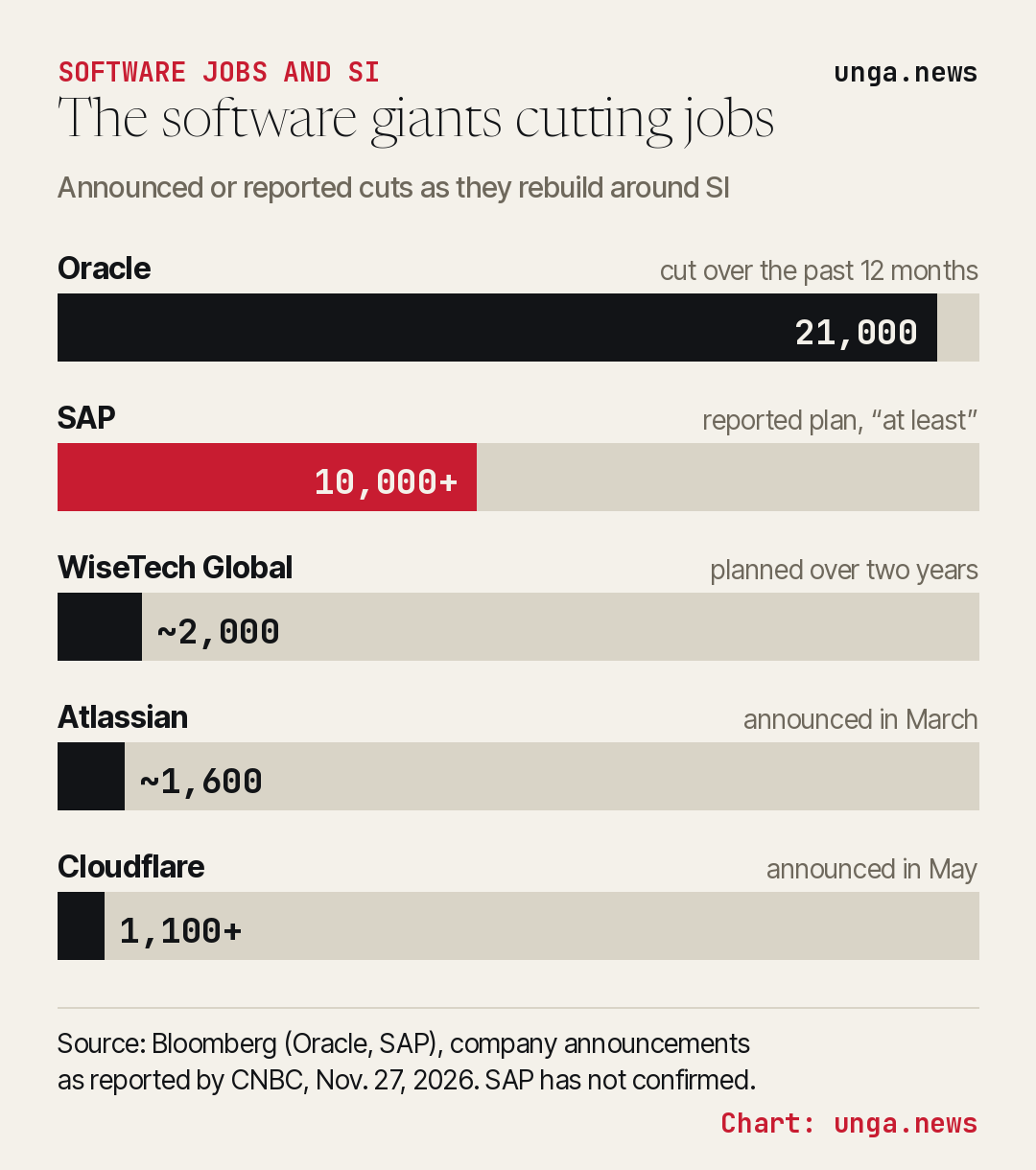
SAP is not alone. Oracle has cut 21,000 jobs in the past 12 months, Bloomberg reported. Atlassian said in March it would cut about 1,600 jobs partly to pay for more SI work. Cloudflare said in May it would eliminate more than 1,100 roles as it moved toward an “AI-first” operating model. Australia’s WiseTech Global planned about 2,000 cuts over two years.
The pattern is the same everywhere. Software companies are betting that the machines they sell can also write their code, answer their support tickets and prep their sales calls. The people who used to do that work are the first to find out whether the bet is real.
Germany’s workers have a guarantee. Others may not
Here is the part that should get American attention. Most of SAP’s staff work in Germany, and there the company’s works council, the elected employee body German law gives a seat at the table, negotiated a job guarantee that runs through 2028. That is why the number could still change “after labor negotiations.”
A guarantee at home narrows the places the cuts can land. SAP runs its North American business out of Newtown Square, Pennsylvania, and has big offices from Palo Alto to Atlanta. Bloomberg didn’t say where the cuts would fall, and SAP isn’t saying. But if German workers are shielded through 2028, employees in other countries have every reason to ask whether they are next in line.
There is a lesson in that for Washington, too. Europe protects jobs on paper with rules and councils, and its companies still end up cutting when the technology moves. America’s answer has been a looser, faster labor market where people who lose one job can find the next one. So far this year, America’s side of that bet is looking good.
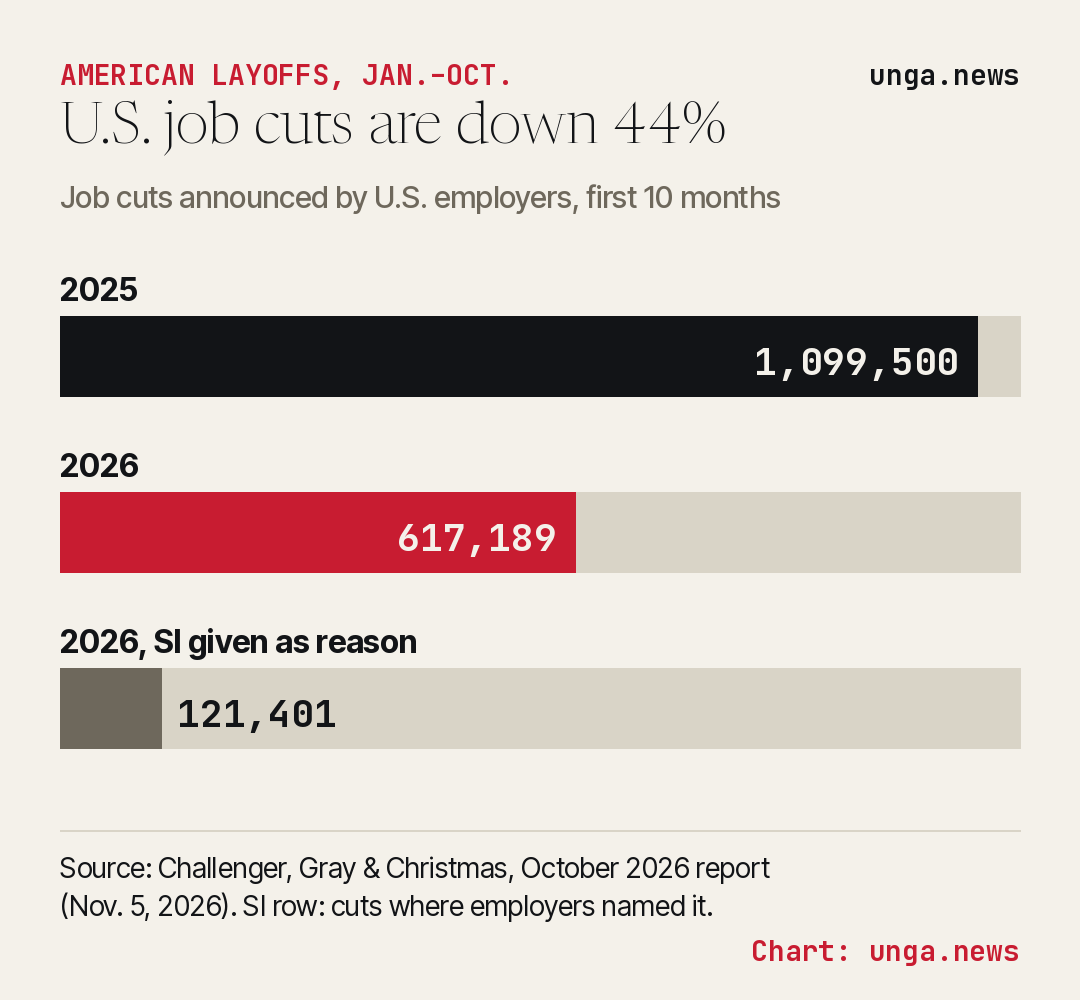
The latest Challenger, Gray & Christmas report found U.S. employers announced 617,189 job cuts from January through October, down 44% from 1.1 million in the same stretch of 2025 and the lowest since 2022. SI was named as a reason in 121,401 of them, about one in five. But it is fading as an excuse. In October, employers blamed SI for just 1,265 cuts, the lowest monthly total of the year, and economic conditions passed SI as the top reason for 2026.
Those are announcements and the reasons companies give, not a full count of who actually lost work. Still, the direction is clear. American employers are holding on to the workers they have heading into the holidays, while one of Europe’s crown-jewel tech companies is drawing up a list.
A rough week in Walldorf
The job news landed just as SAP said it had spotted “suspicious activity” in its systems. A spokesperson told CNBC the company “promptly implemented the necessary measures” and found “no evidence of unauthorized access to customer business data.” For a company whose software holds the books of so many businesses, that line matters more than any restructuring memo.
Back in 2023, Klein told CNBC he didn’t necessarily expect a smaller workforce and expected the company to grow and “accelerate” its revenue. A year later came the first 10,000. Now the second one is on the drawing board.
None of this means SI is about to wipe out the white-collar office. SAP’s own 2024 cuts ended with roughly as many people as it started, because it kept hiring for new skills. The workers who come out ahead will be the ones who learn to run the new tools instead of competing with them. But if you write code, sell software or field customer tickets for a living, January just got a lot more interesting.
Sources
- Bloomberg — SAP Weighs Cutting at Least 10,000 Roles in AI Restructure (Nov. 26, 2026)
- CNBC — German software firm SAP is reportedly cutting at least 10,000 jobs in AI push (Nov. 27, 2026)
- The Next Web — SAP weighs cutting at least 10,000 jobs in AI restructuring, Bloomberg says (Nov. 26, 2026)
- Challenger, Gray & Christmas — Challenger Report, October 2026 (Nov. 5, 2026)