

Europe’s Tech Companies Keep Moving to America for Money. Now Its Government Wants to Buy In
Europe’s tech chief admits investors pour ten times more into America’s quantum startups. Her answer is a €50 billion government fund to buy stakes in European companies.
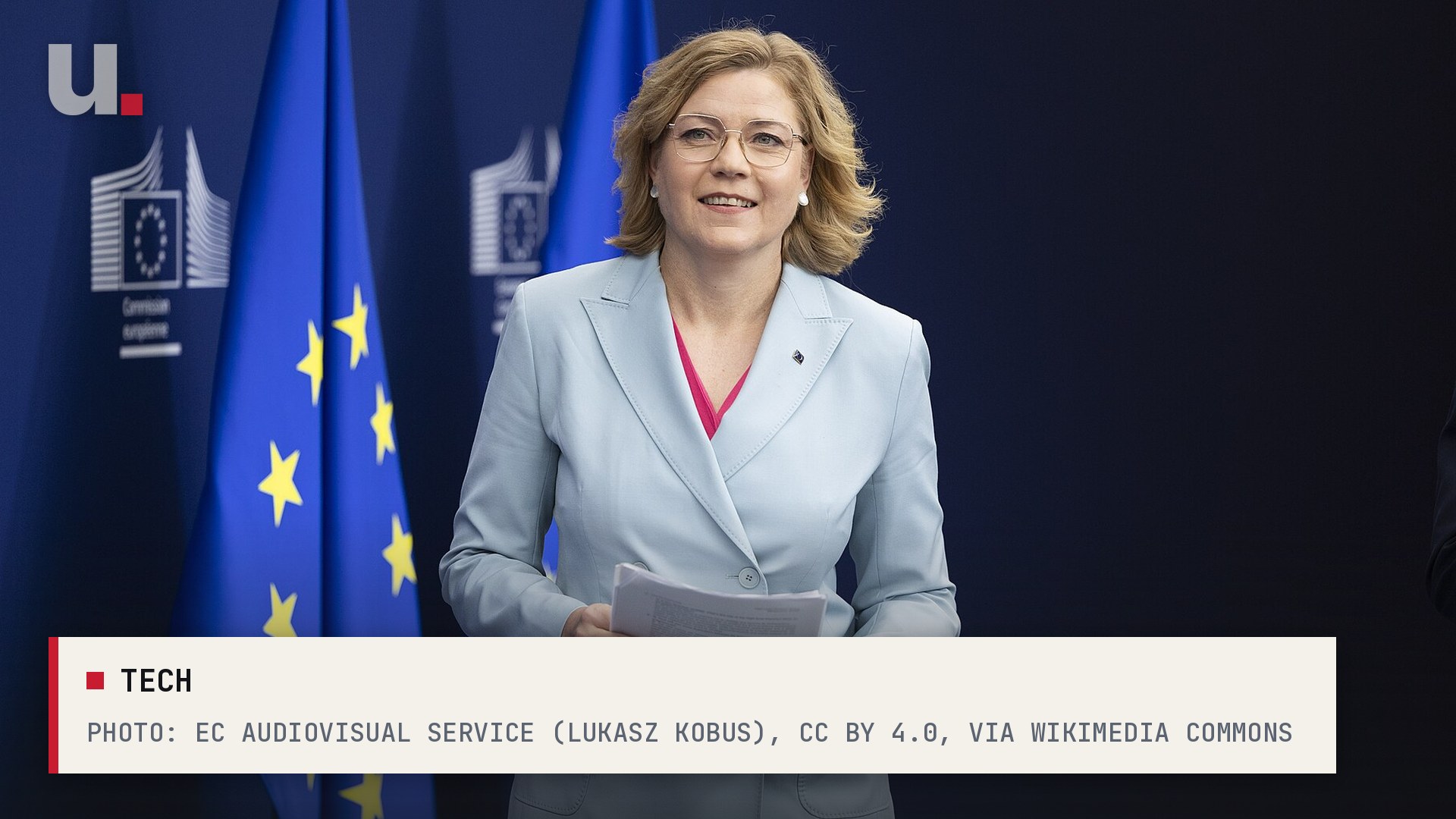
Europe’s top tech official stood up in Brussels on Wednesday and said out loud what investors have been showing with their wallets for years. When a promising young tech company in Europe needs serious money to grow, it usually finds that money in America.
Henna Virkkunen, the European Commission’s executive vice-president for what Brussels calls “tech sovereignty,” rolled out a new Quantum Act, a plan to turn Europe’s lab work on next-generation quantum computers and sensors into real products. Tucked inside it is the legal groundwork for something bigger: a government investment pot of around €50 billion, well over $50 billion, built to buy large ownership stakes in European tech companies so they don’t pack up and leave.
“No company should be obliged to leave Europe due to a lack of finance,” Virkkunen said.
Her own numbers explain why she felt the need to say it. Europe has about a third of the world’s quantum startups, she said, plus the most scientific papers and the most quantum talent on the planet. Yet “quantum start-ups in Europe attracted only 5% of global private funding, compared to 50% in the US.”
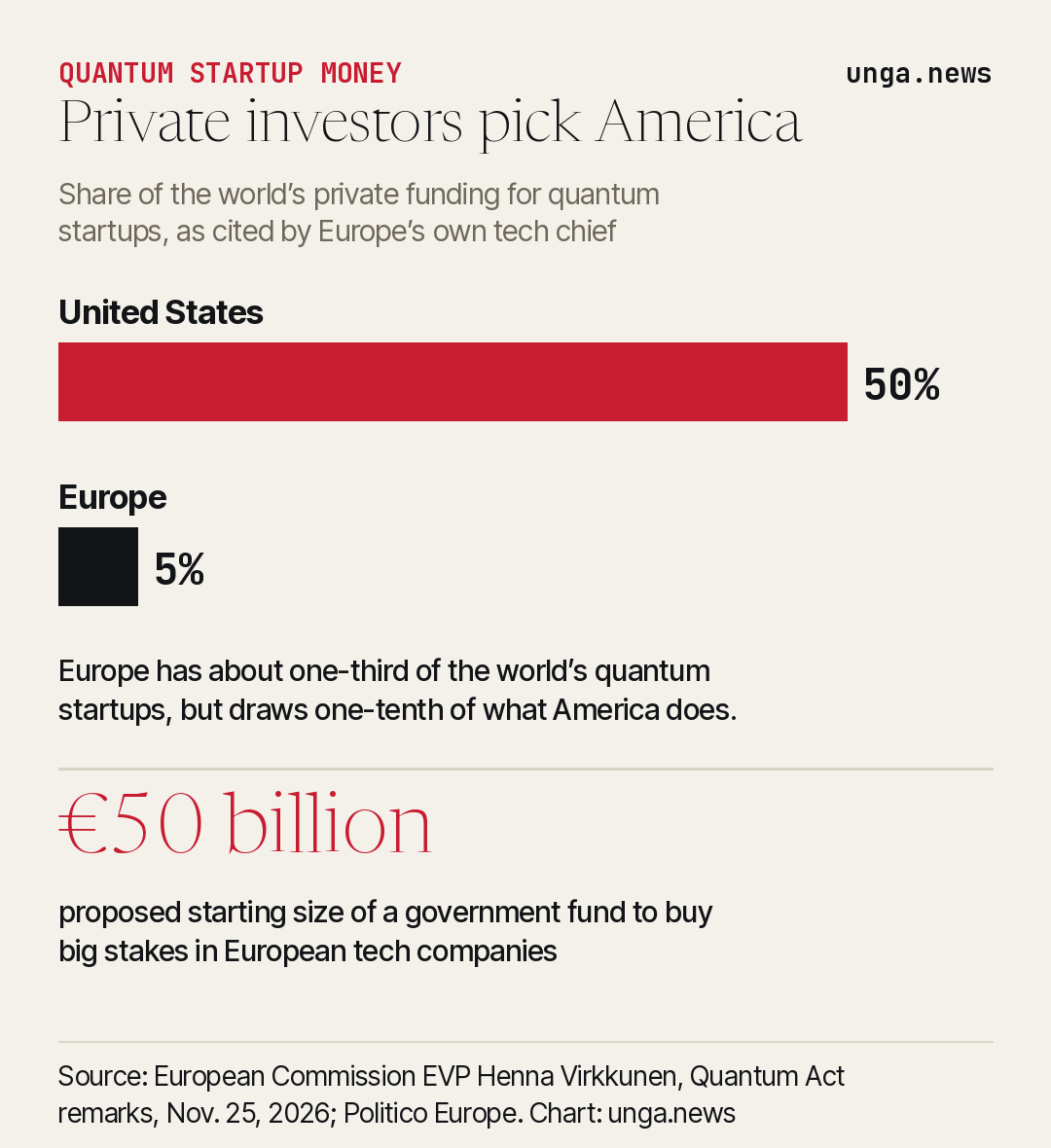
Read that again. A continent with a third of the companies pulls in a tenth of what America does. Private investors, people risking their own money, keep choosing the United States.
Virkkunen didn’t dress it up. Weak access to private capital, she said, “makes it harder for our companies to scale and grow in Europe, putting them at risk of acquisition by non-EU firms or relocation to markets with more favourable financial conditions.” Translate that out of Brussels-speak and it means American buyers and American investors keep winning.
Brussels wants to write the big checks
The answer Europe’s leaders landed on is to make the government the investor. According to Politico Europe, which first laid out the fund’s details, public money from the European Union, its member countries and partners like the European Investment Bank would go in first, with the hope of pulling private investors in behind it. Single investments could run to hundreds of millions of euros per company.
“We need to use public funding more efficiently as a catalyst to crowd in private capital,” a Commission official told reporters before the formal rollout. The same official said quantum companies “often find the capital they need in order to grow, to scale up outside Europe.”
Europe already plays venture capitalist. Its European Innovation Council can put up to €30 million into a company, and its Scaleup Europe Fund can go up to €300 million, Politico reported. The official said what’s missing is “larger tickets aimed to finance our strategic companies.” So the plan is a third, much larger layer of government money on top of the first two.
And this is only the opening bid. The Commission figures its broader tech investment plan would take about €500 billion, according to Politico. Virkkunen called the €50 billion a “starting point” last week, and French President Emmanuel Macron has already signed on. The fund itself isn’t real yet. It hinges on the EU’s next seven-year budget, which European leaders are still fighting over, including at a summit on Thursday and Friday.
What the quantum law itself does
Strip away the fund and the Quantum Act is mostly about organizing. It sets up a single framework to line up the EU’s quantum research with each member country’s own programs, links top labs into one network, creates specialist hubs for small companies stuck on engineering problems, and puts an “acceleration centre” in every member state. Promising projects can be named “strategic” to help them scale up, and governments are told to buy early quantum products to give them their first customers. The day-to-day work goes to EuroHPC, the EU’s existing supercomputer agency.
There is a security piece worth paying attention to. Quantum computers powerful enough to crack today’s encryption would put bank records, government secrets and private messages at risk. The act pushes a coordinated shift to new encryption built to survive that, which Virkkunen called “an urgent priority already today,” and orders officials to map Europe’s critical quantum companies and parts so they know where the supply chain can be squeezed.
The Commission’s own pitch for why this matters is big: “navigation without satellites and faster drug discovery to ultra-advanced batteries and next-generation secure communications.” Plenty of that is still years from your phone or your doctor’s office. But the race is real, and America and China are both running hard.
America’s edge came from investors, not a ministry
Conservatives have argued for years that Europe’s problem isn’t a shortage of brains. It is a mountain of rules and a timid investment culture. This is the same Brussels that slapped Apple with a €500 million fine and Meta with a €200 million fine last year under its Digital Markets Act. Build a reputation for hounding successful tech companies and don’t be shocked when the next ones raise money somewhere friendlier.
Washington has stepped in too, but on different terms. When President Trump took a stake in Intel in August 2025, the government got 9.9% of the company for $8.9 billion, paid mostly with grant money Intel had already been promised under the CHIPS Act and a Pentagon chip program. Taxpayers turned handouts into ownership, with no seat on the board. Trump’s deal fixed a giveaway already on the books. Brussels is proposing a brand-new standing fund, run by the same institutions whose rulebook helped send investors west.
Virkkunen is right that Europe has the talent. She is right that money keeps flowing out. The question her own chart raises is whether the cure for investors fleeing government is more government. Private investors chose America ten to one. A €50 billion fund from Brussels may slow that down. It won’t change why it happened.
Sources
- European Commission — Remarks by Executive Vice-President Virkkunen on the Quantum Act (SPEECH/26/2588, Nov. 25, 2026)
- European Commission — Commission proposes Quantum Act and new Sovereign Tech Equity Fund (Nov. 25, 2026)
- European Commission — The Quantum Act factsheet (Nov. 2026)
- Politico Europe — EU Commission wants €50B fund to keep tech European (Nov. 25, 2026)
- Intel — Intel and Trump Administration Reach Historic Agreement (Aug. 22, 2025)
- European Commission — Commission finds Apple and Meta in breach of the Digital Markets Act (Apr. 23, 2025)